-
Use Cases
-
Resources
-
Pricing
The Potala Palace is a monumental fortress-palace in Lhasa, Tibet, perched atop Red Hill (Marpo Ri) at an altitude of about 3,700 meters. Originally built in 637 CE by Songtsen Gampo and expanded beginning in 1645 by the Fifth Dalai Lama, it served as the winter residence of the Dalai Lamas and the political center of Tibet until 1959. Renowned for its White Palace and Red Palace sections, it houses chapels, tombs of past Dalai Lamas, and thousands of artworks, making it one of Tibet's most iconic cultural landmarks. More Less
1621
% complete
During 1621, Lhasa was made the jurisdiction of Ganden Podrang by Tsang, setting the political stage for the region that would later become the site of the Potala Palace.
Mar 1642
% complete
During the third month of 1642, Gushri Khan, the Dharma King and Holder of the Faith, took from the Sde-srid Tsang-pa regime of the Garma Kagyu Sect the places in Tibet held by that government, and then offered the thirteen parts of Tibet — the whole land of Wooden Doors — to the Dalai Lama.
1644
% complete
Sometime during or soon after 1644, the Dalai Lama, the then regent of Ganden Podrang, and Gushri Khan all decided to build a palace on the site that would become the Potala Palace.
1645
% complete
Konchog Chophel, the Thirty-fifth Ganden Tripa of the Gelug school, advised the 5th Dalai Lama that the site was ideal as a seat of government, situated between Drepung and Sera monasteries and the old city of Lhasa.
Image source: Potala Palace
1645
% complete
Ngawang Lozang Gyatso, the Great Fifth Dalai Lama, started the construction of the modern Potala Palace in 1645, after his spiritual adviser Konchog Chophel pointed out that the site was ideal as a seat of government.
Image source: 5th Dalai Lama
1645 - 1694
% complete
Construction of the present structure was begun in 1645 at the order of the 5th Dalai Lama, advised by Konchog Chophel. The work continued long after the Great Fifth's death, lasting until 1694.
1649
% complete
The Dalai Lama and his government moved into the Potrang Karpo ('White Palace') in 1649, which from then until 1959 served as the residence of the Dalai Lamas.
1690 - 1694
% complete
The Potrang Marpo ('Red Palace') was added to the Potala complex between 1690 and 1694, completing the main construction phase twelve years after the death of the Great Fifth Dalai Lama.
1694
% complete
Construction of the Potala Palace lasted until 1694, some twelve years after the death of the Great Fifth Dalai Lama, marking the completion of the present structure.
1751
% complete
The Yamantaka Mandala, an intricate tantric artwork housed within the palace, was made during 1751.
Image source: Yamantaka
1649 - 1959
% complete
The Potala Palace was formerly the winter palace of the Dalai Lamas, and from 1649 until 1959 served as their official residence.
1950
% complete
By 1950 the 'Potala' was known colloquially as 'Peak Potala' (Tse Potala), or most commonly simply as 'the Peak'.
1959
% complete
In 1959, after serving as the residence of the Dalai Lamas since 1649, the palace ceased to function as their home following the events of the Tibetan uprising.
1959
% complete
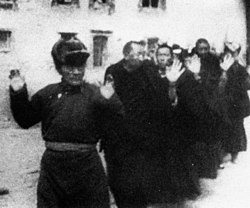
The palace was damaged during the Tibetan uprising against the Chinese in 1959, when Chinese shells were launched into the palace's windows.
Image source: 1959 Tibetan uprising
1966
% complete
The Potala Palace escaped damage during the Cultural Revolution in 1966 through the personal intervention of Zhou Enlai, who was then Premier of the People's Republic of China.
Image source: Zhou Enlai
1989 - 1994
% complete
The palace received restoration works between 1989 and 1994, costing RMB55 million (US$6.875 million).
1994
% complete
The restoration works begun in 1989 were completed in 1994, having cost RMB55 million (US$6.875 million).
1994
% complete
The Potala Palace was inscribed to the UNESCO World Heritage List in 1994, recognizing its outstanding cultural significance.
Image source: World Heritage Site
2002
% complete
A second restoration of the palace commenced in 2002 at a cost of RMB180 million (US$22.5 million), drawing UNESCO concern over materials, though director Qiangba Gesang clarified that only traditional materials and craftsmanship were used.
May 1, 2003 - Jun 30, 2006
% complete
From 1 May 2003, the number of visitors to the palace was restricted to 1,600 a day, with opening hours reduced to six hours daily to avoid overcrowding.
May 1, 2003
% complete
To avoid over-crowding, opening hours at the palace were reduced to six hours daily beginning 1 May 2003, alongside restrictions limiting visitors to 1,600 per day.
2006
% complete
Restoration efforts on the Potala Palace were completed in 2006, after which visits to the structure's roof were banned to avoid further structural damage.
2006
% complete
Visits to the structure's roof were banned after restoration efforts were completed in 2006 to avoid further structural damage.
Jul 1, 2006
% complete
The Qingzang railway into Lhasa opened on 1 July 2006, bringing a 30% increase in visitorship to the Potala Palace.
Image source: Qinghai–Tibet railway
Jul 1, 2006
% complete
Visitorship quotas were raised to 2,300 daily to accommodate a 30% increase in visitors since the opening of the Qingzang railway, but the quota is often reached by mid-morning.
Or browse the full history timeline directory, with more than 2,000 topics.
This Potala Palace timeline was generated with the help of AI, using information found on the internet.
We work hard to keep these timelines accurate, but mistakes do get through. If you spot one, email us at [email protected] and we'll fix it for future visitors.
Generate yours with AI or build it from scratch, for free.
Export your timeline, add your own events, edit or remove AI-generated events, and much more
No credit card required.
Cancel anytime.
Cancel anytime.
You can create an unlimited number of timelines with up to 10 events on each one, customize how they look, export them to PDF, PNG, PowerPoint, CSV, and Excel, and share them with a link. Paid plans raise the event limit and add features like spreadsheet imports and collaborators.
Yes. You can cancel your subscription from your account page at any time, and you will not be charged again. Your subscription stays active for the rest of the period you already paid for.
Yes. We will email you a reminder before the annual renewal, and we will also email you a receipt.
Yes. You can email us within 15 days of any payment, and we will issue you a full refund.
Check out our pricing docs or send us an email anytime: [email protected].