-
Use Cases
-
Resources
-
Pricing
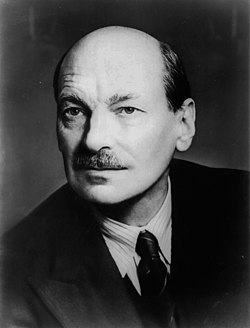
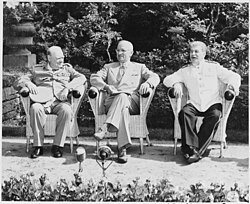
The Potsdam Conference was the final Allied summit of World War II, held in Potsdam, Germany, from July 17 to August 2, 1945. Leaders Harry Truman, Joseph Stalin, and Winston Churchill (later replaced by Clement Attlee) met to negotiate the terms for ending the war and organizing postwar Europe, including the occupation of Germany, borders, reparations, and the ultimatum to Japan known as the Potsdam Declaration. More Less
Jan 18, 1919 - Jan 21, 1920
% complete
The Paris Peace Conference of 1919, which ended World War I, was widely seen as having made punitive mistakes that contributed to future conflict. The Allies at Potsdam explicitly sought to plan the postwar peace while avoiding these mistakes.
Image source: Paris Peace Conference (1919–1920)
Nov 1, 1933 - May 31, 1936
% complete
William Bullitt served as the United States' first ambassador to the Soviet Union until 1936. His observations of Soviet behavior during this period later informed his skepticism about Stalin's intentions in eastern Europe, contrasting with President Roosevelt's more optimistic outlook.
Image source: William Christian Bullitt Jr.
Jan 1, 1936 - Dec 31, 1940
% complete
Following his posting in Moscow, William Bullitt served as the American ambassador to France until 1940, witnessing the fall of France to Nazi Germany before returning to Washington.
Jan 1, 1941
% complete
After his diplomatic postings, William Bullitt had a falling out with President Roosevelt and was demoted within the State Department. This rift set the stage for his later public criticism of Roosevelt's policy toward the Soviet Union.
Jan 1, 1943
% complete
In January 1943, Roosevelt told Bullitt regarding potential Soviet domination over eastern Europe: "I just have a hunch that Stalin is not that kind of a man... I think that if I give him everything I possibly can and ask for nothing from him in return, 'noblesse oblige', he won't try to annex anything and will work with me for a world of democracy and peace."
May 1, 1943
% complete
Bullitt wrote a memo criticizing Roosevelt and his focus on Europe over Asia, which was published in the press in May 1943. It publicly aired concerns that appeasing Stalin would lead to Soviet domination of eastern Europe.
Oct 30, 1943
% complete
The Moscow Declaration of October 1943 established Allied principles for prosecuting war crimes committed without geographical restriction. At the Potsdam Conference two years later, the three governments would try to agree on trial methods for such war criminals.
Apr 12, 1945
% complete
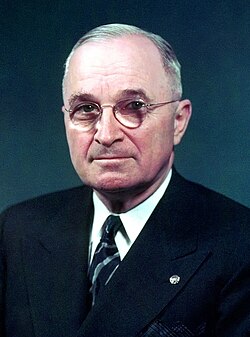
President Franklin D. Roosevelt died on April 12, 1945, and Vice President Harry Truman assumed the presidency. Truman would now lead the United States into the postwar negotiations, including the upcoming Potsdam Conference.
Image source: Franklin D. Roosevelt
Apr 12, 1945
% complete
Upon Roosevelt's death, Harry Truman became president. His tenure immediately saw VE Day within a month, and VJ Day on the horizon, placing him at the helm during the decisive final phase of World War II and its aftermath.
Image source: Harry S. Truman
May 1, 1945
% complete
In May 1945, British Prime Minister Winston Churchill wrote to President Truman hoping to arrange a meeting of the three leading Allied governments to occur in June. This correspondence helped set in motion what became the Potsdam Conference.
Image source: Potsdam Conference
May 8, 1945
% complete
VE Day marked the formal acceptance of Germany's unconditional surrender, ending the war in Europe less than a month after Truman took office. With Germany defeated, the Allied leaders could turn their attention to planning the postwar order.
Image source: Victory in Europe Day
Jul 5, 1945 - Jul 26, 1945
% complete
Because ballots from servicemen overseas had to be counted in their home constituencies, the results of Britain's July 5 election were delayed until late July. When announced, they showed Labour under Clement Attlee had won, changing Britain's representation mid-conference.
Image source: 1945 United Kingdom general election
Jul 5, 1945
% complete
A general election was held in the United Kingdom on July 5, 1945, but its results were delayed to allow the votes of armed forces personnel serving overseas to be counted in their home constituencies, leaving Churchill's political fate uncertain during Potsdam.
Jul 17, 1945 - Aug 2, 1945
% complete
At Potsdam it was decided that Germany's eastern border would be shifted westwards to the Oder–Neisse line, effectively reducing Germany in size by approximately 25% from its 1937 borders and approximately 34% from its 1913 borders.
Image source: Oder–Neisse line
Jul 17, 1945 - Aug 2, 1945
% complete
The Potsdam Conference (German: Potsdamer Konferenz) was held at Potsdam in the Soviet occupation zone from July 17 to August 2, 1945, allowing the three leading Allies—Truman, Stalin, and Churchill (later Attlee)—to plan the postwar peace while avoiding the mistakes of the Paris Peace Conference of 1919.
Jul 17, 1945 - Aug 2, 1945
% complete
At the Potsdam Conference, the three governments tried to reach an agreement on trial methods for war criminals whose crimes under the Moscow Declaration of October 1943 had no geographical restriction, aiming for the London negotiations to yield a positive result validated by an agreement.
Aug 2, 1945
% complete
The Potsdam Conference concluded on August 2, 1945, issuing the Potsdam Agreement, which covered the occupation of Germany, its eastern border shift, war criminal trials, and other arrangements shaping the postwar world.
Aug 2, 1945
% complete
While the Oder–Neisse line was agreed upon, the final delimitation of the western frontier of Poland was left to await a peace settlement—one that would only take place 45 years later, in 1990, with the Treaty on the Final Settlement with Respect to Germany.
Image source: Potsdam Agreement
Aug 2, 1945
% complete
As part of the conference agreements, it was decided that the first meeting of the new Council of Foreign Ministers should be held in London not later than September 1, 1945, providing an ongoing forum for postwar diplomacy among the major powers.
Aug 2, 1945
% complete
In accordance with the decision at the Potsdam Conference, the United States, Great Britain, and the Soviet Union agreed that the 1936 Montreux Convention governing the Turkish Straits should be revised, reflecting Soviet desires for greater access through the straits.
Image source: Montreux Convention Regarding the Regime of the Straits
Aug 6, 1945
% complete
During the Potsdam Conference, the United States dropped an atomic bomb on Hiroshima on August 6, 1945. The bombing demonstrated America's devastating new weapon while the Allied leaders were still gathered in Potsdam.
Image source: Atomic bombings of Hiroshima and Nagasaki
Aug 8, 1945
% complete
The leaders' objective at Potsdam was that the London negotiations would have a positive result validated by an agreement, which was duly signed in London on August 8, 1945, creating the legal basis for trying Axis war criminals at Nuremberg.
Image source: Nuremberg trials
Aug 9, 1945
% complete
Three days after Hiroshima, the United States dropped a second atomic bomb on Nagasaki on August 9, 1945, hastening Japan's surrender and bringing the war in the Pacific to an end.
Feb 1, 1946
% complete
In early 1946, an agreement was reached on the details of the economic plans outlined at Potsdam, in which Germany was to be converted into having an agricultural and light industrial economy, reflecting the Allies' initial deindustrialization policy.
Or browse the full history timeline directory, with more than 2,000 topics.
This Potsdam Conference timeline was generated with the help of AI, using information found on the internet.
We work hard to keep these timelines accurate, but mistakes do get through. If you spot one, email us at [email protected] and we'll fix it for future visitors.
Generate yours with AI or build it from scratch, for free.
Export your timeline, add your own events, edit or remove AI-generated events, and much more
No credit card required.
Cancel anytime.
Cancel anytime.
You can create an unlimited number of timelines with up to 10 events on each one, customize how they look, export them to PDF, PNG, PowerPoint, CSV, and Excel, and share them with a link. Paid plans raise the event limit and add features like spreadsheet imports and collaborators.
Yes. You can cancel your subscription from your account page at any time, and you will not be charged again. Your subscription stays active for the rest of the period you already paid for.
Yes. We will email you a reminder before the annual renewal, and we will also email you a receipt.
Yes. You can email us within 15 days of any payment, and we will issue you a full refund.
Check out our pricing docs or send us an email anytime: [email protected].