-
Use Cases
-
Resources
-
Pricing
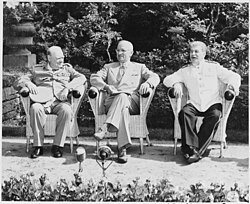
The Yalta Conference, held February 4-11, 1945 in Crimea, brought together U.S. President Franklin D. Roosevelt, British Prime Minister Winston Churchill, and Soviet leader Joseph Stalin to plan the defeat of Germany and the postwar reorganization of Europe. The leaders agreed on Germany's division into occupation zones, the Soviet entry into the war against Japan, the creation of the United Nations, and promises of free elections in Eastern Europe—decisions whose contested implementation helped trigger the Cold War. More Less
Sep 5, 1905
The Russo-Japanese War ended in 1905, with Japan taking South Sakhalin from Russia. Decades later at Yalta, the Soviets demanded the return of South Sakhalin along with the cession of the Kuril Islands, demands approved by the other Allies.
Image source: Treaty of Portsmouth

Nov 26, 1924
The Mongolian People's Republic had been a Soviet satellite state from 1924 until World War II. One Soviet precondition for a declaration of war against Japan was American official recognition of Mongolian independence from China.
Image source: Mongolian People's Republic

May 17, 1939
The British White Paper of 1939 limited Jewish immigration to Mandatory Palestine, angering many. At Yalta, Churchill gave informal support to Roosevelt's goals in exchange for refraining from discussions on the White Paper.
Image source: White Paper of 1939

Nov 28, 1943 - Dec 1, 1943
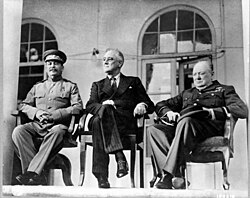
The Tehran Conference in November 1943 was the first meeting of Roosevelt, Churchill, and Stalin during World War II. It preceded the Yalta Conference and set the stage for further Allied coordination on the war and postwar planning.
Image source: Tehran Conference
Oct 9, 1944 - Oct 18, 1944
In October 1944, a conference was held in Moscow without Roosevelt's attendance. There, Churchill and Stalin reached an informal agreement dividing Western and Soviet spheres of influence in Europe, a precursor to the arrangements discussed at Yalta.
Image source: Percentages agreement

Nov 7, 1944
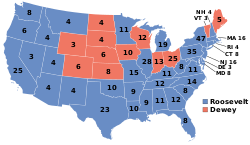
Roosevelt had hoped for a second Big Three conference before the US presidential election in November 1944, which he won for an unprecedented fourth term. He instead pressed for a meeting early in 1945 at a neutral location in the Mediterranean.
Image source: 1944 United States presidential election
Sep 17, 1939 - 1946
Following the Soviet invasion of eastern Poland, Soviet authorities carried out widespread repressions of Polish citizens between 1939 and 1946, including deportations and executions. These atrocities led many Polish soldiers to refuse repatriation after the war.
Image source: Soviet repressions of Polish citizens (1939–1946)

Jan 1, 1945 - May 22, 1945
In early 1945, Churchill commissioned a contingency military enforcement operation plan for war on the Soviet Union to obtain a 'square deal for Poland'. The resulting May 22 report stated that the odds of success were unfavorable, and the plan was shelved.
Image source: Operation Unthinkable
Jun 18, 1945 - Jun 21, 1945
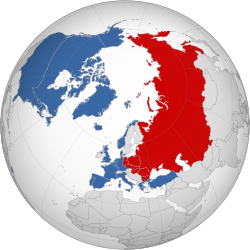
The Trial of the Sixteen was a show trial of leaders of the Polish Underground State held by the Soviet authorities. Along with other executions of pro-Western Poles, particularly former members of the Armia Krajowa, it discouraged Polish soldiers abroad from returning home.
Image source: Trial of the Sixteen

Jan 16, 1947
The Polish elections held on January 16, 1947 were marred by communist manipulation. They resulted in Poland's official transformation to a communist state by 1949, fulfilling the fears of those who criticized the Yalta arrangements for Poland's future.
Image source: 1947 Polish parliamentary election

This Yalta Conference timeline was generated with the help of AI, using information found on the internet.
We work hard to keep these timelines accurate, but mistakes do get through. If you spot one, email us at [email protected] and we'll fix it for future visitors.
Generate yours with AI or build it from scratch, for free.