
-
Use Cases
-
Resources
-
Pricing
Rigoberta Menchu is a K'iche' Maya activist from Guatemala who became an internationally recognized advocate for Indigenous rights. Her life story, marked by family losses during the Guatemalan Civil War and her exile in Mexico, brought global attention to the plight of Indigenous peoples in Latin America, culminating in her 1992 Nobel Peace Prize. More Less
1954
% complete
The CIA orchestrated the removal of democratically elected Guatemalan President Jacobo Arbenz, beginning a chain of military coups that contributed to the conditions leading to the Guatemalan Civil War.
Image source: 1954 Guatemalan coup d'état
1959
% complete
Following the Cuban revolution of 1959 and Che Guevara's commitment to create as many Vietnams as he could, revolutionary movements spread across Latin America, including Guatemala.
Image source: Cuban Revolution
1960
% complete
The Guatemalan Civil War began in 1960 and lasted until 1996. It was provoked by social, economic, and political inequality, and Menchú would later dedicate her life to publicizing the rights of Guatemala's Indigenous peoples during and after the conflict.
Image source: Guatemalan Civil War
May 1978 - 1982
% complete
Massacres of Indigenous men, women, and children in Guatemala began in May 1978 and culminated in 1982 during the peak of state counterinsurgency violence.
Image source: Guatemalan genocide
1981
% complete
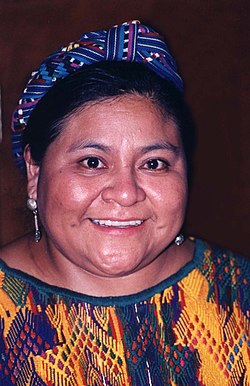
Investigators reported on the 1980 embassy massacre, concluding that the army carried out a premeditated firebombing of the embassy, contradicting later claims that it was a self-immolation coordinated by protesters.
Image source: Rigoberta Menchú
1981
% complete
By 1981, the US Central Intelligence Agency was reporting on the indiscriminate killing of civilians in rural areas of Guatemala, noting government soldiers were "forced to fire at anything that moved".
1982 - 1984
% complete
Tens of thousands of people, mostly indigenous Maya people, fled to Mexico from 1982 to 1984 at the height of Guatemala's 36-year civil war.
Feb 1982
% complete
A declassified CIA document from late February 1982 states that in mid-February 1982 the Guatemalan army launched a sweep operation in the Ixil Triangle, with commanding officers instructed to destroy all towns and villages cooperating with the Guerilla Army of the Poor and eliminate all sources of resistance.
1983
% complete
At the peak of state counterinsurgency, the Permanent Peoples' Tribunal: Session on Guinea (PPT-SG), held in Madrid in 1983, was the first of its kind for Central America. It examined evidence going back to the 1954 CIA-backed coup and focused on massacres under General Efraín Ríos Montt.
1996
% complete
The Guatemalan Civil War ended in 1996 with peace accords. Menchú served as the Presidential Goodwill Ambassador for the 1996 Peace Accords in Guatemala.
2010
% complete
Almost thirty years after the 1983 PPT-SG, the First Tribunal of Consciousness Against Sexual Violence Toward Women took place in Guatemala City in 2010, fully recognizing sexual violence against women, particularly Maya women, during the armed conflict for the first time in an ethical tribunal.
2013
% complete
The trial and conviction of José Efraín Ríos Montt in Guatemala in 2013 demonstrated that, fifteen years after Menchú's complaint, it is possible to convict a former head of state of crimes against humanity.
Image source: Efraín Ríos Montt
Jan 2015
% complete
In January 2015, Pedro García Arredondo, a former police commander who had served as chief of the National Police, was convicted of attempted murder and crimes against humanity for his role in the 1980 Spanish Embassy attack. He had previously been convicted in 2012 of ordering the enforced disappearance of agronomy student Édgar Enrique Sáenz Calito.
Image source: Uvalde school shooting
2016
% complete
Thirty-three years after the 1983 PPT-SG failed to acknowledge rape during the armed conflict, sexual violence against Maya women was legally condemned in 2016 in the landmark Sepur Zarco case in Guatemala.
Jan 9, 1959
% complete
Rigoberta Menchú Tum was born on January 9, 1959. She is a K'iche' Guatemalan human rights activist, feminist, and Nobel Peace Prize laureate.
1979 - 1980
% complete
In 1979–80, Menchú's brother, Patrocinio, and mother, Juana Tum Kótoja, were kidnapped, brutally tortured, and murdered by the Guatemalan Army.
1980
% complete
Menchú's father, Vicente Menchú Perez, died in the 1980 Burning of the Spanish Embassy in Guatemala City, which occurred after urban guerrillas took hostages and were attacked by government security forces.
Image source: Guatemalan Civil War
1984
% complete
In 1984, Menchú's other brother, Victor, was shot to death after he surrendered to the Guatemalan Army, was threatened by soldiers, and tried to escape.
1995
% complete
In 1995, Menchú married Ángel Canil, a Guatemalan, in a traditional Mayan ceremony.
Jan 1998
% complete
Menchú and Ángel Canil had a Catholic wedding in January 1998; at that time they also buried their son Tz'unun ("hummingbird" in K'iche' Maya), who had died after being born prematurely in December.
2025
% complete
In 2025, decades after finding refuge in Mexico during her exile, Rigoberta Menchú became a Mexican citizen.
1970
% complete
After leaving school, Menchú worked as an activist campaigning against human rights violations committed by the Guatemalan Army during the country's civil war, which lasted from 1960 to 1996.
1981
% complete
In 1981, Menchú was exiled and escaped to Mexico where she found refuge in the home of a Catholic bishop in Chiapas.
1983
% complete
In 1982, Menchú narrated a book about her life to Venezuelan author and anthropologist Elizabeth Burgos. Published as I, Rigoberta Menchú (1983), the testimonial biography brought worldwide attention to the plight of Indigenous Guatemalans.
Image source: Rigoberta Menchú
1983
% complete
Menchú featured prominently in the 1983 documentary When the Mountains Tremble, directed by Newton Thomas Sigel and Pamela Yates, bringing international attention to her story and the Guatemalan conflict.
1998
% complete
In 1998, Menchú published Crossing Borders, an autobiographical work continuing the testimony begun in I, Rigoberta Menchú.
1999
% complete
In 1999, Menchú filed a complaint before a court in Spain because prosecutions of civil-war era crimes in Guatemala were practically impossible.
Sep 21, 2002
% complete
On September 21, 2002, together with Rita Levi-Montalcini, Menchú took part in a meeting at Villa del Vascello, Rome, Italy, in the headquarters of the Masonic organization Grand Orient of Italy, to discuss science and peace in the service of mankind.
Image source: Grand Orient of Italy
2003
% complete
Since 2003, Menchú has become involved in the Indigenous pharmaceutical industry as president of "Salud para Todos" ("Health for All") and the company "Farmacias Similares", with the goal of offering low-cost generic medicines.
2005
% complete
In 2005, Menchú joined the Guatemalan federal government as goodwill ambassador for the National Peace Accords.
Apr 2005
% complete
In April 2005, five Guatemalan politicians were convicted for hurling racial epithets at Menchú.
2006
% complete
In 2006, Menchú was one of the founders of the Nobel Women's Initiative along with sister Nobel Peace Laureates Jody Williams, Shirin Ebadi, Wangari Maathai, Betty Williams and Mairead Corrigan Maguire.
Dec 23, 2006
% complete
On December 23, 2006, Spain called for the extradition from Guatemala of seven former members of Guatemala's government, including Efraín Ríos Montt and Óscar Mejía, on charges of genocide and torture, following Menchú's earlier complaint.
2008
% complete
Menchú has been a member of the Foundation Chirac's honor committee since the foundation was launched in 2008 by former French president Jacques Chirac in order to promote world peace.
Image source: Fondation Chirac
2015
% complete
In 2015, Menchú met with the general director of UNESCO, Irina Bokova, in order to solidify relations between Guatemala and the organization.
Image source: UNESCO
1992
% complete
Rigoberta Menchú received the Nobel Peace Prize in 1992 in recognition of her work for social justice and ethno-cultural reconciliation based on respect for the rights of Indigenous peoples.
1996
% complete
In 1996, Menchú was appointed as a UNESCO Goodwill Ambassador in recognition of her activism for the rights of Indigenous people. She acted as spokesperson for the first International Decade of the World's Indigenous Peoples (1995–2004).
1998
% complete
In 1998, Menchú received the Prince of Asturias Award for improving the condition of women and the communities they serve.
Image source: Princess of Asturias Awards
1999
% complete
In 1999, asteroid 9481 Menchú was named in honor of Rigoberta Menchú.
2022
% complete
In 2022, the University of Bordeaux Montaigne, located in Pessac, France, gave the name of Rigoberta Menchú to its newly built library in her honor.
Image source: Bordeaux Montaigne University
Feb 12, 2007
% complete
On February 12, 2007, Menchú announced that she would form an Indigenous political party called Encuentro por Guatemala and stand in the 2007 presidential election.
Image source: Encuentro por Guatemala
Sep 2007
% complete
In the 2007 election, Menchú was defeated in the first round, receiving three percent of the vote.
Image source: 2007 Guatemalan general election
2011
% complete
In 2009, Menchú became involved in the newly founded indigenous party Winaq, the country's first indigenous political party. She ran as its candidate in the 2011 presidential election but lost in the first round, winning three percent of the vote again.
Image source: Winaq
Or browse the full history timeline directory, with more than 2,000 topics.
This Rigoberta Menchu timeline was generated with the help of AI, using information found on the internet.
We work hard to keep these timelines accurate, but mistakes do get through. If you spot one, email us at [email protected] and we'll fix it for future visitors.
Generate yours with AI or build it from scratch, for free.
Export your timeline, add your own events, edit or remove AI-generated events, and much more
No credit card required.
Cancel anytime.
Cancel anytime.
You can create an unlimited number of timelines with up to 10 events on each one, customize how they look, export them to PDF, PNG, PowerPoint, CSV, and Excel, and share them with a link. Paid plans raise the event limit and add features like spreadsheet imports and collaborators.
Yes. You can cancel your subscription from your account page at any time, and you will not be charged again. Your subscription stays active for the rest of the period you already paid for.
Yes. We will email you a reminder before the annual renewal, and we will also email you a receipt.
Yes. You can email us within 15 days of any payment, and we will issue you a full refund.
Check out our pricing docs or send us an email anytime: [email protected].