
-
Use Cases
-
Resources
-
Pricing
Rosa Parks (1913–2005) was an African American civil rights activist whose refusal to give up her bus seat to a white passenger in Montgomery, Alabama, on December 1, 1955, sparked the Montgomery Bus Boycott. Her courageous act of defiance became a defining moment in the struggle for racial equality in the United States, earning her the title 'the mother of the civil rights movement.' More Less
Feb 4, 1913
% complete
Rosa Louise McCauley Parks was born on February 4, 1913, in Tuskegee, Alabama, to James McCauley, a carpenter, and Leona Edwards, a teacher. Her birth in the heart of the segregated South shaped the world she would grow up in and later challenge.
Image source: Rosa Parks
1915
% complete
After her parents separated, Rosa moved with her mother to her grandparents' farm in Pine Level, Alabama. There she experienced the harsh realities of racial segregation and learned resilience from her family, including her grandfather who guarded their home against Ku Klux Klan violence.
1924 - 1928
% complete
Rosa enrolled at the Montgomery Industrial School for Girls, a private institution founded by liberal-minded women from the North. The school emphasized academic excellence, self-respect, and dignity, values that deeply influenced Parks' character and future activism.
Image source: Montgomery Industrial School for Girls
Dec 18, 1932
% complete
At age 19, Rosa married Raymond Parks, a barber from Montgomery and a member of the NAACP. He encouraged her education, helping her earn her high school diploma in 1933, a time when fewer than 7% of African Americans had one.
Image source: Raymond Parks (activist)
1944
% complete
Parks worked briefly at Maxwell Air Force Base, where federal desegregation policies meant she could ride an integrated trolley. She later said this experience made segregation on Montgomery city buses feel even more intolerable to her.
Image source: Maxwell Air Force Base
Dec 1, 1943
% complete
Rosa Parks became an active member of the National Association for the Advancement of Colored People's Montgomery chapter, serving as its secretary. She investigated cases of racial injustice, including sexual assaults against Black women, laying groundwork for her lifelong fight against discrimination.
Image source: NAACP
Aug 1955
% complete
Parks attended a workshop on school desegregation at the Highlander Folk School in Tennessee, a training center for labor and civil rights activists. The experience strengthened her commitment to activism just months before her historic arrest.
Image source: Highlander Research and Education Center
1960 - 1970
% complete
Throughout the late 1960s, Parks expressed support for more militant strands of the movement, including the Black Power movement and figures like Malcolm X and Robert F. Williams. She believed in self-defense and economic justice alongside nonviolent resistance.
Image source: Black power movement
Aug 28, 1963
% complete
Parks attended the March on Washington for Jobs and Freedom, where Martin Luther King Jr. delivered his famous 'I Have a Dream' speech. She was honored during the proceedings as a pioneer of the movement she had helped ignite eight years earlier.
Image source: March on Washington for Jobs and Freedom
Mar 21, 1965 - Mar 25, 1965
% complete
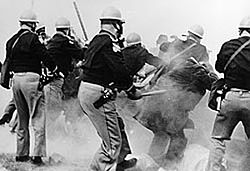
Parks joined the final leg of the Selma to Montgomery marches demanding voting rights for African Americans. Her presence connected the earlier bus boycott struggle to the broader fight for political enfranchisement that led to the Voting Rights Act.
Image source: Selma to Montgomery marches
Mar 2, 1955
% complete
Nine months before Parks' arrest, teenager Claudette Colvin was arrested in Montgomery for refusing to surrender her bus seat. Local civil rights leaders considered using her case but ultimately decided Parks would be a more suitable symbol for a legal challenge.
Image source: Claudette Colvin
Dec 1, 1955
% complete
In Montgomery, Alabama, Rosa Parks refused to obey bus driver James F. Blake's order to give up her seat in the 'colored section' to a white passenger after the whites-only section was filled. Her quiet act of defiance became one of the most iconic moments of the American civil rights movement.
Dec 1, 1955
% complete
Following her refusal to move, Parks was arrested and charged with violating Montgomery's segregation laws. She was booked, fingerprinted, and fined $14. Her arrest galvanized the Black community of Montgomery into unprecedented collective action.
Dec 2, 1955
% complete
The night of Parks' arrest, Jo Ann Robinson and members of the Women's Political Council mimeographed and distributed tens of thousands of flyers calling for a one-day bus boycott on December 5, urging Black residents to stay off Montgomery buses in protest.
Dec 5, 1955
% complete
On the day of Parks' trial, approximately 40,000 Black bus riders stayed off Montgomery buses, leaving them nearly empty. The overwhelming success convinced community leaders to extend the boycott indefinitely, launching a 381-day protest.
Image source: Montgomery bus boycott
Dec 5, 1955 - Dec 20, 1956
% complete
A young 26-year-old minister, Martin Luther King Jr., was elected president of the newly formed Montgomery Improvement Association to lead the boycott. His leadership during the campaign catapulted him to national prominence as a civil rights leader.
Image source: Martin Luther King Jr.
1956
% complete
As punishment for her activism, Parks was fired from her job as a seamstress at a local department store. Her husband also lost his job, and the couple faced ongoing harassment and death threats, yet Parks remained committed to the movement.
Nov 13, 1956
% complete
The U.S. Supreme Court ruled in Browder v. Gayle that bus segregation was unconstitutional, upholding a lower court decision. The ruling arose from the arrests of Claudette Colvin, Aurelia Browder, Susie McDonald, and Mary Louise Smith, not from Parks' own case.
Image source: Browder v. Gayle
Dec 20, 1956
% complete
After 381 days, the Montgomery Bus Boycott ended when the Supreme Court's order arrived in Montgomery and buses were officially integrated on December 21, 1956. The victory marked a landmark triumph for nonviolent protest and the civil rights movement.
Aug 1957
% complete
Facing persistent death threats, inability to find work, and health problems, Parks relocated to Detroit, Michigan, where her brother lived. She found life in the North still marked by discrimination but with new opportunities for activism.
Sep 14, 1964
% complete
President Bill Clinton awarded Parks the Presidential Medal of Freedom, the highest civilian honor in the United States, recognizing her enduring contribution to American democracy and the struggle for equality.
Image source: Presidential Medal of Freedom
1965 - 1988
% complete
Parks was hired as a secretary and receptionist in the Detroit office of Representative John Conyers, a position she held for over two decades until her retirement in 1988. She considered it a way to continue serving the cause of justice through government work.
Image source: John Conyers
Feb 1987
% complete
With her friend Elaine Eason Steele, Parks founded the Rosa and Raymond Parks Institute for Self Development in Detroit. The institute runs programs like 'Pathways to Freedom,' taking young people on bus tours of civil rights sites to educate new generations.
1992
% complete
Parks published her autobiography, 'Rosa Parks: My Story,' written with Jim Haskins. The book recounted her life, her arrest, and the boycott, offering her own perspective on events that had become central to American history.
Aug 30, 1994
% complete
At age 81, Parks was assaulted and robbed in her Detroit home by Joseph Skipper. The incident drew national attention and sympathy, and she recovered while continuing her public advocacy, demonstrating remarkable resilience in her later years.
Apr 1999 - 2005
% complete
Parks filed a lawsuit against the hip-hop duo OutKast over their song 'Rosa Parks,' objecting to the use of her name without permission. The legal dispute lasted years before being settled in 2005, highlighting debates over her legacy and image.
Image source: Rosa Parks (song)
Jun 15, 1999
% complete
Congress awarded Parks the Congressional Gold Medal, among the highest civilian honors bestowed by the United States. She was hailed as 'the mother of the modern-day civil rights movement' during ceremonies in Washington, D.C.
Image source: Congressional Gold Medal
Oct 24, 2005
% complete
Rosa Parks died of natural causes in her Detroit home on October 24, 2005. Her passing prompted an outpouring of national mourning, with tributes from across the country honoring the quiet woman whose courage changed America.
Image source: Rosa Parks
Oct 30, 2005 - Oct 31, 2005
% complete
Parks became the first woman and second private citizen in American history to lie in honor in the Capitol Rotunda. Tens of thousands of mourners paid their respects, and President George W. Bush ordered flags flown at half-staff nationwide.
Feb 27, 2013
% complete
A nine-foot bronze statue of Rosa Parks was unveiled in the National Statuary Hall of the U.S. Capitol, making her the first African American woman to be commemorated there. President Barack Obama attended the ceremony marking the centennial year of her birth.
Image source: Statue of Rosa Parks (U.S. Capitol)
Or browse the full history timeline directory, with more than 2,000 topics.
This Rosa Parks timeline was generated with the help of AI, using information found on the internet.
We work hard to keep these timelines accurate, but mistakes do get through. If you spot one, email us at [email protected] and we'll fix it for future visitors.
Generate yours with AI or build it from scratch, for free.
Export your timeline, add your own events, edit or remove AI-generated events, and much more
No credit card required.
Cancel anytime.
Cancel anytime.
You can create an unlimited number of timelines with up to 10 events on each one, customize how they look, export them to PDF, PNG, PowerPoint, CSV, and Excel, and share them with a link. Paid plans raise the event limit and add features like spreadsheet imports and collaborators.
Yes. You can cancel your subscription from your account page at any time, and you will not be charged again. Your subscription stays active for the rest of the period you already paid for.
Yes. We will email you a reminder before the annual renewal, and we will also email you a receipt.
Yes. You can email us within 15 days of any payment, and we will issue you a full refund.
Check out our pricing docs or send us an email anytime: [email protected].