-
Use Cases
-
Resources
-
Pricing
Saladin (1137–1193) was a Muslim military and political leader who founded the Ayyubid dynasty. He united Egypt and Syria, famously defeated the Crusaders at the Battle of Hattin in 1187, and retook Jerusalem, prompting the Third Crusade. He is remembered both in the Muslim world and the West as a chivalrous and skilled commander. More Less
1132
% complete
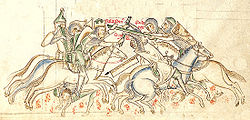
The defeated army of Zengi, Atabeg of Mosul, found its retreat blocked by the Tigris River opposite the fortress of Tikrit, where Saladin's father, Najm ad-Din Ayyub, served as warden. Ayyub gave Zengi refuge.
Image source: Saladin
1137
% complete
Salah ad-Din Yusuf ibn Ayyub, commonly known as Saladin, was born around 1137 into a Kurdish family. He would become a renowned commander and political leader, founder of the Ayyubid dynasty.
1137
% complete
Mujahid ad-Din Bihruz, military governor of northern Mesopotamia, reprimanded Ayyub for giving Zengi refuge, and banished him from Tikrit after his brother Asad ad-Din Shirkuh killed a friend of Bihruz.
1139
% complete
Ayyub and his family moved to Mosul, where Imad ad-Din Zengi acknowledged his debt and appointed Ayyub commander of his fortress in Baalbek.
1146
% complete
After the death of Zengi in 1146, his son Nur ad-Din became the regent of Aleppo and the leader of the Zengid dynasty, later becoming Saladin's master and patron.
Image source: Nur al-Din Zengi
Jul 31, 1173 - Aug 9, 1173
% complete
On 31 July 1173, Saladin's father Ayyub was wounded in a horse-riding accident, ultimately causing his death on 9 August 1173.
1174
% complete
Not long after Nur ad-Din died in 1174, Saladin launched his conquest of Syria, peacefully entering Damascus at the request of its governor.
1176
% complete
Saladin married Ismat ad-Din Khatun, the widow of Nur ad-Din Zengi, in 1176, strengthening his political position in Syria.
1163
% complete
Shawar, the vizier to the Fatimid caliph al-Adid, was driven out of Egypt by his rival Dirgham, a member of the powerful Banu Ruzzaik tribe. He asked for military backing from Nur ad-Din, who complied.
Image source: Shawar
1164
% complete
Alongside his uncle Shirkuh, a Kurdish mercenary commander in service of the Zengid dynasty, Saladin was sent to Fatimid Egypt on the orders of Nur ad-Din, as part of an expedition against Dirgham.
1169
% complete
After Shawar was reportedly assassinated by Saladin and Shirkuh died later that year, the Fatimid caliph al-Adid appointed Saladin as vizier of Egypt.
1169
% complete
Towards the end of 1169, Saladin, with reinforcements from Nur ad-Din, defeated a massive Crusader-Byzantine force near Damietta, securing Egypt against invasion.
Image source: Siege of Damietta (1169)
1171
% complete
After al-Adid's death in 1171, Saladin abolished the Cairo-based Isma'ili Fatimid Caliphate and realigned Egypt with the Baghdad-based Sunni Abbasid Caliphate, following encouragement from Nur ad-Din and Najm ad-Din al-Khabushani.
Image source: Fatimid Caliphate
1173
% complete
During the summer of 1173, a Nubian army along with former Fatimid Armenian troops appeared on the Egyptian border preparing to besiege Aswan. The Nubians departed but returned in 1173 and were again driven off.
1174
% complete
In 1174, Saladin ordered the arrest of a Sufi mystic, Qadid al-Qaffas, in Alexandria.
1174
% complete
In 1174, Saladin sent his brother Turan-Shah to conquer Yemen to allocate it and its port Aden to the territories of the Ayyubid Dynasty.
Image source: Turan-Shah
1175
% complete
After defeating the Zengids, Saladin was proclaimed Sultan of Egypt and Syria by the Abbasid caliph al-Mustadi. He also agreed to truces with the Zengids and the Kingdom of Jerusalem during the summer of 1175.
Image source: Ayyubid dynasty
1175 - 1183
% complete
Saladin first fortified the Citadel of Cairo between 1175 and 1183, transforming what had been a domed pleasure pavilion into a major defensive stronghold overlooking the city.
Image source: Cairo Citadel
Mar 1175
% complete
Soon after entering Hama and Homs' region, Saladin captured the citadel of Homs in March 1175 after stubborn resistance from its defenders.
Image source: Homs
Apr 13, 1175
% complete
On 13 April 1175, the Zengid troops marched to attack Saladin's forces, but soon found themselves surrounded by Saladin's Ayyubid veterans, who crushed them at the Battle of the Horns of Hama.
May 11, 1175
% complete
On 11 May 1175, a group of thirteen Assassins easily gained admission into Saladin's camp but were detected immediately before they carried out their attack by Nasih ad-Din Khumartekin of Abu Qubays.
Image source: Order of Assassins
Aug 1176
% complete
As soon as he dispatched the bulk of his troops to Egypt, Saladin led his army into the an-Nusayriyah range in August 1176, facing threats from the Order of Assassins led by Rashid ad-Din Sinan.
1178
% complete
In the spring of 1178, Saladin was encamped under the walls of Homs, and a few skirmishes occurred between his generals and the Crusader army.
Jun 1180
% complete
In June 1180, Saladin hosted a reception for Nur ad-Din Muhammad, the Artuqid emir of Keyfa, at Geuk Su, presenting him and his brother Abu Bakr with gifts valued at over 100,000 dinars according to Imad ad-Din.
1181
% complete
Leaving Farrukh-Shah in charge of Syria, Saladin returned to Cairo at the beginning of 1181. Later that summer, his former palace administrator Baha ad-Din Qaraqush arrested Majd ad-Din in Cairo.
Image source: Cairo
1182
% complete
By 1182, Saladin had completed the conquest of Syria after capturing Aleppo but failed to take over the Zengid stronghold of Mosul. He arrived at Raqqa, an important crossing point, on 10 November 1182.
Image source: Aleppo
May 11, 1182
% complete
On 11 May 1182, Saladin, along with half of the Egyptian Ayyubid army and numerous non-combatants, left Cairo for Syria. The truce with the Zengids officially ended in September 1182.
Feb 1183
% complete
Saladin and his army met the coalition at Harran in February 1183, but on hearing of his approach, the coalition sent messengers to Saladin asking for peace.
Image source: Harran
1185 - Mar 1186
% complete
Following the failure of his Kerak sieges, Saladin resumed attacks on the territory of Izz ad-Din around Mosul. However, Mas'ud allied with the governor of Azerbaijan and Jibal, who began moving troops across the Zagros Mountains in 1185. Saladin fell ill, and in March 1186 a peace treaty was signed.
Image source: Mosul
1191
% complete
In 1191, Saladin ordered his son to execute the Sufi philosopher Yahya al-Suhrawardi, the founder of the Illuminationist current in Muslim philosophy, in Aleppo.
Image source: Shihab al-Din Yahya ibn Habash Suhrawardi
1170
% complete
After establishing himself in Egypt, Saladin launched a campaign against the Crusaders, besieging Darum in 1170. He evaded Amalric's Templar garrison from Gaza and captured Gaza in that campaign period.
Image source: Deir al-Balah
Nov 1177
% complete
In November 1177, Saladin set out upon a raid into Palestine; the Crusaders had recently forayed into the territory of Damascus, so Saladin saw the truce as no longer worth preserving.
Image source: Battle of Montgisard
Aug 30, 1179
% complete
In summer 1179, King Baldwin had set up an outpost at Jacob's Ford commanding the approach to the Banias plain. Saladin moved to besiege the fortress, which fell on 30 August 1179.
Image source: Chastelet
1180
% complete
In the spring of 1180, while Saladin was in the area of Safad anxious to commence a vigorous campaign against the Kingdom of Jerusalem, King Baldwin sent messengers to him with proposals of peace.
Sep 29, 1183 - 1184
% complete
On 29 September 1183, Saladin crossed the Jordan River to attack Beisan, which was found empty. After an unsuccessful campaign into Galilee in 1183, he opened his campaign of 1184 with a second siege of Kerak, but the Crusaders relieved the fortress.
Image source: Kerak Castle
Jul 4, 1187
% complete
On 4 July 1187, Saladin faced the combined forces of Guy of Lusignan, King Consort of Jerusalem, and Raymond III of Tripoli at the decisive Battle of Hattin, crushing the Crusader army and re-establishing Muslim military dominance in the Levant.
Image source: Battle of Hattin
Oct 2, 1187
% complete
Jerusalem capitulated to Saladin's forces on Friday, 2 October 1187, after a siege. Despite the Crusaders' slaughter when they originally conquered Jerusalem in 1099, Saladin granted amnesty and free passage to common Catholics and even to the defeated Christian army, provided they could pay ransom.
Image source: Siege of Jerusalem (1187)
1188 - 1192
% complete
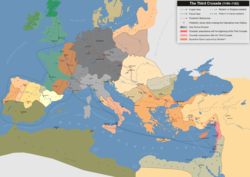
Hattin and the fall of Jerusalem prompted the Third Crusade (1189–1192), partially financed by a special 'Saladin tithe' in 1188. In 1188 at Tortosa, Saladin released Guy of Lusignan; in 1189, Guy and Sibylla were refused admission to Tyre by Conrad.
Image source: Third Crusade
Sep 7, 1191
% complete
The armies of Saladin engaged in combat with the army of King Richard at the Battle of Arsuf on 7 September 1191, at which Saladin's forces suffered heavy losses and were forced to withdraw. In October 1191, Richard began restoring inland castles beyond Jaffa.
Image source: Battle of Arsuf
Jan 1192
% complete
In January 1192, Richard's army occupied Beit Nuba, just twelve miles from Jerusalem, but withdrew without attacking the Holy City.
Jul 1192
% complete
In July 1192, Saladin tried to threaten Richard's command of the coast by attacking Jaffa. The Battle of Jaffa proved to be the last military engagement of the Third Crusade.
Image source: Battle of Jaffa (1192)
Mar 4, 1193
% complete
Saladin died of a fever on 4 March 1193 at Damascus, having given away much of his personal wealth to his subjects. He is buried in a mausoleum adjacent to the Umayyad Mosque.
1202 - 1203
% complete
As early as 1202/03, Walther von der Vogelweide urged the German King Philip of Swabia to be more like Saladin, who believed that a king's hands should have holes to let the gold fall through.
Image source: Walther von der Vogelweide
1308 - 1320
% complete
In The Divine Comedy (1308–1320), Dante mentions Saladin as one of the virtuous non-Christians in limbo, and he is also depicted favorably in Boccaccio's The Decameron (1438–53).
Image source: Divine Comedy
1779
% complete
Although Saladin faded into history after the Middle Ages, he appears in a sympathetic light in modern literature, first in Lessing's play Nathan the Wise (1779).
Image source: Nathan the Wise
1825
% complete
Published in 1825, Sir Walter Scott's novel The Talisman is set during the Third Crusade and centres on the relationship between Richard I of England and Saladin. It more than any other single text influenced the romantic view of Saladin as a liberal European gentleman.
Image source: The Talisman (Scott novel)
1898
% complete
In 1898, Wilhelm II, the German emperor, visited Saladin's tomb to pay his respects and donated a new marble sarcophagus to the mausoleum.
Image source: Mausoleum of Saladin
1935 - 1954
% complete
In Cecil B. DeMille's 1935 epic, Saladin is portrayed by Ian Keith as the noble adversary of King Richard; Ghazi Salahuddin, a 1939 Indian drama film, followed; and in King Richard and the Crusaders (1954), Saladin was played by Rex Harrison.
Image source: The Crusades (1935 film)
1963
% complete
Saladin the Victorious, a 1963 Egyptian war drama film directed by Youssef Chahine, depicted Saladin's life and the Battle of Hattin, becoming one of the most famous cinematic portrayals of the leader.
Image source: Saladin the Victorious
1965 - 1995
% complete
Saladin was portrayed by Bernard Kay in the 1965 Doctor Who serial 'The Crusade', and by Kammy Darweish in Terry Jones' 1995 documentary mini-series Crusades.
Image source: The Crusade (Doctor Who)
1992
% complete
The Statue of Saladin is an oversize equestrian bronze statue depicting Saladin located in front of the 11th century Citadel of Damascus in the Ancient City of Damascus, Syria, commemorating his recapture of Jerusalem.
Image source: Statue of Saladin
1998 - 2000
% complete
The Book of Saladin (1998) by Tariq Ali is a novel based on Saladin's life, and Jan Guillou's Crusades trilogy (1998–2000) features the era of the Crusades in which Saladin figures prominently.
Image source: The Book of Saladin
2001
% complete
Salah ad-Deen Al-Ayyobi, a 2001 TV series, dramatized the life of Salah ad-Din for Arabic-speaking audiences.
2005
% complete
In Ridley Scott's 2005 epic historical drama Kingdom of Heaven, Saladin was played by Ghassan Massoud, presenting him as a wise and honorable leader.
Image source: Kingdom of Heaven (film)
2015
% complete
Saladin appears in the grand strategy game series Crusader Kings, including in Crusader Kings III where Salah al-Din Yusuf leads the Ayyubid Sultanate in the 'Swords of Faith' campaign set in 1178.
Image source: Crusader Kings III
2023 - 2025
% complete
Kudüs Fatihi: Selahaddin Eyyubi (Saladin: The Conqueror of Jerusalem), a Turkish TV series airing 2023–2025, portrays Salahuddin al-Ayyubi played by Uğur Güneş, continuing Saladin's enduring cultural significance amid modern Arab nationalism and the Arab–Israeli conflict.
Or browse the full history timeline directory, with more than 2,000 topics.
This Saladin timeline was generated with the help of AI, using information found on the internet.
We work hard to keep these timelines accurate, but mistakes do get through. If you spot one, email us at [email protected] and we'll fix it for future visitors.
Generate yours with AI or build it from scratch, for free.
Export your timeline, add your own events, edit or remove AI-generated events, and much more
No credit card required.
Cancel anytime.
Cancel anytime.
You can create an unlimited number of timelines with up to 10 events on each one, customize how they look, export them to PDF, PNG, PowerPoint, CSV, and Excel, and share them with a link. Paid plans raise the event limit and add features like spreadsheet imports and collaborators.
Yes. You can cancel your subscription from your account page at any time, and you will not be charged again. Your subscription stays active for the rest of the period you already paid for.
Yes. We will email you a reminder before the annual renewal, and we will also email you a receipt.
Yes. You can email us within 15 days of any payment, and we will issue you a full refund.
Check out our pricing docs or send us an email anytime: [email protected].