-
Use Cases
-
Resources
-
Pricing
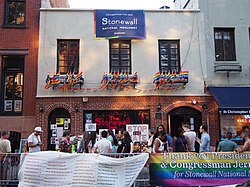
The Stonewall Riots were a series of spontaneous demonstrations by members of the LGBTQ+ community against a police raid at the Stonewall Inn, a gay bar in New York City's Greenwich Village. The uprising began in the early hours of June 28, 1969, and continued for several nights. It is widely regarded as a turning point that galvanized the modern fight for LGBTQ+ rights in the United States and around the world. More Less
1947 - 1950
% complete
Between 1947 and 1950, 1,700 federal job applications were denied, 4,380 people were discharged from the military, and 420 were fired from their government jobs for being suspected homosexuals.
Image source: Stonewall riots
1950
% complete
In 1950, a Senate investigation chaired by Clyde R. Hoey examined the employment of homosexuals in government, reflecting and fueling widespread persecution of gay people during the Lavender Scare era.
1950
% complete
Los Angeles area homosexuals created the Mattachine Society in 1950, in the home of communist activist Harry Hay, one of the earliest sustained gay rights organizations in the United States.
Image source: Mattachine Society
1952
% complete
In 1952, the American Psychiatric Association listed homosexuality in the Diagnostic and Statistical Manual (DSM) as a mental disorder, pathologizing gay people for decades.
1953
% complete
Facing enormous opposition to their radical approach, in 1953 the Mattachine Society shifted their focus to assimilation and respectability, moderating their activism.
1956
% complete
In 1956, psychologist Evelyn Hooker compared the happiness and well-adjusted nature of self-identified homosexual men with heterosexual men and found no difference. Her study stunned the medical community and made her a hero to many gay men and lesbians, though homosexuality remained in the DSM until 1974.
Image source: Evelyn Hooker
1958
% complete
One of the first challenges to government repression came in 1953 over ONE magazine's mailing rights. The case eventually went to the Supreme Court, which in 1958 ruled that ONE, Inc. could continue publishing its gay-themed magazine through the mail.
Image source: One, Inc. v. Olesen
May 1959
% complete
Gay, lesbian, bisexual, and transgender people rioted at the Cooper Do-nuts café in Los Angeles in 1959 to counteract police harassment, an early instance of resistance preceding Stonewall.
1966
% complete
In 1966, three members of the Mafia invested $3,500 to turn the Stonewall Inn into a gay bar, after it had been a restaurant and a nightclub for heterosexuals.
Image source: Stonewall Inn
Apr 1966
% complete
In 1966 the New York Mattachine held a 'sip-in' at a Greenwich Village bar named Julius, frequented by gay men, to illustrate the discrimination homosexuals faced in bars.
Aug 1966
% complete
In a larger 1966 event in San Francisco, drag queens, hustlers, and trans women sitting in Compton's Cafeteria resisted when police arrived to arrest people who appeared to have been assigned male at birth but presented femininely.
Image source: Compton's Cafeteria riot
1967
% complete
Another riot responded to a raid on Los Angeles' Black Cat Tavern in 1967, demonstrating that gay people had fought back against police before the events at Stonewall.
Image source: Black Cat Tavern
Jun 1969
% complete
Mayor John Lindsay's re-election campaign in the summer of 1969 resulted in an acceleration of police enforcement action against gay bars and their patrons, stemming from a belief that such enforcement would be praised by an anxious public amidst the era's social movements.
Jun 22, 1969
% complete
Judy Garland died six days before the riots began. Some accounts, including Stephin Merritt's song "'69: Judy Garland", connect her death to the emotional atmosphere surrounding the uprising, though historians dispute this as a cause.
Image source: Judy Garland
Jun 25, 1969
% complete
West Germany abolished criminal liability for homosexual acts among adults over 21 years of age through a change of Section 175 of the German Criminal Code on June 25, 1969 — just three days before the Stonewall riots began.
Image source: Paragraph 175
Jun 28, 1969
% complete
On Saturday, June 28, 1969, four plainclothes policemen, two patrol officers, Detective Charles Smythe, and Deputy Inspector Seymour Pine arrived at the Stonewall Inn's double doors and announced "Police! We're taking the place!" Undercover officers had entered earlier to gather visual evidence. The raid sparked spontaneous riots and demonstrations against police harassment in Greenwich Village.
Jun 29, 1969
% complete
Activist Mark Segal recounts that Martha Shelley and Marty Robinson stood and made speeches from the front door of the Stonewall on June 29, 1969, the second night of the riot, as crowds continued to gather and clash with police.
Jul 4, 1969
% complete
On July 4, 1969, the Mattachine Society performed its annual picket in front of Independence Hall in Philadelphia, called the Annual Reminder. Since 1965 the pickets had been very controlled: women wore skirts, men wore suits and ties, and all marched quietly in organized lines.
Image source: Annual Reminder
Dec 1969
% complete
In late December 1969, several people who had visited Gay Liberation Front meetings and left out of frustration formed the Gay Activists Alliance (GAA), focused solely on gay and lesbian rights.
Image source: Gay Activists Alliance
Mar 1970
% complete
In March 1970, deputy inspector Seymour Pine, who had led the Stonewall raid, raided the Zodiac and 17 Barrow Street, continuing police enforcement against gay establishments.
May 1970
% complete
One of the first and most important 'zaps' was staged in May 1970 by the Los Angeles Gay Liberation Front at a convention of the American Psychiatric Association (APA), protesting homosexuality's classification as a mental disorder.
Jun 28, 1970
% complete
Christopher Street Liberation Day, on June 28, 1970, marked the first anniversary of the Stonewall riots with an assembly on Christopher Street; with simultaneous Gay Pride marches in Los Angeles and Chicago, these were the first Gay Pride marches in US history.
Image source: Christopher Street Day
1973
% complete
During the 1973 Stonewall rally, moments after Barbara Gittings praised the diversity of the crowd, feminist activist Jean O'Leary protested what she perceived as the mocking of women by cross-dressers and drag queens. She later regretted her stance: "Looking back, I find this so embarrassing because my views have changed so much since then."
Image source: Jean O'Leary
Dec 1973
% complete
In December 1973—in large part due to the efforts of gay activists—the APA voted unanimously to remove homosexuality from the Diagnostic and Statistical Manual, a major victory for the movement energized by Stonewall.
Image source: Diagnostic and Statistical Manual of Mental Disorders
1977 - 1978
% complete
Gay men and lesbians came together to work in grassroots political organizations responding to organized resistance in 1977. Save Our Children was successful enough to influence similar repeals in several American cities in 1978.
Image source: Save Our Children
Oct 14, 1979
% complete
The subsequent 1979 National March on Washington for Lesbian and Gay Rights was timed to coincide with the tenth anniversary of the Stonewall riots, drawing tens of thousands of participants.
1989
% complete
Stonewall (officially Stonewall Equality Limited) is an LGBTQ rights charity in the United Kingdom, founded in 1989 and named after the Stonewall Inn because of the Stonewall riots. It has held the annual Stonewall Awards since 2006.
Image source: Stonewall (charity)
1993
% complete
The middle of the 1990s was marked by the inclusion of bisexuals as a represented group within the gay community, when they successfully sought to be included on the platform of the 1993 March on Washington for Lesbian, Gay and Bi Equal Rights and Liberation.
Image source: March on Washington for Lesbian, Gay, and Bi Equal Rights and Liberation
1994
% complete
In 1994, New York City celebrated "Stonewall 25" with a march that went past the United Nations Headquarters and into Central Park. Sylvia Rivera led an alternate march in New York City in 1994 to protest the exclusion of transgender people from the events.
Jun 1999
% complete
In June 1999, the US Department of the Interior included 51 and 53 Christopher Street and the surrounding area in Greenwich Village in the National Register of Historic Places, the first listing significant to the LGBTQ community. Assistant Secretary John Berry stated, "Let it forever be remembered that here—on this spot—men and women stood proud."
Image source: Stonewall National Monument
Feb 2000
% complete
The Stonewall Inn was named a National Historic Landmark in February 2000, further cementing its status as a site of national historical significance.
Jun 2009
% complete
President Barack Obama declared June 2009 Lesbian, Gay, Bisexual, and Transgender Pride Month, citing the riots as a reason to "commit to achieving equal justice under law for LGBT Americans".
Jun 23, 2015
% complete
On June 23, 2015, the New York City Landmarks Preservation Commission designated Stonewall as a city landmark, the first to be designated based on its LGBTQ cultural significance alone.
Jun 24, 2016
% complete
On June 24, 2016, President Barack Obama announced the establishment of the Stonewall National Monument at the site of the riots, administered by the National Park Service.
2018
% complete
In 2018, 49 years after the uprising, Stonewall Day was announced as a commemoration day by Pride Live, a social advocacy and community engagement organization.
Image source: Stonewall riots
Jun 2019 - Jun 30, 2019
% complete
Throughout June 2019, Stonewall 50 – WorldPride NYC 2019, produced by Heritage of Pride in partnership with the I Love New York program's LGBTQ division, took place in New York to commemorate the 50th anniversary of the Stonewall uprising.
Image source: Stonewall 50 – WorldPride NYC 2019
Jun 2019
% complete
Also in June 2019, to coincide with the fifty-year anniversary of the Stonewall riots, Paris, France, officially named a square in the Marais district as Place des Émeutes-de-Stonewall (Stonewall Riots Place).
Jun 6, 2019
% complete
On June 6, 2019, coinciding with WorldPride being celebrated in New York City, Police Commissioner James P. O'Neill apologized on behalf of the NYPD for the actions of its officers during the 1969 raid on the Stonewall Inn.
Jun 19, 2019
% complete
New York City Opera commissioned English composer Iain Bell and American librettist Mark Campbell in 2018 to write the opera Stonewall to commemorate the 50th anniversary of the riots; it premiered on June 19, 2019, directed by Leonard Foglia.
Image source: Stonewall (opera)
Jun 28, 2019
% complete
The second Stonewall Day was held on Friday, June 28, 2019, outside the Stonewall Inn, marking the official 50th anniversary of the uprising.
Jun 28, 2019
% complete
The official 50th-anniversary commemoration of the Stonewall Uprising occurred on June 28, 2019, on Christopher Street in front of Stonewall Inn, themed as a rally in reference to the original rallies in front of Stonewall Inn in 1969.
Jun 28, 2024
% complete
The National Park Foundation formed a new nonprofit organization to raise funds for a ranger station and interpretive exhibits for the monument, including the first official national visitor center dedicated to the LGBTQ+ experience, which was inaugurated on June 28, 2024.
Feb 13, 2025
% complete
On February 13, 2025, references to transgender and queer people were removed from the Stonewall National Monument's official website, prompting protests. On July 10, 2025, references to bisexual people were removed as well.
Or browse the full history timeline directory, with more than 2,000 topics.
This Stonewall Riots timeline was generated with the help of AI, using information found on the internet.
We work hard to keep these timelines accurate, but mistakes do get through. If you spot one, email us at [email protected] and we'll fix it for future visitors.
Generate yours with AI or build it from scratch, for free.
Export your timeline, add your own events, edit or remove AI-generated events, and much more
No credit card required.
Cancel anytime.
Cancel anytime.
You can create an unlimited number of timelines with up to 10 events on each one, customize how they look, export them to PDF, PNG, PowerPoint, CSV, and Excel, and share them with a link. Paid plans raise the event limit and add features like spreadsheet imports and collaborators.
Yes. You can cancel your subscription from your account page at any time, and you will not be charged again. Your subscription stays active for the rest of the period you already paid for.
Yes. We will email you a reminder before the annual renewal, and we will also email you a receipt.
Yes. You can email us within 15 days of any payment, and we will issue you a full refund.
Check out our pricing docs or send us an email anytime: [email protected].