-
Use Cases
-
Resources
-
Pricing
1500 - 1599
Contacts between Wampanoag communities and colonists began in the sixteenth century as European merchant vessels and fishing boats traveled along the New England coast.
Image source: Wampanoag
1524
Giovanni de Verrazano contacted various Indigenous tribes, including the Wampanoag and Narragansett, in the region of modern-day Rhode Island.
Image source: Giovanni da Verrazzano
1600
Before English contact in the seventeenth century, as many as 40,000 Wampanoag people lived across 67 villages that composed the Wampanoag Nation.
1614
The name probably deriving from Wapanoos was first documented on Adriaen Block's 1614 map, the earliest European representation of Wampanoag territory.
Image source: Adriaen Block
1614
Captain Thomas Hunt captured several Wampanoag people and sold them in Spain as slaves.
1615 - 1619
A leptospirosis epidemic carried by rodent reservoirs arriving on European ships dramatically reduced the Wampanoag and neighboring tribes.
1616
John Smith referred to one Wampanoag tribe as the Pokanoket, a name also used in early colonial records for the community whose leaders headed the Wampanoag confederation.
Image source: John Smith (explorer)
1619
Tisquantum returned to his homeland in 1619 after accompanying an expedition to Newfoundland as an interpreter and found that the entire Patuxet tribe had died in an epidemic.
1676
Increase Mather recorded Wampanoag to describe the alliance of tribes that fought the English in King Philip's War. The Wampanoag translate the word as People of the First Light.
1620
The Pilgrims arrived at Plymouth, beginning sustained English settlement in the region and a new period of interaction with Wampanoag communities.
Image source: Plymouth Colony
1620 - 1621
Tisquantum and other Wampanoag taught the Pilgrims to cultivate corn, squash, and beans, as well as to catch and process fish and collect seafood.
1621
Mourt's Relation recorded initial contact between the Pilgrims and the Wampanoag as beginning in spring 1621.
Image source: Mourt's Relation
1621
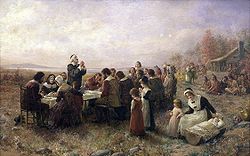
A primary firsthand account of the 1621 celebration states that Indigenous people were present, although it provides no further details about the event.
Image source: Thanksgiving (United States)
1623
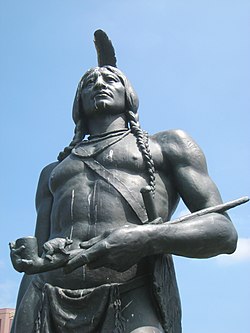
Massasoit became gravely ill in winter 1623 and was nursed back to health by the colonists.
Image source: Massasoit
1632
After 1632, the Plymouth Colony was outnumbered by the growing Puritan settlements around Boston, altering the regional balance of power.
1632
The Narragansetts attacked Massasoit's village at Sowam, but colonists helped the Wampanoag drive them back.
1638
Colonists destroyed the powerful Pequot Confederation, further transforming Indigenous politics in southern New England.
Image source: Pequot War
1643
With colonial support, the Mohegans defeated the Narragansetts and became the dominant tribe in southern New England.
1650 - 1675
Beginning after 1650, John Eliot and other Puritan missionaries sought to convert local tribes. Converts settled in 14 Praying towns.
1671
Philip was summoned to Taunton, Massachusetts, heard colonial accusations, and signed an agreement requiring the Wampanoag to surrender their firearms.
Image source: King Philip's War
1675 - 1676
Philip gradually gained the Nipmuck, Pocomtuc, and Narragansett as allies. The uprising had originally been planned for spring 1676.
Mar 1675
The murder of John Sassamon in March 1675 intensified tensions between the Wampanoag and English colonists.
Jun 1675
Colonists tried three captives before a jury of 12 colonists and six Christian Indians and hanged them in June 1675.
Jun 20, 1675
On June 20, Wampanoag forces attacked colonists in Swansea, Massachusetts, and laid siege to the town, beginning the major uprising known as King Philip's War.
1676
The war turned against Philip in spring 1676 after a winter of hunger and deprivation weakened his forces.
Aug 12, 1676
Colonial troops surrounded Philip's camp on August 12, 1676, and soon shot and killed Metacom, also known as King Philip.
1660
Colonists allotted Indigenous people approximately 50 square miles around Mashpee.
1665
Beginning in 1665, Mashpee residents exercised self-government through an English-style court of law and trials.
1671
Property deeds recorded the Mashpee Plantation as approximately 55 square miles and included provisions intended to prevent the land from being sold or alienated from the community.
1700 - 1899
Martha's Vineyard had three Wampanoag reservations during the eighteenth and nineteenth centuries: Chappaquiddick, Christiantown, and Gay Head.
1763
The Mashpee area was integrated into the district of Mashpee.
1788
After the American Revolutionary War, Massachusetts revoked the Wampanoag ability to self-govern, judging the system a failure.
1789 - 1810
Following land sales in 1789, Indigenous residents lost valuable areas. The remaining land was distributed among Indian residents in 1810.
1834
Massachusetts returned a degree of self-government to the First Nations people, although they remained far from autonomous.
1842
The state illegally allocated 2,000 acres from approximately 13,000 acres of communal land into 60-acre household parcels, violating the Nonintercourse Act and promoting assimilation.
1849
At Gay Head, the Wampanoag held 2,400 acres, of which 500 acres had been distributed among tribal members.
1870 - 1871
In 1870, each Mashpee tribal member over 18 received 60 acres for private ownership. By 1871, non-Mashpee buyers had acquired choice portions from impoverished residents, causing major land loss.
1888
Wampanoag oral history says Christiantown was wiped out by a smallpox epidemic in 1888.
1663
Missionary John Eliot published the first Bible in America, a 1663 translation into Wampanoag.
Image source: Eliot Indian Bible
1924
Since 1924, Wampanoag people have held an annual powwow at the beginning of July in Mashpee.
1972
The Mashpee Wampanoag Tribal Council was established under the leadership of its first president, Russell “Fast Turtle” Peters.
1972
Aquinnah Wampanoag descendants formed the Wampanoag Tribal Council of Gay Head, Inc., to pursue self-determination and federal recognition.
1974
The Mashpee Wampanoag Tribal Council petitioned the Bureau of Indian Affairs for federal recognition.
1976
The Mashpee Wampanoag Tribe sued the Town of Mashpee seeking the return of ancestral homelands.
1987
The Bureau of Indian Affairs recognized the Wampanoag Tribe of Gay Head in 1987.
1993
Jessie Little Doe Baird, a member of the Mashpee Wampanoag Tribe, founded the Wôpanâak Language Reclamation Project.
Apr 2006
After decades of legal disputes, the Bureau of Indian Affairs granted the Mashpee Wampanoag provisional recognition in April 2006.
Feb 2007
The Mashpee Wampanoag Tribe received official federal recognition in February 2007.
2009
The tribe elected council member Cedric Cromwell as council chair and president in 2009.
2010
Jessie Little Doe Baird received a $500,000 MacArthur Fellows grant for her language reclamation work. The project helped teach children who became the first Wôpanâak speakers in more than a century.
2010
In 2010, tribal chair Cheryl Andrews-Maltais proposed developing an Aquinnah reservation casino, drawing opposition from state and local officials.
2011
The Wampanoag casino plan had financing agreement from Malaysia's Genting Group and political support from Massachusetts Senator John Kerry, Governor Deval Patrick, and former Congressman Bill Delahunt.
Nov 2011
The Massachusetts legislature passed a law in November 2011 authorizing up to three resort casino sites and one slot-machine parlor.
2015
The federal government declared 150 acres in Mashpee and 170 acres in Taunton the Mashpee Wampanoag Tribe's initial reservation, where the tribe could exercise full sovereignty rights.
2015
The project Massachusetts Native Peoples and the Social Contract: A Reassessment for Our Times began as an updated report on the cultural, linguistic, and economic state of Wampanoag peoples.
2018
Mashpee High School began offering a course in the Wampanoag language in 2018.
2019
The Wampanoag Tribe of Gay Head (Aquinnah) had 1,364 enrolled tribal citizens in 2019.
Dec 2021
A December 2021 ruling by the United States Department of the Interior gave the Mashpee Wampanoag substantial control over 320 acres on Cape Cod.
2023
The Mashpee Wampanoag Tribe had approximately 3,200 enrolled citizens in 2023.
Nov 19, 2024
Massachusetts Governor Maura Healey granted the Aquinnah Wampanoag state recognition through Executive Order 637.
Or browse the full history timeline directory, with more than 2,500 topics.
This Wampanoag History timeline was generated with the help of AI, using information found on the internet.
We work hard to keep these timelines accurate, but mistakes do get through. If you spot one, email us at [email protected] and we'll fix it for future visitors.
Generate yours with AI or build it from scratch, for free.
Export your timeline, add your own events, edit or remove AI-generated events, and much more
No credit card required.
Cancel anytime.
Cancel anytime.
You can create an unlimited number of timelines with up to 10 events on each one, customize how they look, export them to PDF, PNG, PowerPoint, CSV, and Excel, and share them with a link. Paid plans raise the event limit and add features like spreadsheet imports and collaborators.
Yes. You can cancel your subscription from your account page at any time, and you will not be charged again. Your subscription stays active for the rest of the period you already paid for.
Yes. We will email you a reminder before the annual renewal, and we will also email you a receipt.
Yes. You can email us within 15 days of any payment, and we will issue you a full refund.
Check out our pricing docs or send us an email anytime: [email protected].