-
Use Cases
-
Resources
-
Pricing
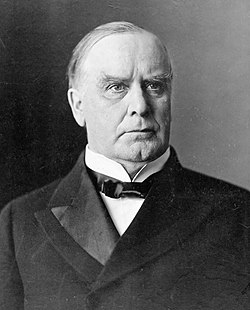
William McKinley (1843–1901) was the 25th President of the United States, serving from 1897 until his assassination in 1901. A Republican from Ohio and veteran of the Civil War, McKinley led the nation during the Spanish-American War, oversaw the annexation of Hawaii, championed protective tariffs and the gold standard, and guided America's emergence as a global power. More Less
Jan 29, 1843
% complete
William McKinley was born on January 29, 1843, in Niles, Ohio, the seventh of eight children of William McKinley Sr., an iron manufacturer, and Nancy Allison McKinley. His family moved frequently during his childhood before settling in Poland, Ohio.
Image source: William McKinley
1860 - 1861
% complete
McKinley briefly attended Allegheny College in Meadville, Pennsylvania, in 1860, but illness forced him to return home after only one year. He did not complete his degree there.
Image source: Allegheny College
Jun 11, 1861
% complete
At the outbreak of the Civil War, McKinley enlisted as a private in the 23rd Ohio Infantry Regiment, serving under future president Rutherford B. Hayes. He would serve throughout the war with distinction.
Sep 17, 1862
% complete
During the Battle of Antietam, McKinley famously served hot coffee and rations to soldiers under fire while acting as a commissary sergeant, an act of bravery that earned him wide praise from his superiors.
Image source: Battle of Antietam
Mar 13, 1865
% complete
In March 1865, McKinley was commissioned as a captain and later received a brevet promotion to major for his gallant conduct during the war, particularly for actions at the Battle of Cedar Creek in 1864.
Image source: Brevet
1867
% complete
After the Civil War, McKinley studied law at Albany Law School in New York for about a year and was admitted to the bar in 1867, opening a practice in Canton, Ohio.
Image source: Albany Law School
Jan 25, 1871
% complete
McKinley married Ida Saxton, daughter of a prominent Canton banker, on January 25, 1871. The couple had two daughters, both of whom died young, and Ida suffered lifelong health problems that McKinley tended devotedly.
Image source: Ida Saxton McKinley
Mar 4, 1877 - Mar 3, 1891
% complete
McKinley served multiple terms in Congress beginning in 1877, interrupted briefly after a disputed election loss in 1890. He became known as a champion of protective tariffs and sound money policies.
Image source: William McKinley 1896 presidential campaign
Oct 1, 1890
% complete
As chairman of the House committee on tariffs, McKinley authored the McKinley Tariff Act of 1890, which raised import duties to record levels to protect American industry. The tariff's unpopularity contributed to his election defeat that year.
Image source: McKinley Tariff
Jan 11, 1892 - Jan 13, 1896
% complete
McKinley was elected Governor of Ohio in 1891 and re-elected in 1893. He guided the state through economic turmoil following the Panic of 1893, balancing compassion for laborers with support for business interests.
Image source: Governor of Ohio
Jun 18, 1896
% complete
At the 1896 Republican National Convention in St. Louis, McKinley secured the presidential nomination on the first ballot. His campaign was managed by Marcus Hanna, who raised unprecedented funds for the effort.
Image source: 1896 Republican National Convention
Nov 3, 1896
% complete
McKinley conducted a famous 'front porch campaign' from his Canton home, addressing visiting delegations, while Bryan toured the nation. McKinley won decisively, carrying the industrial Northeast and Midwest on a platform of prosperity and the gold standard.
Image source: 1896 United States presidential election
Mar 4, 1897
% complete
William McKinley was inaugurated as the 25th President of the United States on March 4, 1897. He pledged tariff reform and sound currency, and appointed a cabinet including John Sherman as Secretary of State.
Image source: First inauguration of William McKinley
Jul 24, 1897
% complete
The Dingley Tariff, signed in July 1897, raised duties even higher than the McKinley Tariff and remained in effect for over a decade, becoming the longest-lasting tariff in U.S. history up to that point.
Image source: Dingley Act
Feb 15, 1898
% complete
The explosion of the battleship USS Maine in Havana harbor killed 266 Americans and inflamed public opinion against Spain. Though McKinley sought peace, 'Remember the Maine' became a rallying cry for war.
Image source: USS Maine (1890)
Apr 21, 1898 - Aug 13, 1898
% complete
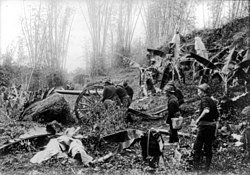
After Congress declared war on Spain in April 1898, McKinley directed a swift military campaign that included Commodore Dewey's victory at Manila Bay and American victories in Cuba, lasting roughly four months.
Image source: Spanish–American War
Jul 7, 1898
% complete
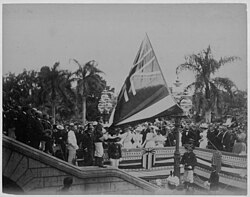
Under McKinley, Congress passed the Newlands Resolution annexing the Republic of Hawaii in July 1898, extending American territory into the Pacific and supporting strategic interests during the war with Spain.
Image source: Newlands Resolution
Dec 10, 1898
% complete
The Treaty of Paris ended the war, with Spain ceding Puerto Rico, Guam, and the Philippines to the United States and renouncing sovereignty over Cuba, transforming America into an overseas imperial power.
Image source: Treaty of Paris (1898)
Feb 4, 1899 - Jul 4, 1902
% complete
Conflict broke out between American forces and Filipino independence fighters led by Emilio Aguinaldo shortly after the treaty's ratification. The brutal conflict lasted years and cost thousands of lives before American control was consolidated.
Image source: Philippine–American War
Sep 6, 1899
% complete
Secretary of State John Hay, under McKinley, issued Open Door Notes calling for equal trading access to China by all powers, shaping American foreign policy in Asia for decades and protecting Chinese territorial integrity.
Image source: Open Door Policy
Mar 14, 1900
% complete
McKinley signed the Gold Standard Act of 1900, formally placing the United States on the gold standard and ending the free silver debate that had dominated politics since the Panic of 1893.
Image source: Gold Standard Act
Aug 14, 1900
% complete
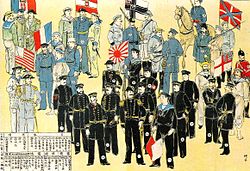
McKinley sent American troops as part of the Eight-Nation Alliance that relieved the siege of foreign legations in Beijing during the Boxer Rebellion, later securing reparations while opposing further partition of China.
Image source: Eight-Nation Alliance
Nov 6, 1900
% complete
McKinley defeated Bryan decisively in a rematch of the 1896 contest, winning on a record of prosperity, victory over Spain, and expansion. Theodore Roosevelt joined the ticket as vice president after the death of Garret Hobart.
Image source: 1900 United States presidential election
Mar 4, 1901
% complete
McKinley began his second term on March 4, 1901, pledging continued prosperity and hinting at new directions in trade policy, including possible reciprocity agreements rather than pure protectionism.
Image source: Second inauguration of William McKinley
Sep 5, 1901
% complete
McKinley delivered a major address at the Pan-American Exposition in Buffalo, New York, advocating reciprocal trade treaties and warning against protectionist excesses, foreshadowing a shift in tariff policy.
Image source: Pan-American Exposition
Sep 6, 1901
% complete
While greeting visitors at the exposition's Temple of Music, McKinley was shot twice in the abdomen by anarchist Leon Czolgosz. The wounded president initially appeared to be recovering.
Image source: Assassination of William McKinley
Sep 14, 1901
% complete
McKinley died of gangrene from his untreated wounds on September 14, 1901, eight days after being shot. His reported last words included 'Nearer, my God, to Thee.' Vice President Theodore Roosevelt succeeded him.
Image source: Assassination of William McKinley
Sep 19, 1901
% complete
Following ceremonies in Washington and a train journey past hundreds of thousands of mourners, McKinley was laid to rest in Canton, Ohio, after a solemn funeral attended by dignitaries from around the world.
Oct 29, 1901
% complete
Czolgosz was tried, convicted, and executed in the electric chair at Auburn Prison just 45 days after the assassination, one of the swiftest executions of a presidential assassin in American history.
Image source: Leon Czolgosz
Sep 30, 1907
% complete
The grand domed McKinley National Memorial in Canton, funded by donations from millions of Americans including schoolchildren, was dedicated in 1907, enshrining the memory of the martyred president.
Image source: McKinley National Memorial
1917
% complete
The tallest peak in North America was officially designated Mount McKinley by federal legislation in 1917. The name stood until 2015, when it was officially renamed Denali, reflecting long-running disputes over the honor.
Image source: Denali–Mount McKinley naming dispute
Or browse the full history timeline directory, with more than 2,000 topics.
This William McKinley timeline was generated with the help of AI, using information found on the internet.
We work hard to keep these timelines accurate, but mistakes do get through. If you spot one, email us at [email protected] and we'll fix it for future visitors.
Generate yours with AI or build it from scratch, for free.
Export your timeline, add your own events, edit or remove AI-generated events, and much more
No credit card required.
Cancel anytime.
Cancel anytime.
You can create an unlimited number of timelines with up to 10 events on each one, customize how they look, export them to PDF, PNG, PowerPoint, CSV, and Excel, and share them with a link. Paid plans raise the event limit and add features like spreadsheet imports and collaborators.
Yes. You can cancel your subscription from your account page at any time, and you will not be charged again. Your subscription stays active for the rest of the period you already paid for.
Yes. We will email you a reminder before the annual renewal, and we will also email you a receipt.
Yes. You can email us within 15 days of any payment, and we will issue you a full refund.
Check out our pricing docs or send us an email anytime: [email protected].