-
Use Cases
-
Resources
-
Pricing
The 1930s was a turbulent decade defined by the global Great Depression, economic hardship, the Dust Bowl in America, the rise of totalitarian regimes in Germany, Italy, and Japan, New Deal reforms under Franklin D. Roosevelt, and escalating international tensions that culminated in the outbreak of World War II in 1939. More Less
Mar 13, 1930
% complete
Clyde Tombaugh at Lowell Observatory in Arizona identified Pluto from photographic plates, revealing a ninth planet in the solar system. The discovery captivated the public and expanded humanity's understanding of the outer solar system.
Image source: Pluto
Feb 27, 1932
% complete
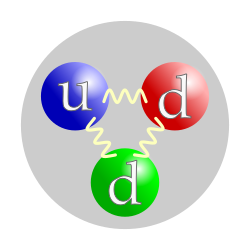
James Chadwick demonstrated the existence of the neutron, a neutral particle in the atomic nucleus. The discovery transformed nuclear physics and laid essential groundwork for nuclear fission and atomic energy.
Image source: Neutron
May 20, 1932 - May 21, 1932
% complete
Earhart became the first woman to fly solo nonstop across the Atlantic Ocean, landing in Ireland after a harrowing flight from Newfoundland. The feat made her an international celebrity and an icon for women's achievement.
Image source: Amelia Earhart
Mar 1, 1936
% complete
The colossal concrete arch-gravity dam on the Colorado River was finished two years ahead of schedule. It tamed floods, provided water storage, and generated hydroelectric power for the growing American Southwest.
Image source: Hoover Dam
May 6, 1937
% complete
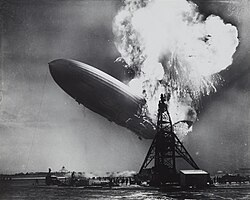
The German passenger airship Hindenburg caught fire while landing at Lakehurst, New Jersey, killing 36 people. Captured on film and broadcast live on radio, the catastrophe ended the era of passenger airship travel.
Image source: Hindenburg disaster
May 27, 1937
% complete
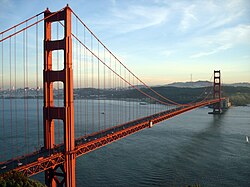
San Francisco celebrated the opening of its iconic suspension bridge spanning the Golden Gate strait. At the time the longest suspension bridge span in the world, it became an enduring symbol of American engineering.
Image source: Golden Gate Bridge
Dec 17, 1938 - Jan 6, 1939
% complete
Otto Hahn, Lise Meitner, and Fritz Strassmann demonstrated that uranium nuclei could be split, releasing enormous energy. Their discovery opened the path to nuclear reactors and atomic weapons and transformed twentieth-century science and geopolitics.
Image source: Nuclear fission
Jun 17, 1930
% complete
The United States raised tariffs on thousands of imported goods, aiming to protect American industries during the Depression. The move triggered retaliatory tariffs from other nations and caused international trade to collapse by roughly two-thirds, deepening the global economic crisis.
Image source: Smoot–Hawley Tariff Act
May 1, 1934 - Apr 14, 1935
% complete
Severe drought and massive dust storms ravaged the American and Canadian prairies, destroying farmland and displacing hundreds of thousands of people. Many 'Okies' migrated west to California, reshaping American demographics and agriculture.
Image source: Dust Bowl
Jul 13, 1930 - Jul 30, 1930
% complete
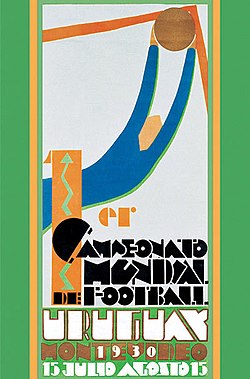
The inaugural World Cup took place in Montevideo, drawing thirteen teams. Host nation Uruguay defeated Argentina 4-2 in the final, establishing football's premier international tournament and beginning a global sporting tradition.
Image source: 1930 FIFA World Cup
Apr 11, 1931
% complete
New York City's 102-story Art Deco skyscraper was finished after just over a year of construction, becoming the world's tallest building. Built during the Depression, it stood as a symbol of American ambition and engineering prowess.
Image source: Empire State Building
Dec 5, 1933
% complete
Utah's ratification completed repeal of the Eighteenth Amendment, ending thirteen years of nationwide Prohibition. Legal alcohol sales resumed, boosting government revenue and eliminating the bootlegging economy.
Image source: Twenty-first Amendment to the United States Constitution
Aug 1, 1936 - Aug 16, 1936
% complete
Nazi Germany hosted the Summer Games as a propaganda showcase. Jesse Owens won four gold medals, debunking Aryan supremacy myths, though the Olympics ultimately burnished Hitler's international image.
Image source: 1936 Summer Olympics
Feb 4, 1938
% complete
Walt Disney's first full-length animated feature premiered and became a massive critical and commercial success. It proved feature animation could be viable cinema and launched Disney's golden age of animation.
Image source: Snow White and the Seven Dwarfs (1937 film)
Jun 1, 1938
% complete
Jerry Siegel and Joe Shuster introduced Superman, launching the superhero genre and transforming popular culture. The character became a global icon and founded what is now one of entertainment's most valuable franchises.
Image source: Action Comics 1
Dec 15, 1939
% complete
The epic adaptation of Margaret Mitchell's novel premiered in Atlanta and became a box office phenomenon. It won a record eight Academy Awards and stands among the most influential films ever made.
Image source: Gone with the Wind (film)
Sep 18, 1931
% complete
Following the staged Mukden Incident, Japanese forces seized Manchuria from China and established the puppet state of Manchukuo. The invasion exposed the League of Nations' weakness and marked an early step on Japan's path to wider war in Asia.
Image source: Japanese invasion of Manchuria
Nov 8, 1932
% complete
Roosevelt defeated incumbent Herbert Hoover in a landslide, promising a 'New Deal' to combat the Great Depression. His election launched a transformative era of American politics and an unprecedented expansion of federal government programs.
Image source: 1932 United States presidential election
Jan 30, 1933
% complete
President Paul von Hindenburg appointed Hitler as chancellor, allowing the Nazi Party to seize control of Germany. Within months, Hitler dismantled democratic institutions and established a totalitarian dictatorship that would plunge the world into war.
Image source: Adolf Hitler's rise to power
Feb 27, 1933
% complete
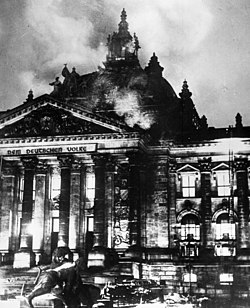
The German parliament building burned days before a crucial election. Hitler used the fire as a pretext to suspend civil liberties, crush the Communist opposition, and consolidate Nazi control over the German state.
Image source: Reichstag fire
Mar 22, 1933
% complete
Nazi Germany opened its first concentration camp near Munich, initially holding political prisoners. Dachau became the model for a vast camp system that would later imprison and murder millions during the Holocaust.
Image source: Dachau concentration camp
Jun 30, 1934 - Jul 2, 1934
% complete
Hitler purged the SA leadership and other political rivals in a series of extrajudicial killings. The purge eliminated Ernst Röhm and secured the loyalty of the German army to Hitler personally, tightening his grip on power.
Image source: Night of the Long Knives
Oct 16, 1934 - Oct 20, 1935
% complete
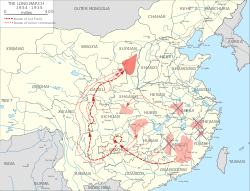
Chinese Communist forces undertook a grueling year-long retreat of thousands of miles to escape Nationalist encirclement. Mao Zedong emerged as the party's paramount leader, setting the stage for the eventual communist victory in China.
Image source: Long March
Aug 14, 1935
% complete
President Roosevelt signed landmark legislation creating old-age pensions, unemployment insurance, and aid to dependent children. It became the cornerstone of the American social safety net and remains one of the New Deal's most enduring legacies.
Oct 3, 1935 - May 9, 1936
% complete
Fascist Italy under Mussolini launched a brutal invasion of independent Ethiopia using modern weapons and poison gas against poorly armed defenders. The League of Nations' ineffective sanctions exposed its impotence and emboldened future aggressors.
Image source: Second Italo-Ethiopian War
Jul 17, 1936 - Apr 1, 1939
% complete
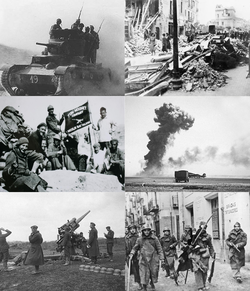
Nationalist generals led by Francisco Franco rose against Spain's Republican government, igniting a brutal civil war. Germany and Italy aided Franco while the Soviet Union backed the Republic; the conflict served as a proving ground for World War II tactics.
Image source: Spanish Civil War
Dec 13, 1937 - Jan 31, 1938
% complete
Japanese troops captured the Chinese capital Nanjing and carried out six weeks of mass murder, rape, and looting, killing hundreds of thousands of civilians and prisoners of war. The atrocity shocked the world and remains a defining trauma of Sino-Japanese relations.
Image source: Nanjing Massacre
Mar 12, 1938
% complete
German troops entered Austria, which was absorbed into the Third Reich amid widespread Nazi celebrations. The bloodless annexation emboldened Hitler's expansionist ambitions and violated the Treaty of Versailles with little international resistance.
Image source: Anschluss
Sep 30, 1938
% complete
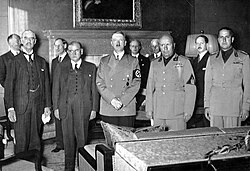
Britain and France allowed Nazi Germany to annex the Sudetenland from Czechoslovakia in hopes of avoiding war. Prime Minister Neville Chamberlain proclaimed 'peace for our time,' but the policy of appeasement failed within a year.
Image source: Munich Agreement
Nov 9, 1938 - Nov 10, 1938
% complete
Nazis unleashed a nationwide pogrom against Jews, smashing synagogues, shops, and homes, killing dozens and arresting some 30,000 Jewish men. The 'Night of Broken Glass' marked a dramatic escalation toward the Holocaust.
Image source: Kristallnacht
Sep 1, 1939
% complete
German forces invaded Poland using blitzkrieg tactics, prompting Britain and France to declare war on September 3. The invasion ended the interwar period and plunged the world into the deadliest conflict in human history.
Image source: Invasion of Poland
Nov 30, 1939 - Mar 13, 1940
% complete
Stalin's forces attacked Finland after it refused territorial demands, expecting a quick victory. Finnish defenders inflicted staggering Soviet casualties in fierce winter fighting, though Finland eventually ceded territory under the Moscow Peace Treaty.
Image source: Winter War
Or browse the full history timeline directory, with more than 2,000 topics.
This 1930s timeline was generated with the help of AI, using information found on the internet.
We work hard to keep these timelines accurate, but mistakes do get through. If you spot one, email us at [email protected] and we'll fix it for future visitors.
Generate yours with AI or build it from scratch, for free.
Export your timeline, add your own events, edit or remove AI-generated events, and much more
No credit card required.
Cancel anytime.
Cancel anytime.
You can create an unlimited number of timelines with up to 10 events on each one, customize how they look, export them to PDF, PNG, PowerPoint, CSV, and Excel, and share them with a link. Paid plans raise the event limit and add features like spreadsheet imports and collaborators.
Yes. You can cancel your subscription from your account page at any time, and you will not be charged again. Your subscription stays active for the rest of the period you already paid for.
Yes. We will email you a reminder before the annual renewal, and we will also email you a receipt.
Yes. You can email us within 15 days of any payment, and we will issue you a full refund.
Check out our pricing docs or send us an email anytime: [email protected].