-
Use Cases
-
Resources
-
Pricing
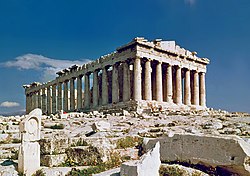
The Acropolis of Athens is an ancient citadel located on a rocky outcrop above the city of Athens, Greece. It is home to some of the most significant surviving buildings of Classical Greece, most notably the Parthenon, built during the height of the Athenian Empire under Pericles. Serving as a religious sanctuary dedicated primarily to the goddess Athena, the Acropolis has witnessed centuries of architectural achievement, foreign occupation, and restoration. Today it stands as a UNESCO World Heritage Site and a symbol of ancient Greek civilization. More Less
4000 BC
% complete
There is evidence that the hill of the Acropolis was inhabited as early as the 4th millennium BC, making it one of the oldest continuously significant sites in the region long before its famous monuments were built.
Image source: Acropolis of Athens
1300 BC
% complete
At some time before the 13th century BC, an earthquake caused a fissure near the northeastern edge of the Acropolis, altering the landscape of the sacred rock.
1200 BC
% complete
From the end of the Late Helladic IIIB period (1300–1200 BC) onward, the great wall around the Acropolis served as the site's main defense until the 5th century BC.
700 BC - 600 BC
% complete
During the 7th and 6th centuries BC, the site was controlled by Kylon during his failed Kylonian revolt, an attempt directed at seizing political power by coup d'état.
560 BC - 520 BC
% complete
Peisistratos seized control of the Acropolis twice during the 6th century BC, in further coup attempts aimed at gaining political power over Athens.
100 BC
% complete
Little is known about the original plan of the interior of the building, which was destroyed by fire during the first century BC and has been rebuilt several times since.
150 AD
% complete
Pausanias, writing his 2nd century AD Description of Greece, does not mention the structure in question, providing evidence about its state or status in antiquity.
267 AD
% complete
The invading Herulians destroyed the building roughly a century after its earlier destructions; it would not be reconstructed until modern times.
300 AD
% complete
During the 3rd century, under threat from a Herulian invasion, repairs were made to the Acropolis walls and the Beulé Gate was constructed in front of the Propylaea, restricting entrance and returning the Acropolis to use as a fortress.
Image source: Beulé Gate
450 BC - 420 BC
% complete
The Temple of Athena Nike, a small amphiprostyle shrine honoring the goddess Athena as the bringer of victory, was built on the southwest bastion of the Acropolis under Pericles' program.
450 BC - 400 BC
% complete
The Erechtheion, an ancient Greek temple dedicated to both Athena and Poseidon, was constructed as part of Pericles' ambitious building program on the Acropolis.
450 BC - 430 BC
% complete
Under the program coordinated by Pericles, the Propylaea was built as the monumental gateway to the Acropolis, forming part of the ensemble that defines the site to this day.
450 BC - 430 BC
% complete
In the fifth century BC, Pericles coordinated the construction of the buildings whose present remains are the site's most important ones. The Parthenon became the crowning temple of Athena Parthenos on the Acropolis.
400 BC - 301 BC
% complete
According to Pausanias, a wooden statue or xoanon of the goddess and a statue of Artemis made by Praxiteles during the 4th century BC were both housed in the sanctuary on the Acropolis.
1200 AD
% complete
A large tower known as the Frankopyrgos (Frankish Tower) was added to the Acropolis during the medieval period; it stood for centuries before being demolished in the 19th century.
Sep 1687
% complete
During the 1687 siege by the Venetians in the Morean War, gunpowder stored in the Parthenon by the Turkish rulers was hit by Venetian bombardment and exploded, seriously damaging the Parthenon and other buildings.
1750 AD
% complete
Within the later tradition of Western civilization and Classical revival, the Acropolis has often been invoked from at least the mid-18th century onward as a critical symbol of the Greek legacy and of the glories of Classical Greece.
1821 AD - 1822 AD
% complete
The Acropolis was besieged thrice during the Greek War of Independence. The first two sieges came from the Greeks in 1821–1822 as they fought to expel the Ottoman garrison.
1822 AD - 1825 AD
% complete
A new bulwark named after Odysseas Androutsos was built by the Greeks between 1822 and 1825 to protect the recently rediscovered Klepsydra spring, which became the sole fresh water supply of the fortress.
1826 AD - 1827 AD
% complete
The third siege of the Acropolis during the Greek War of Independence came from the Ottomans in 1826–1827, as they sought to retake the fortress from Greek revolutionary forces.
1941 AD
% complete
At the beginning of the Axis occupation of Greece in 1941, German soldiers raised the Nazi German War Flag over the Acropolis, symbolizing their occupation of Athens.
1944 AD
% complete
In 1944, Greek Prime Minister Georgios Papandreou arrived on the Acropolis to celebrate the liberation of Greece from Nazi occupation.
Image source: Georgios Papandreou
1800 AD - 1900 AD
% complete
German Neoclassicist architect Leo von Klenze was responsible for the restoration of the Acropolis in the 19th century, according to German historian Wolf Seidl, as described in his book Bavarians in Greece.
Image source: Leo von Klenze
1843 AD
% complete
The mosque that had been established inside the Parthenon during the Ottoman era was demolished in 1843 as part of efforts to clear later structures from the ancient monuments.
1850 AD - 1899 AD
% complete
Some antiquities from the Acropolis were exhibited in the old Acropolis Museum, which was built on the site in the second half of the 19th century.
1875 AD
% complete
The medieval Frankish Tower (Frankopyrgos), which had dominated the Propylaea area for centuries, was demolished in 1875 to restore the classical appearance of the Acropolis.
1885 AD - 1890 AD
% complete
Systematic excavation on the Acropolis uncovered the so-called 'Persian debris,' the richest archaeological deposit excavated on the Acropolis by 1890, containing treasures buried after the Persian sack.
1950 AD - 1959 AD
% complete
The building destroyed by the invading Herulians in antiquity was reconstructed during the 1950s, restoring part of the Acropolis complex after many centuries of ruin.
1975 AD
% complete
The Acropolis Restoration Project began in 1975 to reverse the decay of centuries of attrition, pollution, destruction from military actions, and misguided past restorations of the ancient monuments.
Image source: Acropolis of Athens
1980 AD - 2020 AD
% complete
As part of ongoing restoration work, the Parthenon colonnades, largely destroyed by Venetian bombardment during the 17th century, were restored, with many wrongly assembled columns now properly placed.
Image source: Parthenon
2010 AD
% complete
The painstaking restoration of the Temple of Athena Nike, which had been dismantled and rebuilt piece by piece, was completed in 2010, returning the small marble temple to its historic glory.
Image source: Temple of Athena Nike
2021 AD
% complete
In 2021, the addition of new reinforced concrete paths to the Acropolis site to improve accessibility caused controversy among archaeologists concerned about the impact on the ancient monument.
Or browse the full history timeline directory, with more than 2,000 topics.
This Acropolis of Athens timeline was generated with the help of AI, using information found on the internet.
We work hard to keep these timelines accurate, but mistakes do get through. If you spot one, email us at [email protected] and we'll fix it for future visitors.
Generate yours with AI or build it from scratch, for free.
Export your timeline, add your own events, edit or remove AI-generated events, and much more
No credit card required.
Cancel anytime.
Cancel anytime.
You can create an unlimited number of timelines with up to 10 events on each one, customize how they look, export them to PDF, PNG, PowerPoint, CSV, and Excel, and share them with a link. Paid plans raise the event limit and add features like spreadsheet imports and collaborators.
Yes. You can cancel your subscription from your account page at any time, and you will not be charged again. Your subscription stays active for the rest of the period you already paid for.
Yes. We will email you a reminder before the annual renewal, and we will also email you a receipt.
Yes. You can email us within 15 days of any payment, and we will issue you a full refund.
Check out our pricing docs or send us an email anytime: [email protected].