-
Use Cases
-
Resources
-
Pricing
The Persian Wars (499–449 BC) were a series of conflicts between the Persian Achaemenid Empire and the Greek city-states. Triggered by the Ionian Revolt, the wars featured legendary battles such as Marathon, Thermopylae, Salamis, and Plataea. The Greek victories preserved their independence and allowed Greek culture, democracy, and philosophy to flourish, profoundly shaping the course of Western civilization. More Less
Aug 480 BC
% complete
The Anopoea path, defended by roughly 1000 Phocians according to Herodotus, became decisive when the Phocians reportedly fled before the Persians, allowing the flanking force to turn the Greek position at Thermopylae.
Image source: Battle of Thermopylae
Aug 480 BC
% complete
According to Herodotus, the Anopoea mountain path was defended by roughly 1000 Phocians during the Persian attempt to outflank the Greek position at Thermopylae. The Phocians reportedly fled when confronted by the Persians, allowing the Persian force under Hydarnes to continue along the path.
Aug 480 BC
% complete
The Anopoea path was defended by roughly 1000 Phocians, according to Herodotus, who reportedly fled when confronted by the Persians. This enabled the Persians to bypass the Greek line at Thermopylae and encircle the defenders, sealing the fate of Leonidas and his men.
Aug 480 BC
% complete
According to Herodotus, the Phocian defenders of the Anopoea path reportedly fled when confronted by the Persians under Hydarnes, who then proceeded unhindered toward the rear of the Greek position.
Aug 480 BC
% complete
Roughly 1000 Phocians were posted to guard the Anopoea path, according to Herodotus. Their task was to prevent the Persian army from using the mountain route to flank the Greek forces holding the pass at Thermopylae.
Image source: Thermopylae
477 BC - 460 BC
% complete
The wars fought by the Delian League shifted the balance of power between Greece and Persia in favour of the Greeks, as Athenian-led forces expelled Persian garrisons from Thrace, captured Byzantium, and liberated islands of the Aegean.
Image source: Wars of the Delian League
477 BC - 449 BC
% complete
If the wars of the Delian League shifted the balance of power between Greece and Persia in favour of the Greeks, then the subsequent half-century of internecine conflict in Greece did much to restore the balance of power to Persia. These campaigns carried Greek arms into the Aegean and beyond after the Persian Wars.
431 BC - 404 BC
% complete
The half-century of internecine conflict in Greece, exemplified by the Peloponnesian War, did much to restore the balance of power between Greece and Persia to Persia's favour, undoing gains made during the wars of the Delian League.
Image source: Peloponnesian War
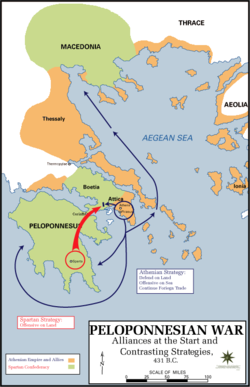
412 BC - 404 BC
% complete
Following decades of internecine conflict in Greece, the balance of power between Greece and Persia was largely restored to Persia, as rival Greek states sought Persian gold and naval support against one another.
Image source: Greco-Persian Wars
386 BC
% complete
This humiliating treaty undid all the Greek gains of the previous century, reversing the liberation of the Ionian Greeks achieved during and after the Persian Wars and returning them to Persian control.
Image source: Peace of Antalcidas
1972 - 2011
% complete
Modern historians from Finley (1972) and Sealey (1976) to Fine (1983), Kagan (1989), Holland (2006), and Roisman and Worthington (2011) have continually reassessed the causes, course, and consequences of the Persian Wars.
450 BC - 420 BC
% complete
Herodotus composed his Histories, the foundational narrative of the Persian Wars, including details such as the defense of the Anopoea path by roughly 1000 Phocians who reportedly fled when confronted by the Persians.
Image source: Histories (Herodotus)
430 BC - 425 BC
% complete
Herodotus records in his Histories that the Anopoea path was defended by roughly 1000 Phocians, who reportedly fled when confronted by the Persians. His account remains the principal narrative source for the battle of Thermopylae and the wider Persian Wars.
Image source: Herodotus
360 BC - 320 BC
% complete
Theopompus, another 4th-century BC author, appears to reject the existence of the Peace of Callias treaty. Alongside Callisthenes, he contributed to the enduring controversy over whether Athens and Persia had formally concluded peace after the wars of the Delian League.
360 BC - 330 BC
% complete
Callisthenes, a 4th-century BC Greek historian, appears to reject the existence of the Peace of Callias. Even during his own time, the idea of the treaty was controversial among writers examining the aftermath of the Persian Wars.
1972 - 2016
% complete
From Finley (1972) and Sealey (1976) through Fine (1983), Kagan (1989), Holland (2006), and Roisman and Worthington (2011), a rich body of scholarship has accumulated on the Persian Wars, with online resources retrieved as recently as March 14, 2016.
1972
% complete
Moses Finley, a renowned historian of antiquity, published significant scholarship in 1972 that shaped modern interpretations of ancient Greek society, including the world of the Persian Wars.
Image source: Moses Finley
1976
% complete
Raphael Sealey published a scholarly history in 1976 examining the development of the Greek city-states, including the pivotal role of the Persian Wars in shaping Greek political life.
1983
% complete
John Van Antwerp Fine published an influential scholarly work in 1983 contributing to modern understanding of ancient Greece, including the period of the Persian Wars and their long-term consequences for the Greek world.
1989
% complete
Donald Kagan published major scholarship in 1989 on ancient Greek history and warfare, illuminating the military and political dynamics that followed the Persian Wars.
Image source: Donald Kagan
2006
% complete
Tom Holland published a widely read popular history in 2006 retelling the story of the Greco-Persian Wars, bringing the dramatic conflicts between Greece and Persia to a broad modern audience.
Image source: Tom Holland
2011
% complete
Joseph Roisman and Ian Worthington co-edited important scholarship published in 2011 on ancient Greek history, covering developments from the Persian Wars through the Hellenistic period.
Image source: Cassander
Mar 14, 2016
% complete
A web source relevant to the study of the Persian Wars was retrieved on March 14, 2016, reflecting the continued digital accessibility of scholarship on the Greco-Persian conflicts.
412 BC - 407 BC
% complete
During the later stages of internecine Greek conflict, Sparta negotiated with Persia for support, setting precedents that culminated in treaties which sacrificed the Greeks of Asia Minor to preserve Spartan hegemony.
Image source: Sparta
400 BC - 350 BC
% complete
Even during the 4th century BC, the idea of the Peace of Callias treaty was controversial. Two authors from that period, Callisthenes and Theopompus, appear to reject its existence, questioning whether such a formal agreement between Athens and Persia was ever concluded.
390 BC - 340 BC
% complete
Even during the 4th century BC, the idea of the Peace of Callias was controversial, with authors such as Callisthenes and Theopompus appearing to reject its existence, making it one of antiquity's most debated diplomatic agreements.
387 BC - 386 BC
% complete
This humiliating treaty, which undid all the Greek gains of the previous century, sacrificed the Greeks of Asia Minor so that the Spartans could maintain their hegemony over Greece. It marked a dramatic reversal of the achievements of the Persian Wars era.
386 BC
% complete
In the humiliating settlement known as the King's Peace, the Greeks of Asia Minor were sacrificed so that Sparta could maintain its hegemony over Greece, undoing the liberating legacy of the Persian Wars.
386 BC - 340 BC
% complete
The humiliating terms of the King's Peace, which undid the Greek gains of the previous century and sacrificed the Greeks of Asia Minor, sparked controversy that echoed even the earlier debate over the Peace of Callias, which 4th-century authors like Callisthenes and Theopompus rejected outright.
386 BC - 371 BC
% complete
The humiliating treaty undid all the Greek gains of the previous century and sacrificed the Greeks of Asia Minor so that the Spartans could maintain their hegemony over Greece, demonstrating how far Greek unity had eroded since the Persian Wars.
Or browse the full history timeline directory, with more than 2,000 topics.
This Persian Wars timeline was generated with the help of AI, using information found on the internet.
We work hard to keep these timelines accurate, but mistakes do get through. If you spot one, email us at [email protected] and we'll fix it for future visitors.
Generate yours with AI or build it from scratch, for free.
Export your timeline, add your own events, edit or remove AI-generated events, and much more
No credit card required.
Cancel anytime.
Cancel anytime.
You can create an unlimited number of timelines with up to 10 events on each one, customize how they look, export them to PDF, PNG, PowerPoint, CSV, and Excel, and share them with a link. Paid plans raise the event limit and add features like spreadsheet imports and collaborators.
Yes. You can cancel your subscription from your account page at any time, and you will not be charged again. Your subscription stays active for the rest of the period you already paid for.
Yes. We will email you a reminder before the annual renewal, and we will also email you a receipt.
Yes. You can email us within 15 days of any payment, and we will issue you a full refund.
Check out our pricing docs or send us an email anytime: [email protected].