-
Use Cases
-
Resources
-
Pricing
Alexander Graham Bell (1847–1922) was a Scottish-born inventor, scientist, and teacher of the deaf, best known for inventing the first practical telephone. His work revolutionized global communication and he also made significant contributions to aviation, hydrofoils, and education for the hearing impaired. More Less
Mar 3, 1847
% complete
Alexander Graham Bell was born in Edinburgh, Scotland, to Eliza Grace Symonds Bell and Alexander Melville Bell, a professor of elocution. Growing up in a family deeply interested in speech and communication, Bell developed an early fascination with sound and the mechanics of the human voice.
Image source: Alexander Graham Bell
1858
% complete
As a young boy, Bell built a simple device with rotating paddles and nail brushes to remove husks from wheat grain. His friend's father rewarded him with a small workshop, encouraging his inventive spirit from an early age.
1863
% complete
At just 16 years old, Bell took a position as a pupil-teacher of elocution and music at Weston House Academy in Elgin, Scotland. This early teaching experience deepened his interest in speech and sound, laying groundwork for his later work with the deaf.
1864 - 1865
% complete
Bell attended lectures at the University of Edinburgh, studying anatomy, physiology, and other subjects that would inform his understanding of human speech and hearing. He continued his scientific education at University College London shortly afterward.
Image source: University of Edinburgh
1867 - 1870
% complete
Both of Bell's brothers, Melville James Bell and Edward Charles Bell, died of tuberculosis within a few years of each other. Their deaths, along with Bell's own fragile health, prompted the family to emigrate to Canada in search of a healthier climate.
Aug 1870
% complete
Seeking a healthier environment after the deaths of two sons, the Bell family sailed to Canada and settled at a farm near Brantford, Ontario. The 'Henderson Home' became Bell's base as he began his North American career.
Oct 1872
% complete
Bell moved to Boston and opened his own school for teachers of the deaf, later becoming a professor of vocal physiology and elocution at Boston University School of Oratory. His work with deaf students, including Helen Keller's eventual connection to him, became a lifelong passion.
Jul 11, 1877
% complete
Bell married Mabel Gardiner Hubbard, a former student who had lost her hearing to scarlet fever as a child. Despite her deafness, their marriage was loving and enduring, producing four children, two of whom survived to adulthood.
Image source: Mabel Gardiner Hubbard
1873
% complete
Funded by Gardiner Greene Hubbard and Thomas Sanders, fathers of two of his deaf students, Bell worked on transmitting multiple telegraph messages simultaneously over a single wire using different musical pitches. This research ultimately led him toward voice transmission.
Nov 1874
% complete
Electrical machinist Thomas A. Watson was hired to assist Bell with his experiments. The partnership between the visionary Bell and the practical Watson proved essential to the development of the telephone.
Image source: Thomas A. Watson
Jun 2, 1875
% complete
While working on the harmonic telegraph, Bell and Watson discovered that a stuck reed transmitted recognizable sounds, including Watson plucking a reed. This accident convinced Bell that intelligible human speech could be carried electrically over a wire.
Image source: Invention of the telephone
Mar 7, 1876
% complete
Three days before demonstrating speech transmission, Bell was granted US Patent No. 174,465 for 'Improvement in Telegraphy,' often called one of the most valuable patents in history. It covered the method of transmitting vocal sounds telegraphically.
Image source: Bell Telephone Company
Mar 10, 1876
% complete
Using an improved liquid transmitter, Bell spoke the famous words 'Mr. Watson — come here — I want to see you' into the first telephone, and Watson clearly heard them in the next room. This marked the birth of the telephone.
Jun 25, 1876
% complete
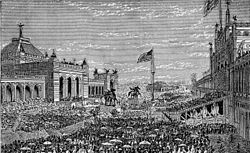
Bell demonstrated his telephone at the Philadelphia Centennial Exhibition, impressing judges including Emperor Pedro II of Brazil, who exclaimed upon hearing the device, 'My God, it talks!' The demonstration won Bell international attention and awards.
Image source: Centennial Exposition
Aug 10, 1876
% complete
Bell made a call over an extended telegraph line from Brantford, Ontario, to Paris, Ontario, about eight miles away, demonstrating that the telephone could work over real-world distances rather than just between adjacent rooms.
Image source: History of the telephone
Jul 9, 1877
% complete
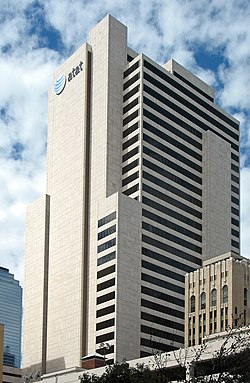
The Bell Telephone Company was organized by Gardiner Hubbard and others to commercialize the telephone. Bell married Mabel Hubbard on the same day, beginning both a business enterprise and a marriage that would shape his life.
Image source: AT&T
Jan 28, 1878
% complete
The world's first commercial telephone exchange opened in New Haven, Connecticut, serving 21 subscribers. This marked the beginning of telephone networks as a public utility and rapid growth for the Bell system.
Image source: Telephone exchange
1880
% complete
After winning the French Volta Prize of 50,000 francs for his invention of the telephone, Bell used the money to establish the Volta Laboratory in Washington, D.C., dedicated to research on communication for the deaf and new sound technologies.
Image source: Volta Laboratory and Bureau
Feb 19, 1880
% complete
Bell and Charles Sumner Tainter invented the photophone, which transmitted speech on a beam of light. Bell considered it his most important invention, as it prefigured modern fiber-optic communications, though it found little commercial use at the time.
Image source: Photophone
1885 - 1887
% complete
Working at the Volta Laboratory, Bell, Tainter, and Chichester Bell improved Edison's phonograph, creating the graphophone, which used wax cylinders instead of tinfoil for clearer, more durable sound recording.
Image source: Graphophone
1890
% complete
Bell founded this organization, now known as the Alexander Graham Bell Association for the Deaf and Hard of Hearing, to promote oral education methods for deaf children, reflecting his lifelong advocacy for speech-based instruction.
Image source: Alexander Graham Bell Association for the Deaf and Hard of Hearing
1891
% complete
Long fascinated by flight, Bell began experimenting with tetrahedral kite designs, believing they could support heavier loads. His aviation research intensified after 1900 and led to significant contributions to early powered flight in Canada.
Image source: Aerial Experiment Association
Sep 30, 1907
% complete
Bell founded the Aerial Experiment Association with Glenn Curtiss, Casey Baldwin, Thomas Selfridge, and Douglas McCurdy, funded by his wife Mabel. The group produced several pioneering aircraft, including the June Bug, which won the Scientific American trophy in 1908.
Feb 23, 1909
% complete
The Silver Dart, built by the Aerial Experiment Association at Baddeck, Nova Scotia, flew about half a mile over the ice of Bras d'Or Lake, piloted by J.A.D. McCurdy. It was the first controlled powered flight in Canada and the British Empire.
Image source: AEA Silver Dart
Sep 9, 1919
% complete
Bell and Casey Baldwin's hydrofoil HD-4 reached a speed of 70.86 miles per hour on Baddeck Bay, setting a world marine speed record that stood for a decade. It demonstrated Bell's continued inventive energy into his seventies.
Image source: HD-4
1880
% complete
France awarded Bell the prestigious Volta Prize of 50,000 francs for his invention of the telephone, along with the Legion of Honor. The prize money funded his subsequent research endeavors, including the photophone and the Volta Laboratory.
Image source: Volta Prize
Jan 7, 1896 - 1904
% complete
Bell served as the second president of the National Geographic Society, transforming its magazine into one of the world's most popular publications by introducing photographs and accessible writing under editor Gilbert Hovey Grosvenor.
Image source: National Geographic Society
1914
% complete
Bell was awarded the Edison Medal by the American Institute of Electrical Engineers for 'meritorious achievement in electrical science, engineering and arts' in recognition of his invention of the telephone and related contributions.
1922
% complete
Following his death, Bell's life and inventions have been celebrated worldwide, including the Alexander Graham Bell National Historic Site in Baddeck, Nova Scotia, his induction into halls of fame, and enduring recognition of the telephone as one of history's most transformative inventions.
Image source: Alexander Graham Bell National Historic Site
Aug 2, 1922
% complete
Bell died at his estate Beinn Bhreagh near Baddeck, Nova Scotia, at age 75 from complications of diabetes. As a tribute, all telephone service in the United States and Canada was silenced for one minute during his funeral.
Or browse the full history timeline directory, with more than 2,000 topics.
This Alexander Graham Bell timeline was generated with the help of AI, using information found on the internet.
We work hard to keep these timelines accurate, but mistakes do get through. If you spot one, email us at [email protected] and we'll fix it for future visitors.
Generate yours with AI or build it from scratch, for free.
Export your timeline, add your own events, edit or remove AI-generated events, and much more
No credit card required.
Cancel anytime.
Cancel anytime.
You can create an unlimited number of timelines with up to 10 events on each one, customize how they look, export them to PDF, PNG, PowerPoint, CSV, and Excel, and share them with a link. Paid plans raise the event limit and add features like spreadsheet imports and collaborators.
Yes. You can cancel your subscription from your account page at any time, and you will not be charged again. Your subscription stays active for the rest of the period you already paid for.
Yes. We will email you a reminder before the annual renewal, and we will also email you a receipt.
Yes. You can email us within 15 days of any payment, and we will issue you a full refund.
Check out our pricing docs or send us an email anytime: [email protected].