-
Use Cases
-
Resources
-
Pricing
320 BC
% complete
The Pella mosaic of a lion hunt from the late 4th century BC depicts Alexander as having blond hair. The mosaic contains empty spots where eye stones, which would have been made of semi-precious gems, were plucked out.
Image source: Alexander the Great
1886
% complete
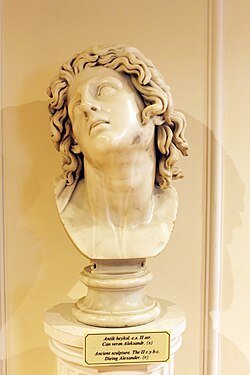
A head statue of Alexander was found in 1886. The Acropolis Museum suggests that trace amounts of red paint on it were most likely a base coat for golden hues to be painted over for his hair.
Image source: Acropolis Museum

1969
% complete
In 1969, Karl Schefold suggested that the sarcophagus associated with Abdalonymus may date from earlier than Abdalonymus's death, challenging its traditional dating.
Image source: Alexander Sarcophagus
2014
% complete
The 2014 discovery of an enormous tomb in northern Greece, at Amphipolis, dating from the time of Alexander the Great gave rise to speculation that it was originally intended to be the burial place of Alexander.
Image source: Kasta Tomb
2023
% complete
In 2023, British Museum experts suggested the possibility that a Greek temple at Girsu in Iraq was founded by Alexander the Great, extending evidence of his city-building activities.
Image source: Girsu
300 BC
% complete
Many of the cities founded by Alexander the Great became major cultural centers, many of which survived into the 21st century, spreading Greek culture across the ancient world.
300 BC - 1453
% complete
Through the Hellenistic period and the Roman Empire into modern Western culture, the Greek language became the lingua franca of the region and was the predominant language of the Byzantine Empire until its collapse in 1453 AD.
Image source: Koine Greek
250 BC
% complete
Greek astronomical instruments dating to the 3rd century BC were found in the Greco-Bactrian city of Ai Khanoum in modern-day Afghanistan, showing the reach of Hellenistic science into Central Asia.
Image source: Ai-Khanoum
250 BC
% complete
Several examples of capitals displaying Ionic influences can be seen as far as Patna, especially with the Pataliputra capital, dated to the 3rd century BC, evidencing Hellenistic artistic influence in India.
Image source: Pataliputra capital
250 BC - 500
% complete
The cosmopolitan art and mythology of Gandhara, spanning roughly the 3rd century BC to the 5th century AD, is among the most evident signs of direct contact between Hellenistic civilization and South Asia.
Image source: Gandhara
250 BC
% complete
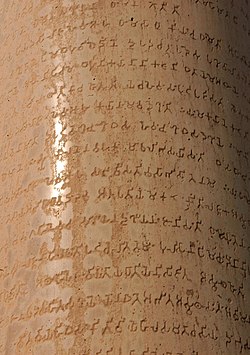
The Edicts of Ashoka directly mention Greeks within Ashoka's dominion as converting to Buddhism, along with the reception of Buddhist emissaries by Ashoka's contemporaries in the Hellenistic world.
Image source: Edicts of Ashoka
220 BC
% complete
A century or so after Alexander's death, many of the Alexandrias were thriving, with elaborate public buildings and substantial populations that included both Greek and local peoples.
200 BC
% complete
The Greek concept of a spherical Earth surrounded by the spheres of planets eventually supplanted the long-standing Indian cosmological belief of a disc consisting of four continents grouped around Mount Meru like flower petals.
330 - 1453
% complete
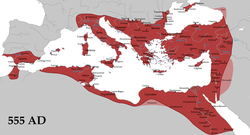
Aspects of Hellenistic culture remained evident in the traditions of the Byzantine Empire through the mid-15th century, when the empire collapsed in 1453 AD.
Image source: Byzantine Empire
100 BC - 200
% complete
In the first centuries after Alexander's death, probably in Alexandria, legendary material coalesced into the Alexander Romance, later falsely ascribed to Callisthenes and therefore known as Pseudo-Callisthenes.
Image source: Alexander Romance
60 BC
% complete
Diodorus Siculus, writing in the 1st century BC, is the earliest of the main surviving ancient historians whose works describe the life and campaigns of Alexander the Great.
Image source: Diodorus Siculus
100 - 150
% complete
Arrian, writing between the 1st and 2nd centuries AD, composed the Anabasis of Alexander, one of the most reliable surviving accounts of Alexander's campaigns.
Image source: Arrian
100 - 150
% complete
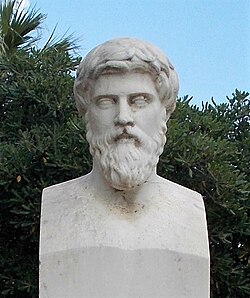
The biographer Plutarch, writing between the 1st and 2nd centuries AD, included a Life of Alexander in his Parallel Lives, shaping much of the later perception of Alexander's character.
Image source: Plutarch
250 - 1453
% complete
Legends of Alexander's exploits coalesced into the 3rd-century Alexander Romance, which went through over one hundred recensions, translations, and derivations in the premodern period, translated into almost every European vernacular and every language of the Islamic world.
300 - 400
% complete
Justin's work, dated as late as the 4th century, is the last of the major surviving ancient sources used by historians studying Alexander the Great.
Image source: Justin (historian)
340 - 360
% complete
The Itinerarium Alexandri is a 4th-century Latin description of Alexander the Great's campaigns, likely composed for the emperor Constantius II.
40 - 70
% complete
Quintus Curtius Rufus, writing in the mid-to-late 1st century AD, produced one of the major Latin accounts of Alexander the Great's campaigns and character.
Image source: Quintus Curtius Rufus
1958
% complete
In 1958, Ernst Badian countered William Tarn's arguments regarding Alexander, though his concern was the reliability of the sources for Alexander rather than the figure of the eunuch himself.
Image source: Ernst Badian
1998
% complete
A 1998 article in the New England Journal of Medicine attributed Alexander's death to typhoid fever complicated by bowel perforation and ascending paralysis.
Image source: Death of Alexander the Great
2003
% complete
In a 2003 BBC documentary investigating the death of Alexander, Leo Schep from the New Zealand National Poisons Centre proposed that white hellebore (Veratrum album), known in antiquity, may have been used to poison Alexander.
2004
% complete
A 2004 analysis suggested that Alexander's death could have been caused by pyogenic (infectious) spondylitis or meningitis, adding another medical explanation to the debate.
2010
% complete
A 2010 poisoning explanation proposed that the circumstances of Alexander's death were compatible with poisoning by water of the river Styx (modern-day Mavroneri in Arcadia, Greece) containing calicheamicin, a dangerous compound produced by bacteria.
2014
% complete
In a 2014 paper in the journal Clinical Toxicology, Leo Schep suggested Alexander's wine was spiked with Veratrum album, producing poisoning symptoms matching the course of events described in the Alexander Romance.
Or browse the full history timeline directory, with more than 2,000 topics.
This Alexander the Great timeline was generated with the help of AI, using information found on the internet.
We work hard to keep these timelines accurate, but mistakes do get through. If you spot one, email us at [email protected] and we'll fix it for future visitors.
Generate yours with AI or build it from scratch, for free.
Export your timeline, add your own events, edit or remove AI-generated events, and much more
No credit card required.
Cancel anytime.
Cancel anytime.
You can create an unlimited number of timelines with up to 10 events on each one, customize how they look, export them to PDF, PNG, PowerPoint, CSV, and Excel, and share them with a link. Paid plans raise the event limit and add features like spreadsheet imports and collaborators.
Yes. You can cancel your subscription from your account page at any time, and you will not be charged again. Your subscription stays active for the rest of the period you already paid for.
Yes. We will email you a reminder before the annual renewal, and we will also email you a receipt.
Yes. You can email us within 15 days of any payment, and we will issue you a full refund.
Check out our pricing docs or send us an email anytime: [email protected].