-
Use Cases
-
Resources
-
Pricing
Alexander Hamilton was an American statesman, military officer, and one of the Founding Fathers of the United States. Born in the Caribbean, he rose to prominence during the American Revolution as George Washington's aide-de-camp. As the first Secretary of the Treasury, he established the nation's financial system, founded the Federalist Party, co-authored The Federalist Papers, and shaped early American government before his death in a duel with Aaron Burr. More Less
Jan 11, 1755
% complete
Alexander Hamilton was born on the Caribbean island of Nevis, the illegitimate son of Rachel Faucette and James A. Hamilton, a Scottish trader. His exact birth year is disputed, with some sources citing 1757. He grew up in poverty amid the sugar plantations of the West Indies.
Image source: Alexander Hamilton
1768 - 1772
% complete
As a young teenager, Hamilton worked as a clerk at the import-export firm of Beekman and Cruger in Christiansted, St. Croix. He proved remarkably capable, managing the business during his employer's absences and gaining a practical education in commerce and finance.
Image source: Mary Cruger
Feb 19, 1768
% complete
Hamilton's mother died of fever in St. Croix, leaving him and his brother orphaned. Their father had earlier abandoned the family. The boys were separated, and Alexander was taken in by a merchant cousin who soon committed suicide.
Image source: Alexander Hamilton
Sep 1772
% complete
After a devastating hurricane struck St. Croix, Hamilton wrote a vivid letter about it that was published in the Royal Danish-American Gazette. Local leaders were so impressed by his talent that they pooled funds to send him to North America for an education.
Oct 1772
% complete
Hamilton sailed to North America, landing first in Boston before settling near Elizabethtown, New Jersey. He prepared for college under the tutelage of Francis Barber while immersing himself in the growing revolutionary ferment of the colonies.
1773 - 1774
% complete
Hamilton enrolled at King's College in New York City after being denied an accelerated program at the College of New Jersey. There he studied voraciously and began writing pamphlets supporting the patriot cause against British policies.
Image source: King's College London
Dec 15, 1774
% complete
Hamilton published 'A Full Vindication of the Measures of the Congress' followed by 'The Farmer Refuted,' anonymous pamphlets defending the Continental Congress's actions and attacking British authority, which established his reputation as a brilliant political writer.
Image source: A Full Vindication of the Measures of Congress
May 10, 1775
% complete
During a mob attack on Myles Cooper, the loyalist president of King's College, Hamilton gave an impromptu speech that distracted the crowd long enough for Cooper to escape, demonstrating both his oratorical skill and personal courage.
Image source: Liberty pole
Mar 14, 1776
% complete
Hamilton was commissioned as a captain in the New York Provincial Company of Artillery. He drilled his men rigorously and led them through the campaigns around New York City, including the Battle of White Plains.
Image source: New York Provincial Company of Artillery
Dec 26, 1776
% complete
Hamilton's artillery company crossed the Delaware River with Washington's army and fired on Hessian positions during the surprise attack on Trenton, contributing to a crucial early victory that revived American morale.
Image source: Battle of Trenton
Mar 1, 1777 - Feb 16, 1781
% complete
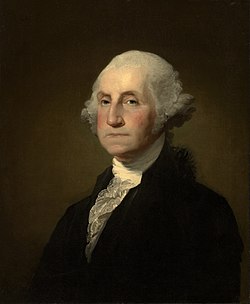
Washington invited Hamilton to join his staff as lieutenant colonel and aide-de-camp. For four years Hamilton handled correspondence, drafted orders, negotiated with generals and politicians, and became one of Washington's most trusted advisers.
Image source: George Washington
Oct 14, 1781
% complete
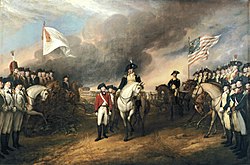
Seeking battlefield glory, Hamilton led a bayonet charge that captured British Redoubt No. 10 at Yorktown, Virginia. The action helped seal the siege that forced General Cornwallis's surrender, effectively ending major combat in the Revolutionary War.
Image source: Siege of Yorktown
Dec 14, 1780
% complete
Hamilton married Elizabeth Schuyler, daughter of General Philip Schuyler, a powerful New York landowner and politician. The marriage allied Hamilton with one of New York's most prominent families; the couple eventually had eight children.
Image source: Elizabeth Schuyler Hamilton
Nov 3, 1782 - Jul 1783
% complete
Hamilton was elected as a New York delegate to the Congress of the Confederation, where he became frustrated by the weak central government and began advocating for a stronger national constitution.
Image source: Congress of the Confederation
1783
% complete
After leaving Congress, Hamilton established a highly successful law practice in New York City, becoming known for defending Loyalists' rights and arguing for the rule of law even toward former enemies.
Sep 11, 1786 - Sep 14, 1786
% complete
Hamilton attended the Annapolis Convention, called to address interstate commerce problems. With only five states represented, he drafted the report urging all thirteen states to meet in Philadelphia to revise the Articles of Confederation, paving the way for the Constitutional Convention.
May 25, 1787 - Sep 17, 1787
% complete
As one of New York's three delegates, Hamilton spoke rarely but delivered a six-hour speech proposing a government modeled loosely on the British constitution. He signed the final Constitution as the only New Yorker still present.
Image source: Constitutional Convention (United States)
Oct 27, 1787 - Aug 16, 1788
% complete
Writing under the pseudonym 'Publius,' Hamilton authored 51 of the 85 Federalist essays, with James Madison and John Jay writing the rest. These papers defended the proposed Constitution and remain among the most influential works of American political thought.
Image source: The Federalist Papers
Jun 17, 1788 - Jul 26, 1788
% complete
At New York's ratifying convention, Hamilton led Federalist delegates against strong Anti-Federalist opposition. News that New Hampshire and Virginia had ratified shifted momentum, and New York narrowly approved the Constitution by a vote of 30 to 27.
Image source: Virginia Ratifying Convention
Sep 11, 1789 - Jan 31, 1795
% complete
President George Washington appointed Hamilton as the nation's first Secretary of the Treasury. In this role he built the financial architecture of the United States almost from scratch, becoming the most influential member of Washington's cabinet.
Image source: United States Secretary of the Treasury
Jan 9, 1790
% complete
Hamilton proposed that the federal government assume state debts and fund the national debt at par value to establish public credit. After a famous compromise brokered over dinner with Jefferson and Madison, involving relocation of the capital, Congress adopted the plan.
Image source: First Report on the Public Credit
Dec 14, 1790 - Feb 25, 1791
% complete
Hamilton advocated creating a national bank modeled on the Bank of England. Despite Madison and Jefferson's objections that it was unconstitutional, Washington accepted Hamilton's argument for implied powers and signed the bank into existence.
Image source: First Bank of the United States
1791 - 1792
% complete
Hamilton began an affair with Maria Reynolds, whose husband James extorted blackmail payments from him. When the scandal surfaced years later through journalist James Callender, it damaged Hamilton's reputation and contributed to his decision not to seek higher office.
Feb 23, 1791
% complete
Hamilton had helped draft the constitution of the Bank of New York in 1784, one of the first banks in the United States. It opened its doors in 1791 and became a cornerstone of New York's rise as a financial center.
Image source: BNY
Mar 22, 1791
% complete
Hamilton helped found the S.U.M., a private corporation promoting industrialization, and selected the Great Falls of the Passaic River as the site for what became Paterson, New Jersey — America's first planned industrial city, realizing his vision of an manufacturing economy.
Image source: Paterson, New Jersey
Dec 5, 1791
% complete
Hamilton's landmark report argued that government should actively promote industry through tariffs and subsidies, laying out an economic vision of a diversified economy that contrasted sharply with Jefferson's agrarian idealism.
Image source: Report on Manufactures
Aug 7, 1794 - Nov 1794
% complete
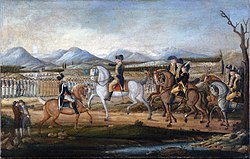
When western Pennsylvania farmers violently resisted federal excise taxes on whiskey, Hamilton accompanied President Washington at the head of a nearly 13,000-man militia force. The rebellion collapsed without significant bloodshed, affirming federal authority.
Image source: Whiskey Rebellion
Jan 31, 1795
% complete
Hamilton resigned from the cabinet to earn money for his growing family through private law practice, but he remained Washington's unofficial adviser and continued to shape Federalist policy behind the scenes.
May 15, 1796 - Sep 19, 1796
% complete
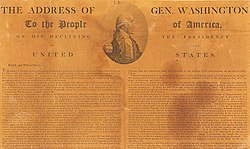
Washington asked Hamilton to draft his farewell address announcing his retirement from the presidency. Hamilton shaped the document's warnings against partisan division and permanent foreign alliances, one of the most celebrated documents in American history.
Image source: George Washington's Farewell Address
Aug 25, 1797
% complete
Accused of corruption related to James Reynolds's blackmail, Hamilton published a detailed confession of his affair to prove his financial innocence. The self-inflicted scandal humiliated his wife Eliza and destroyed any remaining presidential ambitions.
Jul 1798 - 1800
% complete
During tensions with France, President John Adams appointed Hamilton inspector general of the Army with the rank of major general. Hamilton effectively organized and commanded the new army, though the conflict ended without full-scale war.
Image source: Quasi-War
Oct 24, 1800
% complete
Hamilton circulated a scathing pamphlet attacking President John Adams, hoping to swing the election to Federalist candidate Charles Cotesworth Pinckney. Instead, the pamphlet discredited the party and helped Thomas Jefferson and Aaron Burr win the election.
Image source: 1800 United States presidential election
Feb 17, 1801
% complete
With Jefferson and Burr tied in electoral votes, Hamilton lobbied Federalists in the House to support Jefferson, whom he considered principled if wrong, over Burr, whom he called unprincipled. Jefferson won the presidency, and Burr's grudge against Hamilton deepened.
Nov 16, 1801
% complete
Hamilton founded the New York Evening Post as a Federalist newspaper, recruiting editor William Coleman. The paper, now the New York Post, survives today as one of America's oldest continuously published newspapers.
Image source: New York Post
Nov 23, 1801
% complete
Hamilton's eldest son Philip died in a duel defending his father's honor after a confrontation with lawyer George Eacker. Philip's death devastated the family; his sister Angelica suffered a mental breakdown from grief.
Image source: Philip Hamilton
Jul 11, 1804
% complete
After Aaron Burr lost the New York governor's race and blamed Hamilton's opposition, Burr challenged him to a duel. At Weehawken, New Jersey — the same site where Philip had fallen — Hamilton apparently fired into the air while Burr's shot mortally wounded him.
Image source: Burr–Hamilton duel
Jul 12, 1804
% complete
Hamilton died at William Bayard's house in Greenwich Village the day after the duel, surrounded by family and clergy. He received last rites and was buried in Trinity Churchyard. His death made Burr a pariah and ended Burr's political career.
Image source: Burr–Hamilton duel
Or browse the full history timeline directory, with more than 2,000 topics.
This Alexander Hamilton timeline was generated with the help of AI, using information found on the internet.
We work hard to keep these timelines accurate, but mistakes do get through. If you spot one, email us at [email protected] and we'll fix it for future visitors.
Generate yours with AI or build it from scratch, for free.
Export your timeline, add your own events, edit or remove AI-generated events, and much more
No credit card required.
Cancel anytime.
Cancel anytime.
You can create an unlimited number of timelines with up to 10 events on each one, customize how they look, export them to PDF, PNG, PowerPoint, CSV, and Excel, and share them with a link. Paid plans raise the event limit and add features like spreadsheet imports and collaborators.
Yes. You can cancel your subscription from your account page at any time, and you will not be charged again. Your subscription stays active for the rest of the period you already paid for.
Yes. We will email you a reminder before the annual renewal, and we will also email you a receipt.
Yes. You can email us within 15 days of any payment, and we will issue you a full refund.
Check out our pricing docs or send us an email anytime: [email protected].