-
Use Cases
-
Resources
-
Pricing
Andrew Johnson (1808–1875) was the 17th President of the United States, serving from 1865 to 1869. Born into poverty in North Carolina and trained as a tailor, he rose through Tennessee politics to become vice president. He assumed the presidency after Abraham Lincoln's assassination and clashed with Congress over Reconstruction policies, becoming the first U.S. president to be impeached by the House of Representatives, though he was acquitted by the Senate. More Less
Dec 29, 1808
% complete
Andrew Johnson was born into poverty in Raleigh, North Carolina, the son of Jacob Johnson, a laborer who died when Andrew was three. His humble origins shaped his lifelong identification with working-class Americans.
Image source: Andrew Johnson
1818
% complete
Johnson was apprenticed to a tailor in Raleigh at age ten. He ran away from his apprenticeship around 1824 and never received any formal schooling, learning to read later with help from his wife Eliza McCardle.
1826
% complete
After fleeing his apprenticeship, Johnson settled in Greeneville, Tennessee, where he established himself as a tailor and began his rise in local politics.
May 17, 1827
% complete
Johnson married sixteen-year-old Eliza McCardle in Greeneville. She taught him to read and write more effectively, becoming an important partner throughout his political career.
Image source: Eliza McCardle Johnson
1830
% complete
At just twenty-one years old, Johnson was elected mayor of Greeneville, launching his long career in public office.
Image source: Greeneville, Tennessee
1835
% complete
Johnson won election to the state legislature as a Democrat, championing small farmers and laborers against wealthy planters.
1843 - 1853
% complete
Johnson served five terms in Congress, supporting the annexation of Texas and the Compromise of 1850 while opposing federal spending on internal improvements.
Image source: United States House of Representatives
Oct 1853 - 1857
% complete
Johnson served two terms as governor of Tennessee, advocating public education reform and a state militia reorganization while building his national profile.
Image source: Governor of Tennessee
Oct 1857 - Mar 1862
% complete
In the Senate, Johnson became known for his advocacy of the Homestead Bill, which granted free land to settlers, and for defending the Union as secession loomed.
Image source: United States Senate
Dec 20, 1860
% complete
When Southern states seceded following Abraham Lincoln's election, Johnson alone among Southern senators remained in Washington and denounced secession as treason.
Image source: Secession in the United States
Mar 1862 - Mar 1865
% complete
Lincoln appointed Johnson military governor of occupied Tennessee, where he worked to restore Union control and supported gradual emancipation of slaves.
Image source: Governor of Tennessee
Jan 1, 1863
% complete
Lincoln's Emancipation Proclamation declared freedom for slaves in rebelling states, shifting the war's purpose and creating tensions with border-state Unionists like Johnson.
Image source: Emancipation Proclamation
Jun 1864
% complete
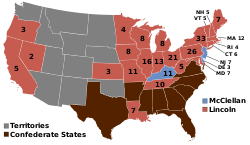
To broaden support during wartime, Lincoln chose Democrat Andrew Johnson of Tennessee as his running mate on the National Union Party ticket.
Image source: 1864 United States presidential election
Nov 8, 1864
% complete
Lincoln and Johnson decisively defeated Democrat George McClellan, winning reelection amid the Civil War.
Mar 4, 1865
% complete
Appearing intoxicated at his inauguration, reportedly due to illness and medication, Johnson gave rambling remarks that embarrassed him and raised doubts about his fitness for office.
Image source: Second inauguration of Abraham Lincoln
Apr 14, 1865 - Apr 15, 1865
% complete
John Wilkes Booth shot President Lincoln at Ford's Theatre; Lincoln died the next morning, making Johnson president during the critical early Reconstruction period.
Image source: Assassination of Abraham Lincoln
Apr 15, 1865
% complete
Johnson became the seventeenth president hours after Lincoln's death, inheriting the immense challenge of reconstructing the South after the Civil War.
May 29, 1865
% complete
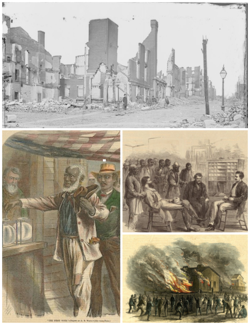
Johnson offered amnesty to most former Confederates who took a loyalty oath, requiring only wealthy planters to seek individual pardons, setting the stage for conflict with Congress.
Image source: Reconstruction era
Dec 6, 1865
% complete
The Thirteenth Amendment abolished slavery nationwide, though Johnson's tolerance of discriminatory Black Codes in the South angered Radical Republicans.
Apr 9, 1866
% complete
Congress overrode Johnson's veto to pass the Civil Rights Act, granting citizenship and equal rights to African Americans — the first major law enacted over a presidential veto.
Image source: Civil Rights Act of 1866
Aug 14, 1866
% complete
A rump convention in Philadelphia nominated Johnson for the presidency, but he declined the nomination, hoping instead to build a conservative coalition.
Mar 30, 1867
% complete
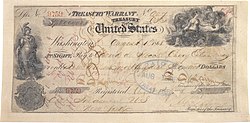
Secretary of State William Seward negotiated the purchase of Alaska from Russia for $7.2 million, a deal mocked as 'Seward's Folly' but later recognized as a strategic triumph.
Image source: Alaska Purchase
Feb 24, 1868
% complete
The House impeached Johnson for violating the Tenure of Office Act after he removed Secretary of War Edwin Stanton, making him the first U.S. president to be impeached.
Image source: Impeachment of Andrew Johnson
Mar 13, 1868 - May 16, 1868
% complete
Johnson's Senate trial lasted weeks before Chief Justice Salmon Chase; the vote fell one short of the two-thirds needed for conviction, acquitting Johnson by a single vote.
Jul 9, 1868
% complete
The Fourteenth Amendment granted citizenship to all persons born in the United States and guaranteed equal protection under the law, over Johnson's opposition.
Image source: Fourteenth Amendment to the United States Constitution
Nov 3, 1868
% complete
Grant's victory over Horatio Seymour signaled public endorsement of Republican Reconstruction policies that Johnson had resisted.
Image source: 1868 United States presidential election
Mar 4, 1869
% complete
Johnson declined to attend Grant's inauguration and returned to Tennessee, one of only a handful of presidents to skip their successor's swearing-in.
Feb 3, 1870
% complete
The final Reconstruction Amendment prohibited denying the vote based on race or previous servitude, cementing the constitutional legacy Johnson had opposed.
Nov 5, 1872
% complete
After failing to win a Senate seat, Johnson was elected to the House from Tennessee's at-large district, returning to Congress after his presidency.
Jan 1875 - Jul 31, 1875
% complete
Johnson became the only former president to serve in the Senate, taking his seat just months before his death and delivering a final defiant speech about his impeachment.
Jul 31, 1875
% complete
Johnson suffered a stroke while visiting family in Tennessee and died at age sixty-six. He was buried in Greeneville with a copy of the Constitution placed beneath his head.
Or browse the full history timeline directory, with more than 2,000 topics.
This Andrew Johnson timeline was generated with the help of AI, using information found on the internet.
We work hard to keep these timelines accurate, but mistakes do get through. If you spot one, email us at [email protected] and we'll fix it for future visitors.
Generate yours with AI or build it from scratch, for free.
Export your timeline, add your own events, edit or remove AI-generated events, and much more
No credit card required.
Cancel anytime.
Cancel anytime.
You can create an unlimited number of timelines with up to 10 events on each one, customize how they look, export them to PDF, PNG, PowerPoint, CSV, and Excel, and share them with a link. Paid plans raise the event limit and add features like spreadsheet imports and collaborators.
Yes. You can cancel your subscription from your account page at any time, and you will not be charged again. Your subscription stays active for the rest of the period you already paid for.
Yes. We will email you a reminder before the annual renewal, and we will also email you a receipt.
Yes. You can email us within 15 days of any payment, and we will issue you a full refund.
Check out our pricing docs or send us an email anytime: [email protected].