-
Use Cases
-
Resources
-
Pricing
Lyndon B. Johnson (LBJ) was the 36th President of the United States, serving from 1963 to 1969. Rising from humble beginnings in the Texas Hill Country, he built a career as a teacher, congressman, senator, Senate Majority Leader, and vice president before assuming the presidency after John F. Kennedy's assassination. His administration championed civil rights legislation, the Great Society programs, Medicare, Medicaid, and education reform, but his legacy was deeply complicated by the escalation of the Vietnam War. More Less
Aug 27, 1908
% complete
Lyndon Baines Johnson was born in a small farmhouse near Stonewall, Texas, to Samuel Ealy Johnson Jr. and Rebekah Baines Johnson. Raised in the Texas Hill Country, his early experiences with rural poverty deeply influenced his later political priorities.
Image source: Lyndon B. Johnson
Aug 1, 1930
% complete
Johnson graduated from Southwest Texas State Teachers College (now Texas State University) after working his way through school as a teacher and janitor. He briefly taught at a school for impoverished Mexican-American children in Cotulla, an experience that shaped his commitment to education.
Image source: Texas State University
Nov 1, 1931
% complete
Johnson moved to Washington, D.C., to work as a congressional secretary for Representative Richard Kleberg of Texas. In this role he learned the inner workings of Congress and built valuable political connections.
Image source: Richard M. Kleberg
Nov 17, 1934
% complete
Johnson married Lady Bird Taylor after a whirlwind courtship. She became an indispensable partner in his political career, managing his offices, advising him, and later campaigning tirelessly on his behalf.
Image source: Lady Bird Johnson
Jul 1, 1935
% complete
Johnson was appointed Texas director of the New Deal's National Youth Administration, helping young people find jobs and continue their education during the Great Depression. The position raised his public profile across the state.
Image source: National Youth Administration
Dec 1, 1941 - Jun 1, 1942
% complete
After Pearl Harbor, Johnson became the first sitting member of Congress to volunteer for active duty, serving as a lieutenant commander in the Navy. He earned the Silver Star for his conduct during a bombing mission in the Pacific.
Image source: Presidency of Lyndon B. Johnson
Apr 10, 1937
% complete
At age 28, Johnson won a special election to represent Texas's 10th congressional district, campaigning as a loyal supporter of President Franklin D. Roosevelt's New Deal programs.
Image source: United States House of Representatives
Nov 2, 1948
% complete
Johnson narrowly defeated Coke Stevenson in the Democratic primary runoff by just 87 disputed votes, earning the nickname 'Landslide Lyndon.' The controversial result was upheld, and he entered the Senate in January 1949.
Image source: 1948 United States Senate election in Texas
Jan 3, 1955
% complete
At age 46, Johnson became Senate Majority Leader, using his legendary persuasive skills known as 'the Johnson Treatment' to pass significant legislation, including the Civil Rights Act of 1957, the first such law since Reconstruction.
Image source: Party leaders of the United States Senate
Jul 2, 1955
% complete
Johnson suffered a massive heart attack at age 48 that nearly killed him. His recovery led him to quit smoking and adopt healthier habits, though he remained concerned about his health for the rest of his life.
Jul 1, 1960 - Jul 15, 1960
% complete
Johnson sought the Democratic presidential nomination but lost to Senator John F. Kennedy of Massachusetts, who secured the nomination at the party convention in Los Angeles.
Image source: 1960 Democratic Party presidential primaries
Nov 8, 1960
% complete
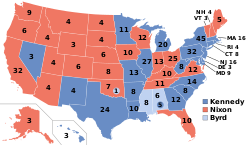
Kennedy chose Johnson as his running mate to balance the ticket geographically and regionally. They narrowly defeated Richard Nixon and Henry Cabot Lodge Jr., with Johnson winning his home state of Texas decisively.
Image source: 1960 United States presidential election
Jan 20, 1961
% complete
Johnson took office as the 37th vice president. Though often frustrated by the limited role, he chaired the Space Council, undertook diplomatic missions abroad, and championed civil rights and space program initiatives.
Image source: Lyndon B. Johnson
Nov 22, 1963
% complete
President Kennedy was assassinated while riding in a motorcade in Dallas, Texas. Johnson, who had been riding two cars behind, was rushed to safety aboard Air Force One.
Image source: Assassination of John F. Kennedy
Nov 22, 1963
% complete
Just over two hours after Kennedy's death, Johnson took the oath of office aboard Air Force One at Dallas Love Field, with Jacqueline Kennedy standing beside him, still wearing her bloodstained pink suit.
Image source: First inauguration of Lyndon B. Johnson
Jan 8, 1964
% complete
In his first State of the Union address, Johnson declared an 'unconditional war on poverty in America,' launching programs like Job Corps, Head Start, VISTA, and Community Action Agencies to combat economic hardship.
Image source: War on poverty
May 22, 1964
% complete
In a commencement speech at the University of Michigan, Johnson articulated his vision of a 'Great Society' that would end poverty and racial injustice and improve education, healthcare, and urban life for all Americans.
Image source: Great Society
Jul 2, 1964
% complete
Johnson signed landmark legislation outlawing discrimination based on race, color, religion, sex, or national origin, ending segregation in public places and banning employment discrimination. It was one of the most consequential civil rights laws in American history.
Image source: Civil Rights Act of 1964
Nov 3, 1964
% complete
Johnson won one of the most lopsided victories in American history, capturing 61 percent of the popular vote and 44 states against Republican Barry Goldwater, giving him a mandate for his liberal agenda.
Image source: 1964 United States presidential election
Jul 30, 1965
% complete
At a ceremony in Independence, Missouri, with former President Harry Truman at his side, Johnson signed amendments establishing Medicare and Medicaid, providing health insurance for the elderly and low-income Americans.
Aug 6, 1965
% complete
Following the Selma marches, Johnson signed the Voting Rights Act, which outlawed discriminatory voting practices like literacy tests and empowered federal oversight of elections, dramatically expanding Black voter registration in the South.
Aug 11, 1965 - Aug 16, 1965
% complete
Six days of unrest in the Watts neighborhood of Los Angeles left 34 dead and highlighted deep racial tensions in American cities, challenging Johnson's optimism about the pace of social progress.
Image source: Watts riots
Apr 4, 1968
% complete
The assassination of Dr. Martin Luther King Jr. in Memphis triggered riots in more than 100 cities. Johnson declared a national day of mourning and pushed through the Civil Rights Act of 1968, which banned housing discrimination, days later.
Image source: Assassination of Martin Luther King Jr.
Apr 11, 1968
% complete
One week after King's assassination, Johnson signed the Civil Rights Act of 1968, prohibiting discrimination in the sale, rental, and financing of housing, completing the trilogy of major civil rights laws of his presidency.
Aug 2, 1964 - Aug 4, 1964
% complete
Alleged attacks on U.S. destroyers by North Vietnamese patrol boats prompted Johnson to order retaliatory strikes and seek congressional authorization for military action in Southeast Asia.
Image source: Gulf of Tonkin incident
Aug 7, 1964
% complete
Congress overwhelmingly passed the resolution granting Johnson authority to use military force in Vietnam without a formal declaration of war. It became the legal foundation for escalating American involvement in the conflict.
Mar 2, 1965 - Nov 2, 1968
% complete
Johnson approved a sustained bombing campaign against North Vietnam intended to weaken its war-making capacity and pressure Hanoi into negotiations. The campaign lasted over three years but failed to achieve its objectives.
Image source: Operation Rolling Thunder
Mar 8, 1965
% complete
U.S. Marines landed at Da Nang, marking the beginning of large-scale American ground involvement in Vietnam. Troop levels escalated rapidly, reaching over half a million by 1968.
Image source: Vietnam War
Jan 30, 1968 - Sep 23, 1968
% complete
North Vietnamese and Viet Cong forces launched coordinated attacks across South Vietnam during the Tet holiday. Though militarily repelled, the offensive shattered American confidence that the war was being won and devastated public support for Johnson's policies.
Image source: Tet Offensive
Mar 31, 1968
% complete
In a televised address, Johnson stunned the nation by announcing a partial halt to bombing in Vietnam and declaring, 'I shall not seek, and I will not accept, the nomination of my party for another term as your president.'
Image source: Withdrawal of Lyndon B. Johnson from the 1968 United States presidential election
Jan 20, 1969
% complete
Johnson left office exhausted and unpopular due to the Vietnam War, though his domestic achievements were historic. He retired to his ranch in Stonewall, Texas, and began writing his memoirs, 'The Vantage Point.'
Image source: Presidency of Lyndon B. Johnson
Jan 22, 1973
% complete
Johnson died of a heart attack at age 64, just two days after what would have been the end of his second full term had he run. He was buried at the LBJ Ranch, leaving behind a complex legacy of transformative domestic reform and divisive war.
Or browse the full history timeline directory, with more than 2,000 topics.
This Lyndon B. Johnson timeline was generated with the help of AI, using information found on the internet.
We work hard to keep these timelines accurate, but mistakes do get through. If you spot one, email us at [email protected] and we'll fix it for future visitors.
Generate yours with AI or build it from scratch, for free.
Export your timeline, add your own events, edit or remove AI-generated events, and much more
No credit card required.
Cancel anytime.
Cancel anytime.
You can create an unlimited number of timelines with up to 10 events on each one, customize how they look, export them to PDF, PNG, PowerPoint, CSV, and Excel, and share them with a link. Paid plans raise the event limit and add features like spreadsheet imports and collaborators.
Yes. You can cancel your subscription from your account page at any time, and you will not be charged again. Your subscription stays active for the rest of the period you already paid for.
Yes. We will email you a reminder before the annual renewal, and we will also email you a receipt.
Yes. You can email us within 15 days of any payment, and we will issue you a full refund.
Check out our pricing docs or send us an email anytime: [email protected].