-
Use Cases
-
Resources
-
Pricing
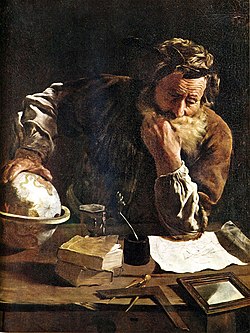
Archimedes of Syracuse (c. 287–212 BC) was an ancient Greek mathematician, physicist, engineer, inventor, and astronomer. Regarded as one of the greatest mathematicians of all time, he made groundbreaking contributions to geometry, hydrostatics, and mechanics, including the principle of buoyancy, the Archimedes screw, and pioneering methods that anticipated modern calculus. More Less
250 BC
According to Vitruvius, writing about two centuries after Archimedes' death, King Hiero II of Syracuse had commissioned a golden wreath for a temple to the immortal gods and supplied pure gold to be used by the goldsmith. Archimedes is credited with solving this problem, which concerns determining whether the goldsmith had adulterated the gold.
Image source: Archimedes
250 BC
In Proposition II of the Measurement of a Circle, Archimedes gives an approximation of the value of pi, showing that it is greater than 223/71 (approximately 3.1408) and less than 22/7 (approximately 3.1429), consistent with its actual value of approximately 3.1416.
Image source: Measurement of a Circle

250 BC
In the same treatise on the measurement of a circle, Archimedes asserts that the value of the square root of 3 lies between 265/153 (approximately 1.7320261) and 1351/780 (approximately 1.7320512), which he may have derived from a method similar to the one he used for approximating pi.
240 BC
Archimedes proposed a number system using powers of a myriad of myriads (100 million, i.e., 10,000 x 10,000) and concluded that the number of grains of sand required to fill the universe would be 8 vigintillion, or 8x1063 in modern notation.
Image source: The Sand Reckoner

212 BC
Archimedes died in 212 BC during the Roman siege of Syracuse. Alfred North Whitehead later remarked that 'in the year 1500 Europe knew less than Archimedes who died in the year 212 BC,' underscoring how far ahead of his time his work was.
1 AD - 99 AD
Scholars in the medieval Islamic world attribute to Archimedes a formula for calculating the area of a triangle from the length of its sides, known today as Heron's formula due to its first known appearance in the work of Heron of Alexandria in the 1st century AD. It may have been proven in a lost work of Archimedes that is no longer extant.
Image source: Heron's formula

150 AD
The earliest account to mention ships being set on fire, by the 2nd century CE satirist Lucian of Samosata, does not mention mirrors, and only says the ships were set on fire by artificial means, which may imply that burning projectiles were used rather than a mirror-based heat ray.
Image source: Archimedes' heat ray

170 AD
The first author to mention mirrors in connection with the burning of Roman ships at Syracuse is Galen, writing later in the same century as Lucian. His account helped establish the popular image of Archimedes using bronze mirrors to focus sunlight on enemy ships.
400 - 499
A different account of the wreath or crown problem is given in the Carmen de Ponderibus, an anonymous 5th-century Latin didactic poem on weights and measures once attributed to the grammarian Priscian. The poem describes the use of a hydrostatic balance to solve the problem of the crown.
500 - 599
Eutocius' commentaries on Archimedes' works in the 6th century opened them to wider readership for the first time, making the great mathematician's ideas accessible to scholars beyond a small circle of specialists.
This Archimedes timeline was generated with the help of AI, using information found on the internet.
We work hard to keep these timelines accurate, but mistakes do get through. If you spot one, email us at [email protected] and we'll fix it for future visitors.
Generate yours with AI or build it from scratch, for free.