-
Use Cases
-
Resources
-
Pricing
Trigonometry is the branch of mathematics that studies the relationships between the angles and sides of triangles. Its development spans over 3,000 years, beginning with ancient Babylonian astronomy and Egyptian surveying, advancing through Greek mathematicians like Hipparchus and Ptolemy who created early chord tables, flourishing during the Islamic Golden Age with the systematic study of all six trigonometric functions, and culminating in Renaissance Europe with Euler's analytical formulation of trigonometry using complex numbers. More Less
400 AD - 500 AD
% complete
Influential works from the 4th–5th century AD, known as the Siddhantas (of which there were five, the most important being the Surya Siddhanta), first defined the sine as the modern relationship between half an angle and half a chord, while also defining the cosine, versine, and inverse sine.
Image source: Surya Siddhanta
500 AD - 600 AD
% complete
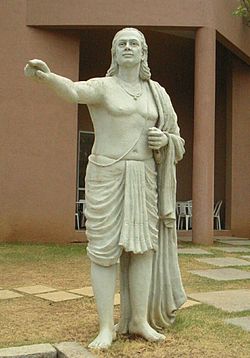
In Indian astronomy, the study of trigonometric functions flourished in the Gupta period, especially due to Aryabhata (6th century AD), who discovered the sine function, cosine function, and versine function.
Image source: Aryabhata
505 AD - 587 AD
% complete
In the 6th century, Varahamihira further developed the Indian tradition of trigonometry established by Aryabhata, building on the foundations laid by the Siddhantas and advancing astronomical applications of trigonometric concepts.
Image source: Varāhamihira
600 AD - 700 AD
% complete
In the 7th century, Bhaskara I produced a formula for calculating the sine of an acute angle without the use of a table, an important advance in practical computation of trigonometric values.
Image source: Bhāskara I's sine approximation formula
1340 AD - 1425 AD
% complete
Madhava of Sangamagrama (c. 1340 – c. 1425) made early strides in the analysis of trigonometric functions and their infinite series expansions. His works were expanded by his followers at the Kerala School up to the 16th century.
800 AD - 850 AD
% complete
In the early 9th century AD, Muhammad ibn Mūsā al-Khwārizmī produced accurate sine and cosine tables, making important contributions to the development of trigonometry in the Islamic world.
Image source: Al-Khwarizmi
940 AD - 998 AD
% complete
By the 10th century AD, in the work of Abū al-Wafā' al-Būzjānī, all six trigonometric functions were used. Mathematicians such as al-Khwarizmi and Abu al-Wafa made important contributions to the field during this era.
Image source: Abu al-Wafa' al-Buzjani
989 AD - 1079 AD
% complete
Al-Jayyani (989–1079) of al-Andalus wrote The book of unknown arcs of a sphere, which is considered "the first treatise on spherical trigonometry", a landmark work in the field.
Image source: Ibn Mu'adh al-Jayyani
1000 AD - 1050 AD
% complete
The method of triangulation was first developed by Muslim mathematicians, who applied it to practical uses such as surveying and Islamic geography, as described by Abu Rayhan Biruni in the early 11th century.
Image source: Triangulation
1048 AD - 1131 AD
% complete
In the late 11th century, Omar Khayyám (1048–1131) solved cubic equations using approximate numerical solutions found by interpolation in trigonometric tables, demonstrating an innovative analytical application of trigonometry.
Image source: Omar Khayyam
1201 AD - 1274 AD
% complete
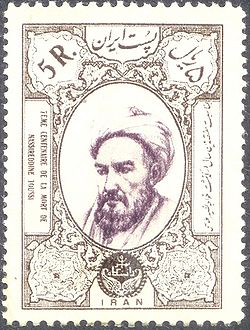
Nasir al-Din al-Tusi (1201–1274) was the first to treat trigonometry as an independent mathematical discipline, separate from astronomy, in his Treatise on the Quadrilateral. He developed spherical trigonometry into its present form, fundamentally transforming the field.
Image source: Nasir al-Din al-Tusi
1427 AD
% complete
The same method described earlier by Muslim mathematicians is detailed in Jamshīd al-Kāshī's Key of Arithmetic (1427), continuing the rich Islamic mathematical tradition of precise computation.
Image source: Jamshid al-Kashi
960 AD - 1279 AD
% complete
This embryonic state of trigonometry in China slowly began to change and advance during the Song dynasty (960–1279), where Chinese mathematicians began to express greater emphasis for the need of spherical trigonometry in calendrical science and astronomical calculations.
Image source: Science and technology of the Song dynasty
1031 AD - 1095 AD
% complete
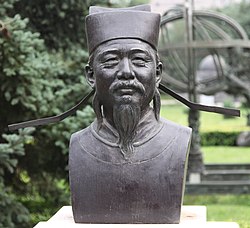
The polymath Chinese scientist, mathematician and official Shen Kuo (1031–1095) used trigonometric functions to solve mathematical problems of chords and arcs. His work in the lengths of arcs of circles provided the basis for later developments in Chinese spherical trigonometry.
Image source: Shen Kuo
1231 AD - 1316 AD
% complete
Sal Restivo writes that Shen Kuo's work in the lengths of arcs of circles provided the basis for spherical trigonometry developed in the 13th century by the mathematician and astronomer Guo Shoujing (1231–1316).
Image source: Guo Shoujing
1607 AD
% complete
Despite the achievements of Shen Kuo and Guo Shoujing's work in trigonometry, another substantial work in Chinese trigonometry would not be published again until 1607, with the dual publication of Euclid's Elements by Chinese official and astronomer Xu Guangqi (1562–1633) and the Italian Jesuit Matteo Ricci (1552–1610).
Image source: Xu Guangqi
1295 AD
% complete
A simplified trigonometric table, the "toleta de marteloio", was used by sailors in the Mediterranean Sea during the 14th–15th centuries to calculate navigation courses. It was described by Ramon Llull of Mallorca in 1295 and laid out in the 1436 atlas of Venetian captain Andrea Bianco.
Image source: Rule of marteloio
1342 AD
% complete
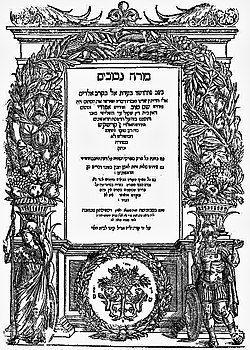
In 1342, Levi ben Gershon (Gersonides) wrote On Sines, Chords and Arcs, also proving the sine law for plane triangles (though after al-Tusi) and giving five-figure sine tables.
Image source: Gersonides
1436 AD
% complete
The simplified trigonometric table known as the "toleta de marteloio" was laid out in the 1436 atlas of Venetian captain Andrea Bianco, helping sailors calculate navigation courses across the Mediterranean Sea.
Image source: Bianco world map
1464 AD
% complete
Regiomontanus was the first mathematician in Europe to treat trigonometry as a distinct mathematical discipline, in his De triangulis omnimodis written in 1464, as well as his later Tabulae directionum which included the tangent function, unnamed. However, Regiomontanus translated al-Tusi's work into Latin without crediting him, effectively erasing al-Tusi's name from European historiography.
Image source: Regiomontanus
1551 AD - 1596 AD
% complete
The Opus palatinum de triangulis of Georg Joachim Rheticus, a student of Copernicus, was probably the first in Europe to define trigonometric functions directly in terms of right triangles instead of circles, with tables for all six trigonometric functions; this work was finished by Rheticus' student Valentin Otho in 1596.
Image source: Georg Joachim Rheticus
1595 AD
% complete
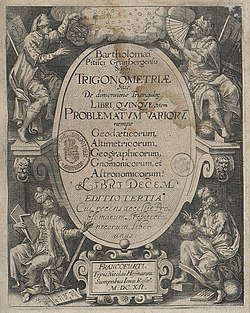
The term "trigonometry" first appeared as the title of the book Trigonometria (1595) by Bartholomaeus Pitiscus, establishing the name by which this branch of mathematics is now universally known.
Image source: Bartholomaeus Pitiscus
1601 AD - 1770 AD
% complete
In the 17th century, Isaac Newton and James Stirling developed the general Newton–Stirling interpolation formula for trigonometric functions, marking the shift of modern trigonometry during the western Age of Enlightenment.
Image source: Brahmagupta's interpolation formula
1620 AD
% complete
The prefix "co-" (in "cosine", "cotangent", "cosecant") is found in Edmund Gunter's Canon triangulorum (1620), which defines the cosinus as an abbreviation for the sinus complementi (sine of the complementary angle) and proceeds to define the cotangens similarly.
Image source: Edmund Gunter
1638 AD - 1675 AD
% complete
The works of James Gregory in the 17th century were very influential in the development of trigonometric series, contributing significantly to the analytic study of trigonometric functions.
Image source: James Gregory (mathematician)
1700 AD - 1800 AD
% complete
Also in the 18th century, Brook Taylor defined the general Taylor series and gave the series expansions and approximations for all six trigonometric functions. Colin Maclaurin's works in the 18th century were also very influential in the development of trigonometric series.
Image source: Brook Taylor
1702 AD
% complete
Johann Bernoulli found the relation between sin−1(z) and Log y in 1702, contributing to the emerging analytic treatment of inverse trigonometric functions.
Image source: Johann Bernoulli
1722 AD
% complete
Prior to Euler's landmark work, Roger Cotes had computed the derivative of sine in his Harmonia Mensurarum (1722), advancing calculus-based understanding of trigonometric functions.
Image source: Roger Cotes
1748 AD
% complete
Introductio in analysin infinitorum (1748) by Leonhard Euler was mostly responsible for establishing the analytic treatment of trigonometric functions in Europe, deriving their infinite series and presenting Euler's formula, bringing modern trigonometry to its present form.
Image source: Introductio in analysin infinitorum
1800 AD - 1830 AD
% complete
In the 19th century, Joseph Fourier discovered the Fourier series during his attempts to find solutions to the heat equation, paving the way for Fourier and harmonic analysis and profoundly expanding the applications of trigonometric functions.
Image source: Fourier series
Or browse the full history timeline directory, with more than 2,000 topics.
This History of Trigonometry timeline was generated with the help of AI, using information found on the internet.
We work hard to keep these timelines accurate, but mistakes do get through. If you spot one, email us at [email protected] and we'll fix it for future visitors.
Generate yours with AI or build it from scratch, for free.
Export your timeline, add your own events, edit or remove AI-generated events, and much more
No credit card required.
Cancel anytime.
Cancel anytime.
You can create an unlimited number of timelines with up to 10 events on each one, customize how they look, export them to PDF, PNG, PowerPoint, CSV, and Excel, and share them with a link. Paid plans raise the event limit and add features like spreadsheet imports and collaborators.
Yes. You can cancel your subscription from your account page at any time, and you will not be charged again. Your subscription stays active for the rest of the period you already paid for.
Yes. We will email you a reminder before the annual renewal, and we will also email you a receipt.
Yes. You can email us within 15 days of any payment, and we will issue you a full refund.
Check out our pricing docs or send us an email anytime: [email protected].