
-
Use Cases
-
Resources
-
Pricing
The history of weather forecasting spans thousands of years, beginning with ancient civilizations observing the skies and developing weather lore, progressing through the invention of instruments like the barometer and thermometer, the birth of scientific forecasting with telegraph networks in the 19th century, and culminating in today's sophisticated numerical models powered by satellites, radar, and supercomputers. More Less
1802
% complete
Luke Howard achieved the first series of classifications of clouds, creating a standard vocabulary that was essential for conveying accurate weather information among observers.
1845
% complete
Francis Ronalds invented instruments to continuously record variations in meteorological parameters using photography. His cameras were later supplied to observing stations from Kew Observatory, and his barograph had earlier been used by Robert FitzRoy.
Image source: Francis Ronalds
1875
% complete
Measurements of barometric pressure and the pressure tendency (the change of pressure over time) have been used in forecasting since the late 19th century, becoming a fundamental tool for predicting weather changes.
Image source: Barometer
1896
% complete
To convey accurate information, a standard vocabulary describing clouds became necessary. This was standardized in the International Cloud Atlas of 1896, building on Luke Howard's earlier classifications.
Image source: International Cloud Atlas
1980
% complete
Indices such as the Canadian Forest fire weather index, the American Haines Index, and the Australian Fire Danger Rating System have been developed to predict the areas more at risk of fire from natural or human causes.
2025
% complete
The American Haines Index, once used alongside other fire weather indices to assess fire risk, was dropped from use in 2025 as fire danger assessment methods evolved.
1835
% complete
The invention of the electric telegraph marked the beginning of the modern age of weather forecasting, allowing warnings of approaching storms to be transmitted far faster than the storms themselves could travel.
Image source: Electrical telegraph
1854
% complete
Robert FitzRoy was appointed in 1854 as chief of a new department within the Board of Trade to deal with the collection of weather data at sea as a service to mariners.
Image source: Robert FitzRoy
Oct 1859
% complete
A storm in October 1859 that caused the loss of the Royal Charter inspired Robert FitzRoy to develop charts to allow predictions to be made, which he called 'forecasting the weather', thus coining the term 'weather forecast'.
Image source: Royal Charter Storm
1861
% complete
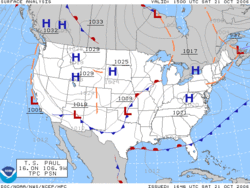
The first weather maps were produced later in the same year as the first daily newspaper forecasts, providing a visual representation of atmospheric conditions across regions.
Image source: Weather map
Feb 1861
% complete
FitzRoy's warning service for shipping was initiated in February 1861, using telegraph communications to alert mariners of dangerous conditions at sea.
Aug 1, 1861
% complete
The first-ever daily weather forecasts were published in The Times on August 1, 1861, bringing weather predictions directly to the general public for the first time.
Image source: Weather forecasting
1863
% complete
The 'Weather Book', which Robert FitzRoy published in 1863, was far in advance of the scientific opinion of the time, laying out his ideas on storm systems and forecasting methodology.
1911
% complete
In 1911, the Met Office began issuing the first marine weather forecasts via radio transmission, extending its warning services to ships at sea through new wireless technology.
Image source: Met Office
1925
% complete
In the United States, the first public radio forecasts were made in 1925 by Edward B., marking the beginning of regular broadcast weather reporting to American audiences.
Nov 1936
% complete
The world's first televised weather forecasts, including the use of weather maps, were experimentally broadcast by the BBC in November 1936, pioneering the presentation of weather information on television.
1947
% complete
Edward B. Fidler delivered early television weather reports in Cincinnati on the DuMont Television Network, an early milestone in American broadcast meteorology.
1949
% complete
After being experimentally introduced in 1936, televised weather forecasting was brought into practice by the BBC in 1949, following World War II, establishing it as a routine part of broadcasting.
1954
% complete
George Cowling gave the first weather forecast while being televised in front of the map in 1954, introducing the familiar style of a presenter explaining the weather live on screen.
1982
% complete
In 1982, John Coleman partnered with Landmark Communications CEO Frank Batten to launch The Weather Channel (TWC), a 24-hour cable network devoted to national and local weather reports.
Image source: The Weather Channel
1922
% complete
English scientist Lewis Fry Richardson published 'Weather Prediction By Numerical Process' in 1922, based on notes and derivations he worked on as an ambulance driver in World War I, founding the field of numerical weather prediction.
Image source: Lewis Fry Richardson
1955
% complete
Practical use of numerical weather prediction began in 1955, spurred by the development of programmable electronic computers that could perform the massive calculations required to model the atmosphere.
Image source: Numerical weather prediction
1963
% complete
As proposed by Edward Lorenz in 1963, long-range forecasts made at a range of two weeks or more cannot definitively predict the state of the atmosphere, owing to the chaotic nature of the fluid dynamics equations involved.
Image source: Edward Norton Lorenz
2024
% complete
In 2024, researchers presented 30-day ensemble simulations of the Madden–Julian oscillation, advancing the ability to model this major driver of tropical weather variability over extended ranges.
Image source: Madden–Julian oscillation
2009
% complete
In 2009, the US spent approximately $5.8 billion on weather forecasting, producing benefits estimated at six times as much, underscoring the enormous economic value of accurate predictions.
2022 - 2023
% complete
The European Centre for Medium-Range Weather Forecasts' Artificial Intelligence/Integrated Forecasting System (AIFS) appeared in 2022–2023, bringing AI-based prediction to one of the world's leading forecast centers.
2022 - 2023
% complete
Jua's EPT-family models appeared in 2022–2023, joining the growing roster of artificial intelligence models transforming operational weather forecasting.
2022 - 2023
% complete
WindBorne's WeatherMesh model appeared during 2022–2023, contributing to the rapid growth of AI-driven approaches to global weather prediction.
2022 - 2023
% complete
Nvidia's FourCastNet and Earth-2 platforms debuted in 2022–2023, applying GPU-accelerated artificial intelligence to high-resolution weather simulation and forecasting.
2022 - 2023
% complete
Google's GraphCast emerged in 2022–2023 as part of the wave of machine-learning weather models capable of producing fast, accurate global forecasts.
2022 - 2023
% complete
Huawei's Pangu-Weather model appeared in 2022–2023 as one of a new generation of AI-based weather forecasting systems demonstrating skill comparable to traditional physics-based models.
2024
% complete
In 2024, AIFS started to publish real-time forecasts, showing specific skill at predicting hurricane tracks, but lower-performing on the intensity changes of such storms relative to physics-based models.
Image source: European Centre for Medium-Range Weather Forecasts
2024
% complete
In 2024, a group of researchers at Google's DeepMind AI research laboratories published a paper in Nature describing their machine-learning model, called GenCast, which is expected to produce more accurate forecasts than the best traditional weather forecasting systems.
Image source: Google DeepMind
Or browse the full history timeline directory, with more than 2,000 topics.
This History of Weather Forecasting timeline was generated with the help of AI, using information found on the internet.
We work hard to keep these timelines accurate, but mistakes do get through. If you spot one, email us at [email protected] and we'll fix it for future visitors.
Generate yours with AI or build it from scratch, for free.
Export your timeline, add your own events, edit or remove AI-generated events, and much more
No credit card required.
Cancel anytime.
Cancel anytime.
You can create an unlimited number of timelines with up to 10 events on each one, customize how they look, export them to PDF, PNG, PowerPoint, CSV, and Excel, and share them with a link. Paid plans raise the event limit and add features like spreadsheet imports and collaborators.
Yes. You can cancel your subscription from your account page at any time, and you will not be charged again. Your subscription stays active for the rest of the period you already paid for.
Yes. We will email you a reminder before the annual renewal, and we will also email you a receipt.
Yes. You can email us within 15 days of any payment, and we will issue you a full refund.
Check out our pricing docs or send us an email anytime: [email protected].