-
Use Cases
-
Resources
-
Pricing
Augustine of Hippo (354–430 AD) was a Roman African philosopher, theologian, and bishop whose writings—including Confessions and The City of God—profoundly shaped Western Christianity. His journey from Manichaeism and skepticism to conversion under Ambrose of Milan, followed by decades as Bishop of Hippo defending the faith against heresies, made him one of history's most influential Christian thinkers. More Less
100 - 400
% complete
During the first four centuries, early Christians opposed the deterministic views of fate held by Stoics, Gnostics, and Manichaeans, setting the stage for Augustine's own later battles with Manichaean thought.
Image source: Augustine of Hippo
418
% complete
The Council of Carthage in 418 affirmed Augustine's theological positions, particularly on grace and original sin, marking an early ecclesiastical endorsement of his doctrine.
Image source: Councils of Carthage
431
% complete
The Council of Ephesus in 431 further cemented the acceptance of Augustine's teachings within the broader Church, contributing to the growing authority of his theology after his death in 430.
Image source: Council of Ephesus
529
% complete
The Synod of Orange in 529 adopted a moderated form of Augustine's teachings on grace and free will, confirming his lasting influence on Western Christian doctrine.
590 - 604
% complete
In the sixth century, Pope Gregory the Great endorsed Augustine's theological justification concerning Jews, which became the Catholic Church's official policy and allowed Jewish communities to live in relative safety among Christian hosts up until the twelfth century.
Image source: Pope Gregory I
1097 - 1098
% complete
Anselm of Canterbury established in Cur Deus Homo the definition followed by the great 13th-century Schoolmen, that Original Sin is the 'privation of the righteousness which every man ought to possess,' separating it from concupiscence, with which some of Augustine's disciples—and later Luther and Calvin—had identified it.
Image source: Cur Deus Homo
1546
% complete
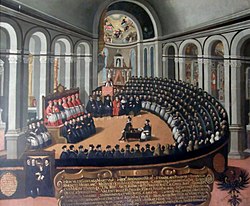
The Council of Trent in 1546 drew upon Augustinian theology in its responses to the Protestant Reformation, demonstrating the continued centrality of Augustine's thought to Catholic doctrinal definition.
Image source: Council of Trent
1567
% complete
In 1567, Pope Pius V condemned the identification of Original Sin with concupiscence, clarifying Catholic teaching in contrast to interpretations by followers of Augustine such as Luther and Calvin.
Image source: Pope Pius V
250 - 354
% complete
By the time Augustine of Hippo was born in 354, his family had held Roman legal status for at least a hundred years, situating him within an established provincial Roman household in North Africa.
1298
% complete
Augustine was canonized by popular acclaim, and in 1298 he was recognized as a Doctor of the Church by Pope Boniface VIII, formally enshrining his authority among the greatest teachers of Western Christianity.
Image source: Doctor of the Church
Jan, 1327
% complete
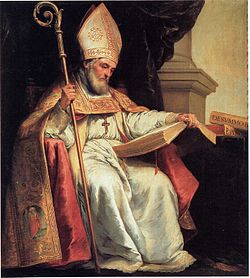
In January 1327, Pope John XXII issued the papal bull Veneranda Santorum Patrum, appointing the Augustinians guardians of the tomb of Augustine, called the Arca, in the Church of San Pietro in Ciel d'Oro in Pavia.
Image source: Pope John XXII
1362
% complete
In 1362, the Ark of Saint Augustine was remade and elaborately carved with bas-reliefs depicting scenes from Augustine's life, created by the sculptor Giovanni di Balduccio.
Image source: San Pietro in Ciel d'Oro
Oct, 1695
% complete
In October 1695, workmen in the Church of San Pietro in Ciel d'Oro in Pavia discovered a marble box containing human bones, including part of a skull, believed to be relics of Saint Augustine.
1724 - 1730
% complete
Pope Benedict XIII directed the Bishop of Pavia, Monsignor Pertusati, to make a formal determination regarding the authenticity of the relics discovered in 1695.
Image source: Pope Benedict XIII
1785 - 1799
% complete
After the Augustinians were expelled from Pavia in 1785, Augustine's ark and relics were brought to Pavia Cathedral in 1799, ensuring their continued preservation.
Image source: Pavia Cathedral
1842
% complete
In 1842, a portion of Augustine's right arm (cubitus) was secured from Pavia and returned to Annaba, Algeria—the site of ancient Hippo—reconnecting the saint's relics with the city of his episcopacy.
Image source: Annaba
1896
% complete
The Church of San Pietro in Ciel d'Oro was reconsecrated in 1896, when the relics of Augustine and the shrine were once again reinstalled in their historic home.
700 - 900
% complete
Under the influence of Bede, Alcuin, and Rabanus Maurus, Augustine's De catechizandis rudibus came to exercise an important role in the education of clergy at monastic schools, especially from the eighth century onwards.
1260 - 1273
% complete
Centuries after Augustine's death, Thomas Aquinas used the authority of Augustine's arguments in an attempt to define the conditions under which a war could be just, shaping the enduring tradition of just war theory.
Image source: Thomas Aquinas
1500 - 2026
% complete
Augustine's theological views extended far beyond his lifetime, influencing clergy throughout Europe and eventually those in the New World. His philosophical method, especially demonstrated in the Confessions, also shaped Continental philosophy throughout the 20th century, including thinkers like Hannah Arendt whose work on banality influenced analyses even of the Holocaust, and continues to inform contemporary critical theory today.
1730 - 1755
% complete
In the American colonies, Augustine's teachings were foundational to the religious precepts among prominent figures of The First Great Awakening of the eighteenth century, including Jonathan Edwards and George Whitefield.
Image source: First Great Awakening
1929
% complete
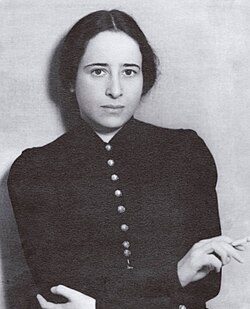
Hannah Arendt, who would become an influential 20th-century political theorist, wrote her doctoral dissertation in philosophy on Augustine and continued to rely on his thought throughout her career.
Image source: Hannah Arendt
1966
% complete
Frances Yates argued in her 1966 study The Art of Memory that a brief passage of the Confessions (10.8.12), in which Augustine describes walking up stairs and entering the vast fields of memory, indicates the ancient Romans used explicit spatial and architectural metaphors as mnemonic techniques.
Image source: Art of memory
1970
% complete
In 1970, Robert Markus argued that, for Augustine, a degree of external pressure being brought for the purpose of reform was compatible with the exercise of free will, shaping modern scholarly understanding of Augustine's views on religious coercion.
1670 - 1687
% complete
Marc-Antoine Charpentier composed the motet 'Pour St Augustin mourant', H.419, for 2 voices and continuo in 1687, and 'Pour St Augustin', H.307, for 2 voices and continuo during the 1670s, honoring the saint in music.
Image source: Marc-Antoine Charpentier
1750
% complete
Much of Augustine's dramatic conversion story was set to music in the oratorio La conversione di Sant'Agostino, composed by Johann Adolph Hasse in 1750.
Image source: Johann Adolph Hasse
1967
% complete
In 1967, American singer-songwriter Bob Dylan released a song entitled 'I Dreamed I Saw St. Augustine', bringing the saint's image into modern popular culture.
1993
% complete
English pop/rock musician Sting wrote 'Saint Augustine in Hell', part of his fourth solo studio album Ten Summoner's Tales released in 1993, continuing the saint's presence in contemporary music.
Image source: Ten Summoner's Tales
2010
% complete
In the 2010 TV miniseries Restless Heart: The Confessions of Saint Augustine, Augustine is played by Matteo Urzia (aged 15), Alessandro Preziosi (aged 25), and Franco Nero (aged 76).
2016
% complete
In 2016, the band The Chairman Dances released 'Augustine', a response song to Bob Dylan's 'I Dreamed I Saw St. Augustine', extending the musical dialogue about the saint into the 21st century.
Or browse the full history timeline directory, with more than 2,000 topics.
This Augustine of Hippo timeline was generated with the help of AI, using information found on the internet.
We work hard to keep these timelines accurate, but mistakes do get through. If you spot one, email us at [email protected] and we'll fix it for future visitors.
Generate yours with AI or build it from scratch, for free.
Export your timeline, add your own events, edit or remove AI-generated events, and much more
No credit card required.
Cancel anytime.
Cancel anytime.
You can create an unlimited number of timelines with up to 10 events on each one, customize how they look, export them to PDF, PNG, PowerPoint, CSV, and Excel, and share them with a link. Paid plans raise the event limit and add features like spreadsheet imports and collaborators.
Yes. You can cancel your subscription from your account page at any time, and you will not be charged again. Your subscription stays active for the rest of the period you already paid for.
Yes. We will email you a reminder before the annual renewal, and we will also email you a receipt.
Yes. You can email us within 15 days of any payment, and we will issue you a full refund.
Check out our pricing docs or send us an email anytime: [email protected].