-
Use Cases
-
Resources
-
Pricing
Christianity is a monotheistic religion centered on the life and teachings of Jesus of Nazareth. Emerging from Judaism in the 1st century CE in the Roman province of Judea, it spread rapidly across the Roman Empire and beyond. Key milestones include the Council of Nicaea (325 CE), the Great Schism between Eastern Orthodox and Roman Catholic churches (1054), the Protestant Reformation (1517), and the global missionary expansion that made Christianity the world's largest religion, with over two billion adherents today. More Less
30 AD
% complete
Christianity began in the 1st century, after the death of Jesus, as a Judaic sect with Hellenistic influence in the Roman province of Judaea. It originated as a Jewish movement within the context of late Second Temple Judaism.
Image source: History of Christianity
100 AD
% complete
Among the earliest Christian symbols, that of the fish or Ichthys seems to have ranked first in importance, as seen on monumental sources such as tombs from the first decades of the 2nd century.
Image source: Ichthys
100 AD - 300 AD
% complete
In the second and third centuries, figures like Justin Martyr, Irenaeus, Tertullian, and Clement of Alexandria insisted that there was one original apostolic teaching and that all rivals had deviated from it.
Image source: Proto-orthodox Christianity
200 AD
% complete
In the second century Apostolic Tradition, Hippolytus instructed Christians to pray at seven fixed prayer times: on rising, at the lighting of the evening lamp, at bedtime, at midnight, and at the third, sixth and ninth hours associated with Christ's Passion.
Image source: Apostolic Tradition
200 AD
% complete
Although the words 'Trinity' and 'Triune' do not appear in the Bible, beginning in the 3rd century theologians developed the term and concept to facilitate apprehension of New Testament teachings of God as Father, Son, and Holy Spirit. The word was in general use in the following century.
Image source: Trinity
300 AD - 500 AD
% complete
Creeds began as baptismal formulae and were later expanded during the Christological controversies of the 4th and 5th centuries to become statements of faith. This particular creed tradition developed between the 2nd and 9th centuries.
Image source: Creed
325 AD - 400 AD
% complete
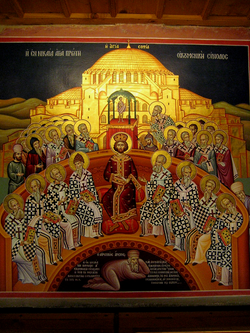
Through prayer, meditation, study and practice, the Christian community concluded that God must exist as both a unity and trinity, codifying this belief in ecumenical council at the end of the 4th century amid Christological controversies.
Image source: First Council of Nicaea
400 AD - 900 AD
% complete
Monasticism became a powerful force throughout Europe, giving rise to many early centers of learning, most famously in Ireland, Scotland, and Gaul, contributing to the Carolingian Renaissance of the 9th century.
Image source: Monasticism
400 AD - 500 AD
% complete
By the fifth century, Jewish-Christian sects and the Jewish-Christian gospels would be largely suppressed by the dominant sects in both Judaism and Christianity.
Image source: Jewish–Christian gospels
400 AD
% complete
Although the cross was known to the early Christians, the crucifix did not appear in use until the 5th century, becoming a central devotional image depicting the suffering of Christ.
Image source: Crucifix
500 AD
% complete
Evidence of cathedral schools dates back to the 6th century AD. From the 11th century onward, some older cathedral schools became universities, such as the University of Oxford, University of Paris, and University of Bologna.
Image source: Cathedral school
700 AD - 800 AD
% complete
Beginning in the 8th century, with the rise of Carolingian leaders, the Papacy sought greater political support in the Frankish Kingdom, forging an alliance between Rome and the Franks.
Image source: Pope Gregory V
910 AD
% complete
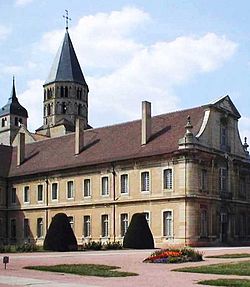
In the early 10th century, Western Christian monasticism was further rejuvenated through the leadership of the great Benedictine monastery of Cluny, which became a model for monastic reform.
Image source: Cluny Abbey
50 AD
% complete
The presence of Christianity in Africa began in the middle of the 1st century in Egypt, and by the end of the 2nd century it had spread to the region around Carthage, marking the faith's early expansion beyond the Levant.
Image source: Christianity in Africa
301 AD
% complete
King Tiridates III made Christianity the state religion in Armenia in the early 4th century, making Armenia the first officially Christian state. The faith had penetrated the country from at least the third century, and possibly earlier.
Image source: Arsacid dynasty of Armenia
1200 AD - 1400 AD
% complete
Between the 9th and 14th centuries, the Church of the East represented the world's largest Christian denomination by geographical extent, with dioceses stretching from the Mediterranean to India, Central Asia, and Tang China. It saw final expansion under the Mongol Empire in the 13th and 14th centuries.
Image source: Church of the East
1492 AD
% complete
The discovery of America by Christopher Columbus in 1492 brought about a new wave of missionary activity. Following the Age of Discovery (15th–17th century), Christianity expanded globally via missionary work, evangelism, immigration, and trade.
Image source: Christopher Columbus
1900 AD - 2026 AD
% complete
Since 1900, Christianity has spread rapidly in the Global South and Third World countries, primarily due to conversion. From 1960 to 2000, reported Evangelical Protestants grew three times the world's population rate, and twice that of Islam.
Image source: Christianity
2020 AD
% complete
With around 2.3 billion adherents according to a 2020 Pew Research Center estimation, split into Catholic, Protestant, and Eastern Orthodox branches, Christianity is the world's largest religion, comprising 28.8% of the world population. By 2020, 120 countries had Christian majorities, and by 2050 the Christian population is expected to exceed 3 billion, with Africa home to 1.1 billion Christians.
Image source: Christianity
100 AD - 300 AD
% complete
In the 2nd century, Christianity was criticized by Jews on various grounds, such as that the prophecies of the Hebrew Bible could not have been fulfilled by Jesus given his unsuccessful life. By the 3rd century, criticism had mounted further.
Image source: Criticism of Christianity
100 AD - 250 AD
% complete
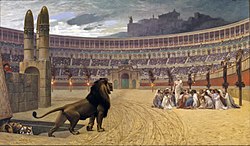
Church Fathers recorded accusations that Christians were responsible for droughts, famines, and plagues. Nevertheless, before the mid-3rd century, persecutions were often reactive, sporadic and local rather than systematic.
Image source: Persecution of Christians in the Roman Empire
600 AD - 700 AD
% complete
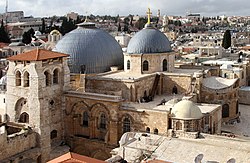
In the 7th century, Muslims conquered Syria (including Jerusalem), North Africa, and Spain, converting some Christian populations to Islam and placing the rest under a separate legal status.
Image source: Early Muslim conquests
1184 AD
% complete
Beginning around 1184, following the crusade against Cathar heresy, various institutions broadly referred to as the Inquisition were established with the aim of suppressing heresy and securing doctrinal unity through conversion and prosecution.
Image source: Inquisition
1200 AD - 1300 AD
% complete
In the thirteenth century, a new emphasis on Jesus' suffering, exemplified by the Franciscans' preaching, turned worshippers' attention towards Jews, on whom Christians placed blame for Jesus' death. Growing antipathy led to the expulsion of Jews from England in 1290, the first of many such expulsions in Europe.
Image source: Franciscans
1200 AD
% complete
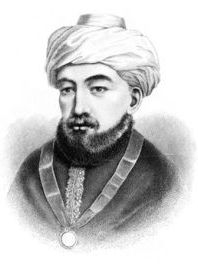
By the 12th century, the Mishneh Torah of Rabbi Moses Maimonides criticized Christianity on the grounds of idol worship, since Christians attributed divinity to Jesus, who had a physical body.
Image source: Mishneh Torah
1800 AD - 1900 AD
% complete
In the 19th century, Nietzsche began to write a series of polemics on the 'unnatural' teachings of Christianity, challenging its moral foundations and influencing later critics.
Image source: Philosophy of Friedrich Nietzsche
1900 AD - 2026 AD
% complete
Postchristianity is a term for the decline of Christianity, particularly in Europe, Canada, Australia, and to a minor degree the Southern Cone, in the 20th and 21st centuries, considered in terms of postmodernism.
Image source: Postchristianity
1927 AD
% complete
In the 20th century, philosopher Bertrand Russell expressed his criticism of Christianity in Why I Am Not a Christian, formulating his rejection of Christian doctrine. Chesterton also wrote in the early twentieth century defending the benefits of Christianity.
Image source: Why I Am Not a Christian
2017 AD
% complete
In 2017, Open Doors estimated approximately 260 million Christians are subjected annually to high, very high, or extreme persecution, with North Korea considered the most hazardous nation. A 2019 UK FCO report found persecution is highest in the Middle East, North Africa, India, China, North Korea, and Latin America.
Image source: Persecution of Christians
400 AD - 500 AD
% complete
The Church of the East and Oriental Orthodoxy both split from the wider church over differences in Christology during the 5th century, creating enduring divisions within Eastern Christianity.
700 AD - 800 AD
% complete
In the early 8th century, iconoclasm became a divisive issue when it was sponsored by the Byzantine emperors, sparking fierce debate over religious images within Eastern Christianity.
Image source: Byzantine Iconoclasm
1054 AD
% complete
The Eastern Orthodox Church and the Catholic Church separated in the East–West Schism of 1054, following internal conflict between the 7th and 13th centuries. This created the enduring distinction between Eastern and Western Christianity.
Image source: East–West Schism
1095 AD
% complete
From 1095 under the pontificate of Urban II, the First Crusade was launched, beginning an era of crusading that would shape relations between Christendom, Islam, and Byzantium.
Image source: First Crusade
1100 AD - 1300 AD
% complete
From the 11th to 13th centuries, Latin Christendom rose to the central role of the Western world, shaping medieval European society, politics, and culture.
Image source: Western Christianity
1274 AD - 1439 AD
% complete
The Second Council of Lyon (1274) and the Council of Florence (1439) attempted to reunite the churches, but in both cases the Eastern Orthodox refused to implement the decisions, and the two principal churches remain in schism to the present day.
1500 AD - 1600 AD
% complete
Within Italy, Poland, Lithuania, Transylvania, Hungary, Romania, and the United Kingdom, Unitarian Churches emerged from the Reformed tradition in the 16th century; the Unitarian Church of Transylvania is an example of such a denomination.
Image source: Unitarianism
1552 AD - 1700 AD
% complete
The Assyrian Church of the East, with an unbroken patriarchate established in the 17th century, claims continuity from the Church of the East—in parallel to the Catholic patriarchate established in the 16th century that evolved into the Chaldean Catholic Church.
Image source: Assyrian Church of the East
1700 AD - 1800 AD
% complete
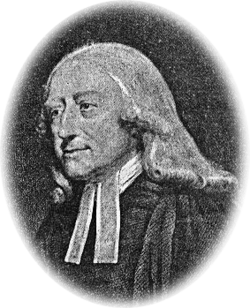
In the 18th century, Methodism grew out of Anglican minister John Wesley's evangelical revival movement, becoming one of the major Protestant denominations.
Image source: Methodism
1800 AD - 1900 AD
% complete
Nondenominational Christianity first arose in the 18th century through the Stone-Campbell Restoration Movement, with followers organizing themselves as 'Christians' and 'Disciples of Christ', often adhering to evangelical Christianity. Some churches connect to early 19th-century camp meetings in the Midwest and upstate New York.
Image source: Non-denominational Christianity
1964 AD
% complete
The Ancient Church of the East distinguished itself from the Assyrian Church of the East in 1964, adding another branch to the lineage descending from the historic Church of the East.
Image source: Ancient Church of the East
1400 AD - 1500 AD
% complete
The 15th-century Renaissance brought about a renewed interest in ancient and classical learning, setting intellectual foundations that would later fuel the Reformation.
Image source: Renaissance
Oct 31, 1517
% complete
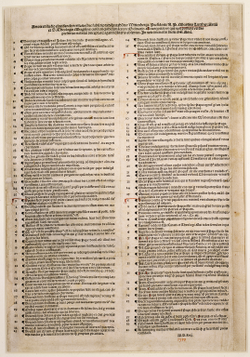
During the Reformation, Martin Luther posted the Ninety-five Theses in 1517 against the sale of indulgences, igniting the Protestant Reformation and challenging Catholic authority.
Image source: Ninety-five Theses
1521 AD
% complete
In 1521 the Edict of Worms condemned and excommunicated Luther and his followers, officially banning citizens of the Holy Roman Empire from defending or propagating his ideas, resulting in the schism of Western Christendom into several branches.
Image source: Diet of Worms
1534 AD
% complete
The Reformation in England began in 1534, when King Henry VIII had himself declared head of the Church of England, establishing Anglicanism as a distinct branch of Christianity.
Image source: English Reformation
1536 AD - 1541 AD
% complete
Beginning in 1536, the monasteries throughout England, Wales and Ireland were dissolved under Henry VIII, redistributing vast church properties and reshaping religious life in the British Isles.
Image source: Dissolution of the monasteries
1550 AD - 1700 AD
% complete
During the following centuries, competition between Catholicism and Protestantism became deeply entangled with political struggles among European states, fueling conflicts across the continent.
Image source: European wars of religion
1846 AD
% complete
The World Evangelical Alliance was founded in 1846 in London, representing an early form of greater cooperation between Christian groups that foreshadowed modern ecumenism.
Image source: World Evangelical Alliance
1925 AD
% complete
Congregationalist, Methodist, and Presbyterian churches united in 1925 to form the United Church of Canada, an example of institutional union in Christian ecumenism.
Image source: United Church of Canada
1947 AD
% complete
The Church of South India was formed in 1947 by the union of Anglican, Baptist, Methodist, Congregationalist, and Presbyterian churches, a landmark in ecumenical unity.
Image source: Church of South India
1948 AD
% complete
The Justice, Peace and Creation Commission of the World Council of Churches was founded in 1948 by Protestant and Orthodox churches, advancing ecumenical cooperation worldwide.
Image source: World Council of Churches
1965 AD
% complete
Steps towards reconciliation on a global level were taken in 1965 by the Catholic and Orthodox churches, mutually revoking the excommunications that marked their Great Schism in 1054.
Image source: Catholic–Eastern Orthodox relations
1999 AD
% complete
The Lutheran World Federation and the Catholic Church signed the Joint Declaration on the Doctrine of Justification in 1999 to address conflicts at the root of the Protestant Reformation. In 2006, the World Methodist Council adopted the declaration.
Image source: Joint Declaration on the Doctrine of Justification
Or browse the full history timeline directory, with more than 2,000 topics.
This Christianity timeline was generated with the help of AI, using information found on the internet.
We work hard to keep these timelines accurate, but mistakes do get through. If you spot one, email us at [email protected] and we'll fix it for future visitors.
Generate yours with AI or build it from scratch, for free.
Export your timeline, add your own events, edit or remove AI-generated events, and much more
No credit card required.
Cancel anytime.
Cancel anytime.
You can create an unlimited number of timelines with up to 10 events on each one, customize how they look, export them to PDF, PNG, PowerPoint, CSV, and Excel, and share them with a link. Paid plans raise the event limit and add features like spreadsheet imports and collaborators.
Yes. You can cancel your subscription from your account page at any time, and you will not be charged again. Your subscription stays active for the rest of the period you already paid for.
Yes. We will email you a reminder before the annual renewal, and we will also email you a receipt.
Yes. You can email us within 15 days of any payment, and we will issue you a full refund.
Check out our pricing docs or send us an email anytime: [email protected].