-
Use Cases
-
Resources
-
Pricing
The Twelve Apostles were the primary disciples of Jesus Christ, chosen to spread his teachings after his crucifixion and resurrection. This timeline traces key events in their lives, including their calling, the Great Commission, Pentecost, their missionary journeys, and their eventual martyrdoms or deaths. More Less
Jan 27 AD
% complete
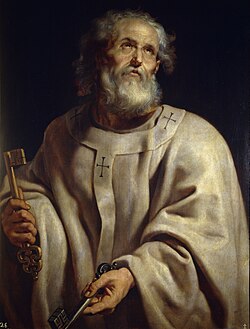
Jesus called Simon Peter and his brother Andrew while they were fishing on the Sea of Galilee, telling them to follow him and become 'fishers of men.' They immediately left their nets to become his first disciples.
Image source: Saint Peter
Feb 27 AD
% complete
Shortly after calling Peter and Andrew, Jesus summoned James and John, the sons of Zebedee, who left their fishing boat and their father to follow him. The brothers became part of Jesus' inner circle.
Image source: James the Great
Mar 27 AD
% complete
Jesus called Matthew (Levi), a tax collector despised by many Jews, to follow him. Matthew's calling demonstrated that Jesus welcomed social outcasts into his movement.
Image source: Matthew the Apostle
Apr 28 AD
% complete
After a night of prayer on a mountainside, Jesus chose twelve men from among his disciples, naming them apostles: Peter, Andrew, James, John, Philip, Bartholomew, Thomas, Matthew, James son of Alphaeus, Thaddaeus, Simon the Zealot, and Judas Iscariot.
Image source: Apostles in the New Testament
May 28 AD
% complete
Jesus delivered the Sermon on the Mount before crowds and his disciples, teaching the Beatitudes, the Lord's Prayer, and core ethical teachings that would shape the apostles' future preaching.
Image source: Sermon on the Mount
Jun 28 AD
% complete
While crossing the Sea of Galilee with the disciples, Jesus calmed a violent storm, astonishing the Twelve and deepening their understanding of his divine authority over nature.
Image source: Calming the storm
Apr 29 AD
% complete
Jesus miraculously fed five thousand people with five loaves and two fish, involving the apostles in distributing the food. The event was a pivotal sign of his power and compassion witnessed by all Twelve.
Image source: Feeding the multitude
Jul 29 AD
% complete
Near Caesarea Philippi, Peter declared that Jesus was 'the Christ, the Son of the living God.' Jesus affirmed this confession and declared he would build his church upon this rock, giving Peter a preeminent role among the Twelve.
Image source: Confession of Peter
Aug 29 AD
% complete
Jesus took Peter, James, and John up a high mountain, where he was transfigured before them, appearing radiant alongside Moses and Elijah. This event revealed his divine glory to the innermost circle of apostles.
Image source: Transfiguration of Jesus
Mar 30 AD
% complete
During the Last Supper period, Jesus predicted that Peter would deny him three times before the rooster crowed, foreshadowing the crisis of faith the apostles would face during the Passion.
Image source: Denial of Peter
Apr 30 AD
% complete
Judas Iscariot, one of the Twelve, agreed to betray Jesus to the chief priests in exchange for thirty pieces of silver, setting in motion the events leading to the crucifixion.
Image source: Judas Iscariot
Apr 30 AD
% complete
Jesus shared a final Passover meal with the Twelve in Jerusalem, instituting the Eucharist, washing their feet as an example of servanthood, and revealing that one of them would betray him.
Apr 30 AD
% complete
Jesus was crucified at Golgotha outside Jerusalem. Most of the apostles fled or watched from afar; only John is traditionally said to have remained at the cross with Mary, the mother of Jesus.
Image source: Crucifixion of Jesus
Apr 30 AD - May 30 AD
% complete
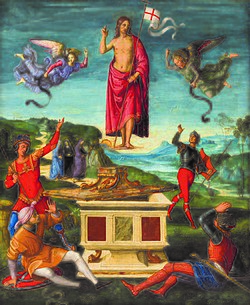
Following his resurrection, Jesus appeared repeatedly to the apostles over forty days, including to the gathered Eleven behind locked doors and to Thomas, who doubted until he saw the risen Christ.
Image source: Resurrection of Jesus
May 30 AD
% complete
In Jerusalem, the remaining eleven apostles cast lots between Joseph Barsabbas and Matthias to replace Judas Iscariot. Matthias was chosen, restoring the number of the Twelve.
Image source: Matthias the Apostle
May 30 AD
% complete
Forty days after the resurrection, Jesus ascended into heaven from the Mount of Olives before the apostles' eyes, instructing them to wait in Jerusalem for the Holy Spirit.
Image source: Ascension of Jesus
May 30 AD
% complete
By the Sea of Galilee, Jesus asked Peter three times if he loved him, restoring him after his denials and commissioning him to 'feed my sheep,' reaffirming Peter's leadership role.
Image source: Saint Peter
Jun 30 AD
% complete
On Pentecost, the Holy Spirit descended upon the apostles as tongues of fire, enabling them to speak in many languages. Peter preached boldly, and about three thousand people were baptized, marking the birth of the church.
Image source: Pentecost
Jun 30 AD
% complete
Peter and John healed a man lame from birth at the Beautiful Gate of the Jerusalem temple, drawing a large crowd and giving Peter the opportunity to preach about the risen Christ.
31 AD
% complete
The apostles were arrested by the Sanhedrin for preaching in Jesus' name but were freed overnight by an angel and resumed teaching in the temple courts, defying the authorities' orders.
Image source: Acts of the Apostles
37 AD
% complete
Through a visionary dream, Peter learned not to call any person unclean. He then baptized the Roman centurion Cornelius, opening the door for Gentiles to enter the church without first becoming Jews.
Image source: Cornelius the Centurion
44 AD
% complete
Imprisoned by Herod Agrippa, Peter was freed by an angel who led him past sleeping guards. He went to the house of Mary, mother of John Mark, where believers were praying for him.
49 AD
% complete
Church leaders, including Peter and James, met in Jerusalem to decide whether Gentile converts needed circumcision. They concluded that Gentiles need only abstain from certain practices, shaping Christianity's universal mission.
Image source: Council of Jerusalem
50 AD - 60 AD
% complete
Tradition holds that Andrew preached in regions north and east of the Black Sea, including Scythia, and later in Greece. He is honored as the patron saint of Russia, Ukraine, and Scotland.
Image source: Andrew the Apostle
52 AD - 72 AD
% complete
According to tradition, Thomas traveled to India, where he established churches along the Malabar Coast. The Saint Thomas Christians trace their origins to his missionary work there.
Image source: Saint Thomas Christians
34 AD
% complete
Stephen, a prominent disciple, became the first Christian martyr when he was stoned to death in Jerusalem. His death triggered persecution that scattered believers and spread the gospel beyond Judea.
Image source: Saint Stephen
44 AD
% complete
King Herod Agrippa I ordered the beheading of James, son of Zebedee, making him the first of the Twelve Apostles to be martyred. His death fulfilled Jesus' earlier prediction that he would drink the cup of suffering.
Oct 64 AD
% complete
During Nero's persecution of Christians after the Great Fire of Rome, Peter was crucified upside down, reportedly at his own request because he felt unworthy to die in the same manner as Jesus. Tradition places his burial beneath St. Peter's Basilica.
67 AD
% complete
Around the same era, Paul was beheaded in Rome under Nero. Church tradition records that most of the Twelve died as martyrs: Andrew was crucified in Greece, Philip died in Hierapolis, and Bartholomew was flayed alive in Armenia.
Image source: Paul the Apostle
Or browse the full history timeline directory, with more than 2,000 topics.
This Twelve Apostles timeline was generated with the help of AI, using information found on the internet.
We work hard to keep these timelines accurate, but mistakes do get through. If you spot one, email us at [email protected] and we'll fix it for future visitors.
Generate yours with AI or build it from scratch, for free.
Export your timeline, add your own events, edit or remove AI-generated events, and much more
No credit card required.
Cancel anytime.
Cancel anytime.
You can create an unlimited number of timelines with up to 10 events on each one, customize how they look, export them to PDF, PNG, PowerPoint, CSV, and Excel, and share them with a link. Paid plans raise the event limit and add features like spreadsheet imports and collaborators.
Yes. You can cancel your subscription from your account page at any time, and you will not be charged again. Your subscription stays active for the rest of the period you already paid for.
Yes. We will email you a reminder before the annual renewal, and we will also email you a receipt.
Yes. You can email us within 15 days of any payment, and we will issue you a full refund.
Check out our pricing docs or send us an email anytime: [email protected].