-
Use Cases
-
Resources
-
Pricing
Augustus, born Gaius Octavius in 63 BCE, was the founder of the Roman Empire and its first emperor. The grandnephew and adopted heir of Julius Caesar, he defeated Mark Antony and Cleopatra at the Battle of Actium, consolidated power, and ushered in the era of peace known as the Pax Romana. More Less
27 BC
% complete
Augustus created a regime that maintained relative peace and prosperity in the Latin West and Greek East for two centuries, initiating the celebrated Pax Romana, also known as the Pax Augusta.
Image source: Pax Romana
27 BC
% complete
While the era was celebrated as a golden age, historians note that the Augustan golden age myth may obscure the complicated political challenges faced by Augustus during his consolidation of power.
Image source: Augustus
27 BC - 312 AD
% complete
The Praetorian Guard, reorganized by Augustus as an imperial bodyguard, served successive emperors into the early 4th century before being disbanded by Constantine the Great.
Image source: Praetorian Guard
Jan 16, 27 BC
% complete
During his reign, Augustus established the principate, a style of government in which the emperor showed nominal deference to the Senate while holding ultimate power himself. This system endured as the defining structure of imperial Rome until the Crisis of the Third Century.
Image source: Principate
14 AD
% complete
His regime laid the foundations of a concept of universal monarchy that influenced the Byzantine and Holy Roman Empires down to their dissolutions in 1453 and 1806, respectively.
14 AD
% complete
After Augustus's death, the surname Caesar and the title augustus became permanent titles of Roman rulers for fourteen centuries, used in both Rome and Constantinople following the Empire's division.
Image source: Augustus (title)
14 AD - 284 AD
% complete
For three centuries after Augustus, emperors preferred his title of civilis princeps, maintaining the fiction of deference to republican norms, until they adopted the title domini ('lords') beginning with Diocletian.
284 AD
% complete
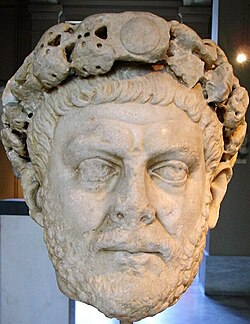
Beginning with Diocletian, Roman emperors abandoned the modest style of civilis princeps favored since Augustus and adopted the more openly autocratic title domini ('lords'), marking a shift in imperial ideology.
Image source: Diocletian
65 AD
% complete
The 1st-century poet Lucan argued that Caesar's victory over Pompey and the death of Cato the Younger in 46 BC marked the end of traditional liberty in Rome, framing the rise of imperial rule as a loss of freedom.
Image source: Lucan
200 AD
% complete
The 3rd-century historian Cassius Dio acknowledged Augustus as a benign, moderate ruler, yet like most other post-Augustan historians he viewed him fundamentally as an autocrat.
Image source: Cassius Dio
1250
% complete
The c. 1250 Golden Legend hagiographical anthology promoted the legend of the Tiburtine Sibyl, in which Augustus had an alleged vision of Jesus and his mother Mary, blending imperial history with Christian prophecy.
Image source: Tiburtine Sibyl
1300
% complete
Medieval iconography depicted Augustus wearing a papal tiara as he ordered geographers to create a survey of the world, reflecting the emperor's elevated status in medieval imagination.
1350
% complete
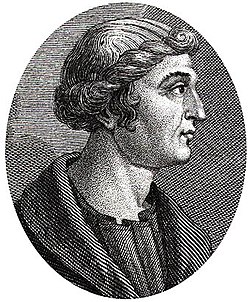
Petrarch viewed Augustus as a righteous ruler, an idea widely accepted in Renaissance humanist literature until the 16th century, when more negative views found acceptance.
Image source: Petrarch
1734
% complete
French political philosopher Montesquieu remarked that Augustus was a coward in battle, contributing to a critical Enlightenment-era assessment of the first emperor's military character.
Image source: Montesquieu
1599
% complete
Shakespeare's 1599 play Julius Caesar features the character of Octavius, presenting the future emperor on the Elizabethan stage in the aftermath of Caesar's assassination.
Image source: Julius Caesar (play)
1607
% complete
In Shakespeare's 1607 play Antony and Cleopatra, Octavius appears under the name Caesar as a weak, cowardly, and manipulative foe to Antony, shaping literary perceptions of Augustus for generations.
Image source: Antony and Cleopatra
1765
% complete
Louis XV disliked van Loo's painting of Augustus closing the gates of Janus and had it removed from his hunting lodge, though the work would later gain renewed significance.
Image source: Charles-André van Loo
1765
% complete
In 1765 Louis XV commissioned French painter Charles-André van Loo to create a painting depicting Augustus closing the gates of the Temple of Janus in the Forum, a signal that Rome was at peace.
Mar 25, 1802
% complete
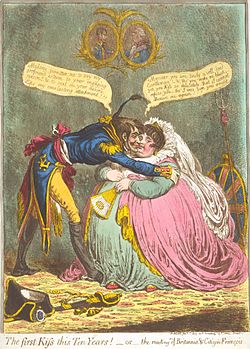
Historian Mary Beard contends that van Loo's painting of Augustus at the Temple of Janus served as 'an appropriate backdrop' during the signing of the 1802 Treaty of Amiens during the Napoleonic Wars.
Image source: Treaty of Amiens
1934
% complete
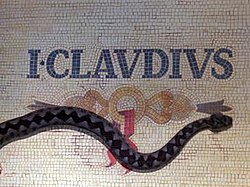
Robert Graves's 1934 novel I, Claudius depicts the older Augustus in a far more sympathetic light as he is outmaneuvered by his murderous wife Livia, though he plays only a supporting character.
Image source: I, Claudius
1937 - 1938
% complete
In 1937–1938 Benito Mussolini held an 'Augustan exhibition' in Rome to celebrate the bimillenary of the birth of Augustus, an event which influenced architectural trends of Fascist Italy.
Image source: Exhibition of the Fascist Revolution
1963
% complete
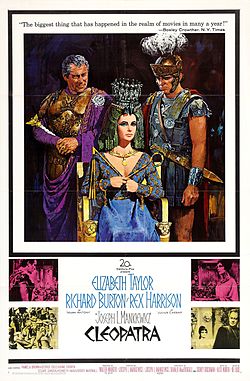
Negative portrayals of Augustus are perhaps based on ancient sources reflecting the propaganda war between Antony and Octavian, manifested in the cold performance of actor Roddy McDowall as Octavian in the 1963 film Cleopatra.
Image source: Cleopatra (1963 film)
1976
% complete
The 1976 television adaptation of Robert Graves's I, Claudius depicts the older Augustus sympathetically as he is outmaneuvered by his wife Livia, bringing the sympathetic portrayal to a wide audience.
Image source: I, Claudius (TV series)
1800 - 1900
% complete
During the 19th century Augustus was widely considered a reformer who brought peace and prosperity after the chaos caused by a failed Republic, marking a broadly positive reassessment of his reign.
1800 - 1821
% complete
Though 19th-century opinion generally praised Augustus, Napoleon Bonaparte emulated Julius Caesar as a role model and remained slightly dismissive of Augustus as a model ruler.
Image source: Napoleon
1930 - 1949
% complete
Attitudes about Augustus shifted during the 20th century, as scholarship during the upheavals of fascism in the 1930s and 1940s generally held negative views about his seizure of power.
1939
% complete
Ronald Syme sparked debate by publishing the then controversial The Roman Revolution (1939) at the onset of the Second World War, acknowledging the political climate that impacted his research.
Image source: The Roman Revolution
1952
% complete
Syme's The Roman Revolution was not widely circulated in continental Europe until 1952, but this and other works by Syme left a major impact on scholarship in the English-speaking world and its views on Augustus.
2000
% complete
Historians Eck and Takács stress that Augustus was responsible for establishing a standing professional army, the dynastic principle of imperial succession, the embellishment of the capital at the emperor's expense, and relative peace and prosperity for over two centuries.
2014
% complete
In 2014 historian Adrian Goldsworthy stressed that, in modern terms, Augustus was essentially a military dictator, but argued he was no more ruthless than 'other warlords' and that comparing him to Mussolini or other modern dictators is anachronistic and inaccurate.
Image source: Adrian Goldsworthy
Or browse the full history timeline directory, with more than 2,000 topics.
This Augustus timeline was generated with the help of AI, using information found on the internet.
We work hard to keep these timelines accurate, but mistakes do get through. If you spot one, email us at [email protected] and we'll fix it for future visitors.
Generate yours with AI or build it from scratch, for free.
Export your timeline, add your own events, edit or remove AI-generated events, and much more
No credit card required.
Cancel anytime.
Cancel anytime.
You can create an unlimited number of timelines with up to 10 events on each one, customize how they look, export them to PDF, PNG, PowerPoint, CSV, and Excel, and share them with a link. Paid plans raise the event limit and add features like spreadsheet imports and collaborators.
Yes. You can cancel your subscription from your account page at any time, and you will not be charged again. Your subscription stays active for the rest of the period you already paid for.
Yes. We will email you a reminder before the annual renewal, and we will also email you a receipt.
Yes. You can email us within 15 days of any payment, and we will issue you a full refund.
Check out our pricing docs or send us an email anytime: [email protected].