-
Use Cases
-
Resources
-
Pricing
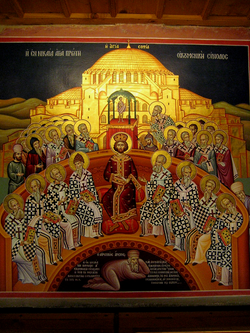
The First Council of Nicaea was the first ecumenical council of the Christian Church, convened by Roman Emperor Constantine I in 325 AD in Nicaea (modern-day İznik, Turkey). It addressed the Arian controversy over the divinity of Jesus Christ, produced the original Nicene Creed, standardized church doctrine, and set the date for Easter celebration. More Less
Jan 1, 100 - Dec 31, 200
% complete
In the 2nd century, the writings of Polycarp, Ignatius, and Justin Martyr expressed a general notion of a 'divine three' in some sense, laying early conceptual groundwork for later Trinitarian theology that would be debated at Nicaea.
Image source: First Council of Nicaea
Jan 1, 200 - Dec 31, 220
% complete
Over a century before the Council of Nicaea, Tertullian used the term 'Trinity' (trinitas in Latin) in his writings, contributing to the developing theological vocabulary surrounding the nature of God.
Jan 1, 220 - Dec 31, 250
% complete
The theologian Origen employed the term 'Trinity' (Τριάς in Greek) in his writings over a century before Nicaea, further establishing the concept of a divine three within Christian theological discourse.
Jan 1, 115 - Dec 31, 128
% complete
As early as Pope Sixtus I in the 2nd century, some Christians had set Easter to a Sunday in the lunar month of Nisan, an early divergence in Easter dating practices that would later be addressed at the Council of Nicaea.
Jan 1, 250 - Dec 31, 300
% complete
By the late 3rd century, some Christians began to express dissatisfaction with what they took to be the disorderly state of the Jewish calendar, fueling debates about how the date of Easter should be computed independently.
Jun 1, 325 - Aug 25, 325
% complete
No details for the computation of Easter were specified at Nicaea; these were worked out in practice, a process that took centuries and generated numerous controversies, some of which remain unresolved to this day.
Image source: Date of Easter
Jan 1, 326 - Dec 31, 1582
% complete
After Nicaea declined to specify details for computing Easter, the calculation was worked out in practice over centuries, generating numerous controversies—some of which remain unresolved even today.
Jan 1, 360 - Dec 31, 400
% complete
That Christians did not all immediately adopt the Nicene approach to Easter is revealed by the existence of sermons, canons, and tracts written against the protopaschite practice in the late 4th century.
Image source: Quartodecimanism
Jan 1, 370 - Dec 31, 400
% complete
Sermons composed in the late 4th century against the protopaschite practice demonstrate that many Christians continued celebrating Easter according to older customs long after the Council of Nicaea.
Jan 1, 370 - Dec 31, 400
% complete
Canons written in the late 4th century against protopaschite practice reveal the persistence of pre-Nicene Easter customs and the ongoing effort of church authorities to enforce uniform observance.
Image source: Canon law
Jan 1, 370 - Dec 31, 400
% complete
Tracts directed against protopaschite practice in the late 4th century form part of the literary evidence that adoption of the Nicene Easter dating was gradual rather than immediate across Christendom.
Image source: Tract (literature)
Jan 1, 2000
% complete
Because Nicaea specified no details for computing Easter, the process worked out in practice generated numerous controversies over centuries—some of which remain unresolved between Eastern and Western churches today.
Jan 1, 300 - Dec 31, 439
% complete
Fifth-century church historian Socrates of Constantinople gives the date of the Council of Nicaea's opening as 20 May 325, though it may have been later in June; his account remains a key primary source for the council's chronology.
Jan 1, 386 - Dec 31, 388
% complete
John Chrysostom's Discourses Against Judaizing Christians, translated by Paul W. Harkins and published in The Fathers of the Church series, belongs to the body of late 4th-century preaching connected to disputes over Jewish calendar influence on Christian practice.
Jan 1, 1900
% complete
Scholars continue to assess the size of the Council of Nicaea: with presbyters and deacons attending each bishop, estimates of total attendance range between 1200 and 1900 participants.
Image source: First Council of Nicaea
Jan 1, 1900
% complete
Historians rely on Socrates of Constantinople's testimony that the council opened on 20 May 325 while acknowledging it may have been later in June, illustrating the challenges of reconstructing the council's chronology.
Jan 1, 2000
% complete
Primary sources relating to the Council of Nicaea and fourth-century Christianity are collected on Wisconsin Lutheran College's Fourth Century Christianity website, providing researchers with convenient access to key texts.
Image source: Wisconsin Lutheran College
Apr 1, 2010
% complete
Paul W. Harkins's English translation of John Chrysostom's Discourses Against Judaizing Christians appeared on 1 April 2010 in The Fathers of the Church series, making this important patristic text accessible to modern readers.
Image source: John Chrysostom
May 20, 325
% complete
With presbyters and deacons attending each bishop, the total attendance at the Council of Nicaea may have been between 1200 and 1900, making it an extraordinarily large gathering for its time.
May 20, 325
% complete
According to Socrates of Constantinople, the Council of Nicaea opened on 20 May 325, though the actual opening may have occurred later in June. The council was convened to address disputes threatening the unity of the Church.
Jun 1, 325 - Jun 30, 325
% complete
While Socrates of Constantinople gives 20 May as the opening date of the Council of Nicaea, it may actually have been later in June, reflecting uncertainty in the surviving historical record about the council's precise start.
Jan 1, 328 - Dec 31, 361
% complete
Like the Arians, the Meletians soon regained nearly all of the rights they had lost after the Council of Nicaea, demonstrating how quickly the council's disciplinary decisions were reversed.
Image source: Meletius of Antioch
Jan 1, 328 - Dec 31, 361
% complete
Following the Council of Nicaea, Arians soon regained nearly all of the rights they had lost through imperial favor and shifting political fortunes, undermining the council's intended settlement.
Jan 1, 330 - Dec 31, 380
% complete
Consequent to the regaining of their rights, Arianism continued to spread and remained a subject of debate within the Church during the remainder of the 4th century, despite its condemnation at Nicaea.
Jan 1, 350 - Dec 31, 381
% complete
Throughout the remainder of the 4th century, Arianism continued to be a subject of intense debate within the Church, showing that the Council of Nicaea did not immediately resolve the christological controversies it addressed.
Or browse the full history timeline directory, with more than 2,000 topics.
This Council of Nicaea timeline was generated with the help of AI, using information found on the internet.
We work hard to keep these timelines accurate, but mistakes do get through. If you spot one, email us at [email protected] and we'll fix it for future visitors.
Generate yours with AI or build it from scratch, for free.
Export your timeline, add your own events, edit or remove AI-generated events, and much more
No credit card required.
Cancel anytime.
Cancel anytime.
You can create an unlimited number of timelines with up to 10 events on each one, customize how they look, export them to PDF, PNG, PowerPoint, CSV, and Excel, and share them with a link. Paid plans raise the event limit and add features like spreadsheet imports and collaborators.
Yes. You can cancel your subscription from your account page at any time, and you will not be charged again. Your subscription stays active for the rest of the period you already paid for.
Yes. We will email you a reminder before the annual renewal, and we will also email you a receipt.
Yes. You can email us within 15 days of any payment, and we will issue you a full refund.
Check out our pricing docs or send us an email anytime: [email protected].