-
Use Cases
-
Resources
-
Pricing
4004 BCE
% complete
Genesis presents Adam and Eve as the first human couple, placed by God in the Garden of Eden. Their disobedience concerning the tree of the knowledge of good and evil leads to expulsion from Eden and becomes foundational to biblical accounts of human sin and mortality.
Image source: Adam and Eve
2500 BCE
% complete
Noah is portrayed as a righteous man who obeys God's command to build an ark before the Flood. He preserves his family and representatives of the animals, and afterward makes a covenant with God symbolized by the rainbow.
Image source: Noah
2091 BCE
% complete
Abram leaves Mesopotamia at God's command and travels toward Canaan. The biblical narrative identifies him as the recipient of promises involving land, descendants, and blessing to the nations.
Image source: Abraham
2080 BCE
% complete
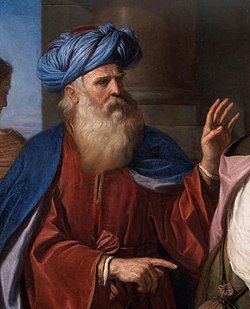
God establishes a covenant with Abraham, later changing his name from Abram to Abraham and promising him numerous descendants. Circumcision becomes the covenant sign, while Sarah is promised a son despite her advanced age.
Image source: Covenant of the pieces
2066 BCE
% complete
Isaac is born to Abraham and Sarah in fulfillment of God's promise. His birth continues the covenant line and makes him the central heir through whom the biblical promises to Abraham are carried forward.
Image source: Isaac
2026 BCE
% complete
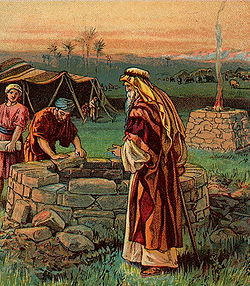
Abraham's servant finds Rebekah in Mesopotamia, and she becomes Isaac's wife. Their marriage introduces a major matriarch into the family narrative and leads to the birth of Esau and Jacob.
Image source: Rebekah Neumann
1953 BCE
% complete
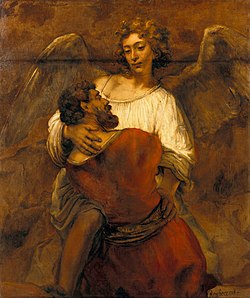
After wrestling with a divine being at Peniel, Jacob receives the name Israel. His twelve sons become ancestors of the tribes of Israel, making Jacob a central patriarch of the biblical people.
Image source: Jacob
1898 BCE
% complete
Jacob's favored son Joseph is sold into slavery by jealous brothers and taken to Egypt. The episode begins a story of betrayal, providence, and eventual reconciliation that brings Jacob's family to Egypt.
Image source: Joseph (Genesis)
1886 BCE
% complete
After interpreting Pharaoh's dreams, Joseph is elevated to a position overseeing Egypt's preparations for famine. His administration enables the survival of Egypt and neighboring peoples, including his own family.
1100 BCE
% complete
After the deaths of their husbands, Ruth refuses to abandon her Israelite mother-in-law Naomi and travels with her to Bethlehem. Ruth's loyalty and later marriage to Boaz place her within the ancestry of King David.
1526 BCE
% complete
Moses is born during Pharaoh's order to kill Hebrew boys. His mother places him in a basket on the Nile, where Pharaoh's daughter adopts him, allowing him to grow up within the royal household while retaining his Hebrew identity.
Image source: Moses
1446 BCE
% complete
While tending sheep in Midian, Moses encounters a bush that burns without being consumed. God calls him to lead the Israelites out of Egypt and reveals the divine name associated with Israel's God.
Image source: Burning bush
1446 BCE
% complete
Moses confronts Pharaoh, and the Israelites depart Egypt after a series of plagues. The Exodus becomes the defining liberation story of Israel and establishes Moses as its principal prophet and leader.
Image source: The Exodus
1446 BCE
% complete
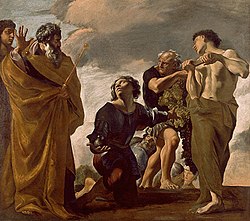
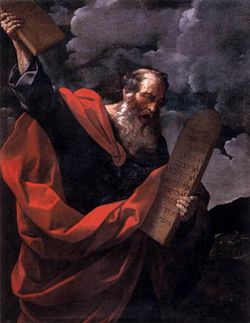
At Mount Sinai, Moses receives the covenant law, including the Ten Commandments, on behalf of Israel. The event marks the formal constitution of the Israelites as a covenant community.
Image source: Ten Commandments
1406 BCE
% complete
Joshua becomes Moses' successor and leads the Israelites into Canaan. Biblical accounts credit him with directing the conquest and distributing the land among the tribes of Israel.
Image source: Joshua
1200 BCE
% complete
Deborah serves as a prophet and judge of Israel during a period of conflict with the Canaanite king Jabin. She summons Barak to battle, and the victory is celebrated in the Song of Deborah.
Image source: Deborah
1150 BCE
% complete
Gideon leads a deliberately small Israelite force against Midianite oppression. The biblical story emphasizes that victory comes through divine guidance rather than superior numbers.
Image source: Gideon
1100 BCE
% complete
Samson, dedicated as a Nazirite, repeatedly battles the Philistines using extraordinary strength. Delilah discovers the source of his strength, but Samson ultimately brings down the Philistine temple at the cost of his own life.
Image source: Samson
1050 BCE
% complete
The prophet Samuel anoints Saul as Israel's first king. Saul's selection marks the transition from the period of judges to the Israelite monarchy, although his reign later becomes troubled by disobedience.
Image source: Samuel
850 BCE
% complete
On Mount Carmel, Elijah challenges the prophets of Baal to demonstrate whose deity will answer by fire. The narrative portrays the resulting sign as a decisive affirmation of Israel's God during Ahab's reign.
Image source: Elijah
850 BCE
% complete
Elisha receives Elijah's prophetic mantle and continues his ministry in the northern kingdom. Biblical stories attribute numerous miracles to him, including healings, provision, and the raising of a child.
Image source: Elisha
740 BCE - 700 BCE
% complete
Isaiah ministers in Judah during the reigns of several kings and speaks about judgment, justice, and trust in God. His book also contains influential visions of restoration and future salvation.
Image source: Isaiah
627 BCE - 586 BCE
% complete
Jeremiah warns Judah that persistent injustice and idolatry will bring catastrophe. Despite opposition and imprisonment, he continues his prophetic ministry through the Babylonian conquest of Jerusalem.
Image source: Jeremiah
603 BCE
% complete
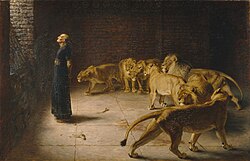
In Babylon, Daniel interprets King Nebuchadnezzar's troubling dream after seeking revelation from God. The episode establishes Daniel as a trusted wise man and a symbol of faithfulness in exile.
Image source: Daniel
1025 BCE
% complete
The young David defeats the Philistine champion Goliath with a sling and a stone. The victory establishes David's reputation, wins him public acclaim, and begins his rise toward Israel's throne.
Image source: Goliath
1010 BCE - 970 BCE
% complete
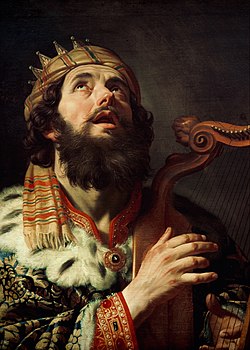
After Saul's death, David is recognized first as king over Judah and later over all Israel. He captures Jerusalem, makes it his capital, and establishes a royal dynasty central to later biblical expectations.
Image source: David
957 BCE
% complete
King Solomon builds the First Temple in Jerusalem as Israel's central sanctuary. The temple becomes the focus of national worship and houses the Ark of the Covenant in its inner sanctuary.
Image source: Solomon's Temple
479 BCE
% complete
The Jewish woman Esther becomes queen to the Persian king Ahasuerus. Concealing her identity at first, she later risks approaching the king to expose Haman's plot against the Jewish population.
Image source: Esther
27 BCE
% complete
John the Baptist preaches repentance and baptizes people in the Jordan River. He announces the coming of a greater figure and prepares the public setting for Jesus' ministry.
Image source: John the Baptist
4 BCE
% complete
The Gospel accounts place Jesus' birth in Bethlehem to Mary, with Joseph acting as his legal father. His birth is interpreted by Christians as the arrival of the Messiah and is associated with angelic announcements and visitors from the east.
Image source: Nativity of Jesus
27 CE
% complete
John baptizes Jesus in the Jordan River. The Gospel narratives describe the Spirit descending upon Jesus and a heavenly voice affirming him, marking the beginning of his public ministry.
Image source: Baptism of Jesus
28 CE
% complete
Jesus selects twelve apostles, including Peter, John, James, Matthew, and Judas Iscariot. They accompany him, receive instruction, and become principal witnesses and messengers of his ministry.
Image source: Apostles in the New Testament
29 CE
% complete
In the Sermon on the Mount, Jesus teaches about the kingdom of heaven, love of enemies, prayer, generosity, and ethical righteousness. The discourse includes the Beatitudes and the Lord's Prayer.
Image source: Sermon on the Mount
29 CE
% complete
Jesus is transfigured before Peter, James, and John on a mountain, where his appearance becomes radiant. Moses and Elijah appear in the vision, and a heavenly voice identifies Jesus as God's beloved Son.
Image source: Transfiguration of Jesus
30 CE
% complete
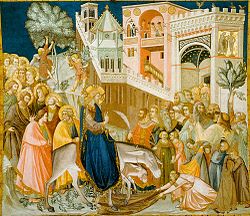
Jesus enters Jerusalem amid public acclamation, with crowds using branches and messianic language. The event begins the final sequence of Gospel episodes leading to his arrest and crucifixion.
Image source: Triumphal entry into Jerusalem
30 CE
% complete
Jesus is arrested, crucified under the Roman prefect Pontius Pilate, and buried. The Gospels then report that his followers find the tomb empty and encounter him risen, forming the foundation of Christian faith.
Image source: Crucifixion of Jesus
30 CE - 44 CE
% complete
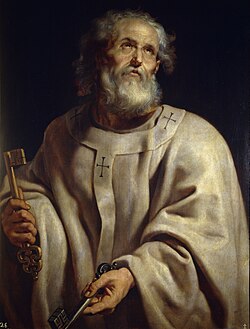
Peter becomes a leading figure among Jesus' followers after the resurrection. In Acts, he preaches at Pentecost, performs acts of healing, and helps extend the movement beyond its original Jewish setting.
Image source: Saint Peter
34 CE
% complete
Saul of Tarsus, a persecutor of Jesus' followers, experiences a revelatory encounter with the risen Jesus on the road to Damascus. He becomes Paul and turns into one of Christianity's most influential missionaries and theologians.
Image source: Conversion of Paul the Apostle
46 CE - 57 CE
% complete
Paul travels through Asia Minor, Macedonia, Greece, and other regions preaching about Jesus and founding congregations. His letters to these communities become a major portion of the New Testament.
Image source: Paul the Apostle
95 CE
% complete
John of Patmos receives and records a series of apocalyptic visions while on Patmos. The Book of Revelation addresses seven churches and presents symbolic visions of judgment, perseverance, and final renewal.
Image source: John of Patmos
Or browse the full history timeline directory, with more than 2,000 topics.
This Bible Characters timeline was generated with the help of AI, using information found on the internet.
We work hard to keep these timelines accurate, but mistakes do get through. If you spot one, email us at [email protected] and we'll fix it for future visitors.
Generate yours with AI or build it from scratch, for free.
Export your timeline, add your own events, edit or remove AI-generated events, and much more
No credit card required.
Cancel anytime.
Cancel anytime.
You can create an unlimited number of timelines with up to 10 events on each one, customize how they look, export them to PDF, PNG, PowerPoint, CSV, and Excel, and share them with a link. Paid plans raise the event limit and add features like spreadsheet imports and collaborators.
Yes. You can cancel your subscription from your account page at any time, and you will not be charged again. Your subscription stays active for the rest of the period you already paid for.
Yes. We will email you a reminder before the annual renewal, and we will also email you a receipt.
Yes. You can email us within 15 days of any payment, and we will issue you a full refund.
Check out our pricing docs or send us an email anytime: [email protected].