-
Use Cases
-
Resources
-
Pricing
The California Gold Rush began in January 1848 when gold was discovered at Sutter's Mill in Coloma, California. The discovery triggered a massive migration of roughly 300,000 prospectors, known as Forty-Niners, from across the United States and abroad, transforming San Francisco into a booming city, accelerating California's admission to statehood in 1850, and devastating Indigenous populations through disease, displacement, and violence. More Less
Mar 9, 1842
% complete
Gold was discovered in California as early as March 9, 1842, at Rancho San Francisco, in the mountains north of present-day Los Angeles. This early find preceded the famous 1848 discovery that sparked the great gold rush.
Image source: California Gold Rush
1843
% complete
In 1843, Lopez found gold in San Feliciano Canyon near his first discovery at Rancho San Francisco. Mexican miners from Sonora worked the placer deposits there until 1846.
1848
% complete
Minor finds of gold in California were also made by Mission Indians prior to 1848, contributing to the earliest knowledge of gold deposits in the region.
Jan 24, 1848
% complete
The California gold rush began on January 24, 1848, when gold was found by James W. Marshall at Sutter's Mill in Coloma, California. This discovery set off one of the largest mass migrations in history.
Feb 1848
% complete
Having sworn all concerned at the mill to secrecy, in February 1848, Sutter sent Charles Bennett to Monterey to meet with Colonel Mason, the chief U.S. official in California, hoping to secure rights to the gold discovery.
Mar 1848
% complete
By March 1848, rumors of the discovery were confirmed by San Francisco newspaper publisher and merchant Samuel Brannan, helping spread word of gold throughout California.
Image source: Samuel Brannan
Aug 19, 1848
% complete
On August 19, 1848, the New York Herald was the first major newspaper on the East Coast to report the discovery of gold in California, spreading news across the nation.
Image source: New York Herald
1851
% complete
Discovery of gold nuggets at the site of present-day Yreka in 1851 brought thousands of gold-seekers up the Siskiyou Trail and throughout California's northern counties.
Image source: Yreka, California
1843 - 1846
% complete
Mexican miners from Sonora worked the placer deposits near the early southern California discoveries until 1846, predating the main gold rush.
Jan 1849
% complete
Issued in January 1849, at the beginning of the California gold rush, Lawson's map was produced specifically for prospectors and miners heading to the goldfields.
1850
% complete
By 1850, most of the easily accessible gold had been collected, and attention turned to extracting gold from more difficult locations, requiring more advanced techniques and capital investment.
1853
% complete
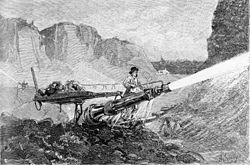
By 1853, hydraulic mining was used on ancient gold-bearing gravel beds on hillsides and bluffs in the goldfields, allowing extraction of gold from previously inaccessible deposits but causing massive environmental damage.
Image source: Hydraulic mining
1853
% complete
By contrast with many failed miners, businessman Levi Strauss went on to great success, first beginning to sell denim overalls in San Francisco in 1853, founding what would become a legendary clothing company.
Image source: Levi Strauss
1857
% complete
The SS Central America, carrying gold from California, ended in disaster as the ship sank in a hurricane off the coast of the Carolinas in 1857, with approximately three tons of California gold aboard.
Image source: SS Central America
1882 - 1884
% complete
Court rulings (1882 Gold Run and 1884 'Sawyer Act') limited hydraulic mining in California, responding to the extensive environmental damage caused by the practice.
1885
% complete
By the mid-1880s, it is estimated that 11 million troy ounces (340 t) of gold (worth approximately US$15 billion at December 2010 prices) had been recovered by hydraulic mining.
Jan 1847
% complete
In January 1847, nine months into the Mexican–American War, the Treaty of Cahuenga was signed, leading to the resolution of the military conflict in Alta California (Upper California).
Image source: Treaty of Cahuenga
Feb 2, 1848
% complete
With the signing of the treaty ending the war on February 2, 1848, California became a possession of the United States, but it was not a formal 'territory' and did not become a state until September 9, 1850.
Image source: Treaty of Guadalupe Hidalgo
Dec 5, 1848
% complete
On December 5, 1848, US president James K. Polk confirmed the discovery of gold in California in an address to Congress, igniting national excitement and accelerating migration westward.
Image source: James K. Polk
1849
% complete
In 1849, a state constitution was written as California moved rapidly toward organized government amid its explosive population growth.
Image source: Constitution of California
Sep 9, 1850
% complete
In September 1850, California achieved statehood as the 31st state of the United States through the Compromise of 1850. The sudden population increase allowed California to grow rapidly into statehood.
Image source: Compromise of 1850
1854
% complete
With the building of the San Francisco Mint in 1854, gold bullion was turned into official United States gold coins for circulation, integrating gold rush wealth into the national economy.
Image source: San Francisco Mint
1863
% complete
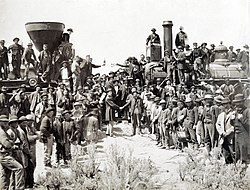
Within a few years after the end of the gold rush, in 1863, the groundbreaking ceremony for the western leg of the first transcontinental railroad was held in Sacramento, connecting California to the East.
Image source: First transcontinental railroad
1869
% complete
By 1869, railroads were built from California to the eastern United States, ending the isolation that had defined the state since the gold rush era.
Mar 1848
% complete
The first people to rush to the goldfields, beginning in the spring of 1848, were the residents of California themselves—primarily agriculturally oriented Americans and Europeans living in Northern California, along with Native Californians and some Californios.
Dec 31, 1848
% complete
By the end of 1848, some 6,000 Argonauts had come to California seeking their fortunes in the goldfields.
Jan 1849
% complete
By the beginning of 1849, word of the gold rush had spread around the world, and an overwhelming number of gold-seekers and merchants began to arrive from virtually every continent.
1849
% complete
The largest group of forty-niners in 1849 were Americans from the East Coast, arriving by the tens of thousands overland across the continent and along various sailing routes. The term 'forty-niner' was derived from the year 1849, the peak year for gold rush immigration.
1849
% complete
Gold-seekers and merchants from Asia, primarily from China, began arriving in 1849, at first in modest numbers to Gum San ('Gold Mountain'), the name given to California in Chinese.
Image source: History of Chinese Americans
1849
% complete
It is estimated that approximately 90,000 people arrived in California in 1849—about half by land and half by sea—seeking fortune in the goldfields.
1849
% complete
Of the 40,000 people who arrived by ship to the San Francisco Bay in 1849, only 700 were women (including those who were poor, wealthy, entrepreneurs, prostitutes, single, and married).
Sep 1849
% complete
The first missionary to arrive during the gold rush was William Taylor, who arrived in San Francisco in September 1849 to minister to the booming population.
Image source: William Taylor (missionary)
Oct 1849
% complete
The first immigrants from Europe, reeling from the effects of the Revolutions of 1848 and with a longer distance to travel, began arriving in late 1849, mostly from France, with some Germans, Italians, and Britons.
1850
% complete
The population of San Francisco increased quickly from about 1,000 in 1848 to 25,000 full-time residents by 1850, transforming it into a major boomtown.
Image source: San Francisco
1852
% complete
Several hundred Chinese arrived in California in 1849 and 1850, and in 1852 more than 20,000 landed in San Francisco, dramatically increasing Chinese presence in the goldfields.
1855
% complete
The Panama Railway, spanning the Isthmus of Panama, was finished in 1855, greatly speeding travel between the eastern United States and California.
Image source: Panama Canal Railway
1855
% complete
By 1855, it is estimated at least 300,000 gold-seekers, merchants, and other immigrants had arrived in California from around the world, marking the end of the gold rush period (1848–1855).
1849
% complete
Chilean miners are known to have resisted eviction by various means, both legal and by the use of revenge attacks culminating in the Chile War of 1849.
1850
% complete
The new California State Legislature passed a foreign miners tax of twenty dollars per month ($770 per month as of 2025), and American prospectors began organized attacks on foreign miners, particularly Latin Americans and Chinese. Taxes such as this targeted mainly Latino miners and kept them from making as much money as whites, who had no taxes imposed on them.
Apr 22, 1850
% complete
Passed on April 22, 1850, by the California Legislature, this act allowed settlers to capture and use Native people as bonded workers, prohibited Native peoples' testimony against settlers, and allowed the adoption of Native children by settlers, often for labor purposes.
Image source: Act for the Government and Protection of Indians
1851
% complete
In 1851, eighteen treaties were signed between tribal leaders and federal agents, but California stood in opposition to ratifying them, leaving many tribes without recognized lands.
Image source: California genocide
1852
% complete
During the 1852 Bridge Gulch Massacre, a group of settlers attacked a band of Wintu Indians in response to the killing of a citizen named J. Nicholson, exemplifying the violence against indigenous peoples during the era.
Or browse the full history timeline directory, with more than 2,000 topics.
This California Gold Rush timeline was generated with the help of AI, using information found on the internet.
We work hard to keep these timelines accurate, but mistakes do get through. If you spot one, email us at [email protected] and we'll fix it for future visitors.
Generate yours with AI or build it from scratch, for free.
Export your timeline, add your own events, edit or remove AI-generated events, and much more
No credit card required.
Cancel anytime.
Cancel anytime.
You can create an unlimited number of timelines with up to 10 events on each one, customize how they look, export them to PDF, PNG, PowerPoint, CSV, and Excel, and share them with a link. Paid plans raise the event limit and add features like spreadsheet imports and collaborators.
Yes. You can cancel your subscription from your account page at any time, and you will not be charged again. Your subscription stays active for the rest of the period you already paid for.
Yes. We will email you a reminder before the annual renewal, and we will also email you a receipt.
Yes. You can email us within 15 days of any payment, and we will issue you a full refund.
Check out our pricing docs or send us an email anytime: [email protected].