-
Use Cases
-
Resources
-
Pricing
Canute the Great (c. 995–1035) was a Danish king who became ruler of England after defeating Edmund Ironside in 1016. He later inherited Denmark and conquered Norway, creating a vast North Sea Empire that united much of Scandinavia and Britain under his rule. His reign is remembered for strong governance, legal reform, and close cooperation with the Church. More Less
900
% complete
Harthacnut I was the semi-legendary founder of the Danish royal house at the beginning of the 10th century. His son, Gorm the Old, became the first king in the official line of Danish rulers from which Cnut descended.
Image source: Harthacnut I of Denmark
995
% complete
Cnut, also known as Canute the Great, was born around 995 as a Danish prince. He was a son of Swein Forkbeard, King of Denmark, and would go on to rule England, Denmark, and Norway.
Image source: Cnut
1000
% complete
According to the Flateyjarbók, a 13th-century Icelandic source, Cnut was taught his soldiery by the chieftain Thorkell the Tall, brother to Sigvaldi, Jarl of Jomsborg, at the Jomsvikings' stronghold on the island of Wollin off the coast of Pomerania.
Image source: Thorkell the Tall
Nov 13, 1002
% complete
In 1002, King Æthelred the Unready ordered the massacre of Danes living in England. The Flateyjarbók mentions a battle identifiable with Swein Forkbeard's invasion of England and attack on Norwich in 1003–04, following this massacre.
1003 - 1004
% complete
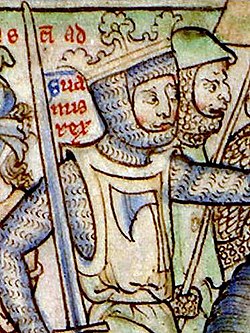
Cnut was likely part of his father King Swein's 1003 and 1004 campaigns in England, which included an attack on the city of Norwich, although the evidence for his participation is not firm.
Image source: Sweyn Forkbeard
1013 - 1014
% complete
Hardly anything is known with certainty of Cnut's life until he joined a Scandinavian force under his father, King Swein, in his invasion of England in summer 1013. This invasion was the climax to a succession of Viking raids spread over several decades.
Feb 3, 1014
% complete
On the death of Swein Forkbeard after a few months as king of England, on Candlemas (Sunday 3 February 1014), Harald succeeded him as King of Denmark, while the Vikings and people of the Danelaw immediately elected Cnut as king in England.
Apr 23, 1014
% complete
While Cnut was preparing his re-invasion of England, the Battle of Clontarf pitted an array of armies against each other on the fields before the walls of Dublin, a significant event in Irish history during Cnut's era.
Image source: Battle of Clontarf
1015
% complete
In the summer of 1015, Cnut's fleet set sail for England with a Danish army of perhaps 10,000 men in 200 longships, beginning his campaign to conquer the English throne.
Sep 1015
% complete
According to the Peterborough Chronicle, early in September 1015 Cnut came into Sandwich, sailed around Kent to Wessex, and harried Dorset, Wiltshire and Somerset, beginning a campaign of an intensity not seen since the days of Alfred the Great.
Oct 1, 1015 - Dec 31, 1015
% complete
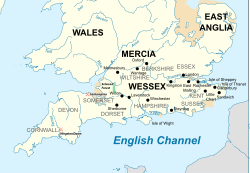
Wessex, long ruled by the dynasty of Alfred and Æthelred, submitted to Cnut late in 1015, just as it had to his father two years earlier. Thorkell the Tall also defected to Cnut around this time.
Image source: Wessex
Jan 1, 1016 - Mar 31, 1016
% complete
Early in 1016, the Vikings crossed the Thames and harried Warwickshire, while Edmund Ironside's attempts at opposition came to little, as the English army disbanded because the king and citizenry of London were not present.
Apr 23, 1016
% complete
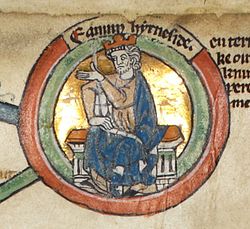
Prince Edmund remained in London, still unsubdued behind its walls, and was elected king after the death of Æthelred on 23 April 1016, setting up a contest between Edmund and Cnut for the English throne.
Image source: Edmund Ironside
Oct 18, 1016
% complete
On 18 October 1016, the Danes were engaged by Edmund Ironside's army as they retired towards their ships, leading to the Battle of Assandun, fought at either Ashingdon or Ashdon in Essex. The battle was decisive in Cnut's conquest.
Image source: Battle of Assandun
1016
% complete
At the Battle of Nesjar, in 1016, Olaf Haraldsson won the kingdom of Norway from the Danes, establishing a rival Scandinavian power that Cnut would later challenge.
Image source: Battle of Nesjar
1017
% complete
After winning the throne of England in 1016 in the wake of centuries of Viking activity in northwestern Europe, Cnut was accepted by the West Saxons as king of all England and crowned by Lyfing, Archbishop of Canterbury, in London in 1017.
Jul 1017
% complete
In July 1017, Cnut wed Queen Emma, widow of Æthelred and daughter of Richard I, Duke of Normandy, strengthening his claim to the English crown through marriage to the previous queen.
Image source: Emma of Normandy
1018
% complete
There is evidence Cnut was in battle with 'pirates' in 1018, destroying the crews of thirty ships, although it is unknown whether this engagement took place off the English or Danish shores.
1018
% complete
Harald II died in 1018, and Cnut went to Denmark to affirm his succession to the Danish crown, bringing the crowns of England and Denmark together and stating his intention to avert attacks against England in a letter written in 1019.
1018
% complete
In 1018, having collected a Danegeld amounting to £72,000 levied nationwide, with an additional £10,500 extracted from London, Cnut paid off his army and sent most of them home. An annual tax called heregeld was collected through the same system Æthelred had instituted in 1012.
Image source: Danegeld
1021
% complete
In 1021, Thorkell the Tall, who had served as an earl under Cnut, fell from favour and was outlawed. His banishment may be seen in relation to Cnut's attack on the Wends.
1022
% complete
With the death of Olof Skötkonung in 1022, and the succession of his son Anund Jacob bringing Sweden into alliance with Norway, there was cause for a demonstration of Danish strength in the Baltic.
Image source: Olof Skötkonung
1023
% complete
Successful after Cnut's clear display of intentions to dominate Scandinavian affairs, it seems that Thorkell reconciled with Cnut in 1023, returning to his service after his earlier banishment.
1026
% complete
In a battle known as the Battle of the Helgeå, Cnut and his men fought the Norwegians and Swedes at the mouth of the river Helgeå, probably in 1026. The apparent victory left Cnut as the dominant leader in Scandinavia.
Image source: Battle of Helgeå
Dec 25, 1026
% complete
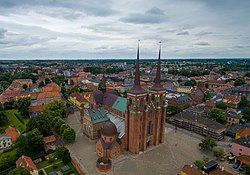
Some sources state that Cnut and his brother-in-law Ulf Jarl were playing chess at a banquet in Roskilde when an argument arose between them, and the next day, Christmas 1026, one of Cnut's housecarls killed the jarl with his blessing, in Trinity Church, predecessor to Roskilde Cathedral.
Image source: Ulf Jarl
1027
% complete
The first stone church recorded to have been built in Scandinavia was in Roskilde around 1027, and its patron was Cnut's sister Estrid, reflecting the Christianization of Denmark under Cnut's dynasty.
Image source: Roskilde Cathedral
1028
% complete
After a decade of conflict with opponents in Scandinavia, Cnut set off from England to Norway in 1028 with a fleet of fifty ships and claimed the crown of Norway in Trondheim, following the expulsion of Olaf Haraldsson.
1029 - 1030
% complete
Hakon, a relative of Cnut's installed as deputy in Norway after the expulsion of Olaf Haraldsson, was drowned in a shipwreck in the Pentland Firth between the Orkney Islands and the mainland either late 1029 or early 1030.
Image source: Haakon Ericsson
1030
% complete
Olaf Haraldsson died at the hands of his own people at the Battle of Stiklestad in 1030, removing a key rival to Cnut's hold over Norway and consolidating Cnut's Scandinavian empire.
Image source: Battle of Stiklestad
1031
% complete
After the consolidation of Norway, Cnut went to Scotland in 1031 with an army and the navy in the Irish Sea, receiving without bloodshed the submission of three Scottish kings: Maelcolm (Malcolm II), the future Maelbeth (Macbeth), and Iehmarc.
Image source: Malcolm II of Scotland
1035 - 1037
% complete
After Cnut's death, Harold Harefoot, son of Cnut by Ælfgifu of Northampton, became regent in England from 1035 to 1037. Queen Emma fled to Bruges in Flanders under pressure from his supporters, before he claimed the full throne in 1037.
Image source: Harold Harefoot
Nov 12, 1035
% complete
Cnut died on 12 November 1035 in Shaftesbury, Dorset, ending his reign as King of England, Denmark and Norway. His death triggered a succession struggle among his sons.
1040 - 1042
% complete
Eventual peace in Scandinavia left Harthacnut free to claim the throne himself in 1040 and restore his mother Emma to her place. He reunited the crowns of Denmark and England until his death in 1042.
Image source: Harthacnut
1042 - 1047
% complete
Denmark fell into disorder with a power struggle between the pretender Sweyn Estridsson, son of Ulf Jarl, and the Norwegian king Magnus, which lasted until Magnus's death in 1047, dissolving Cnut's northern empire.
Image source: Magnus the Good
1066
% complete
Following the events of 1066, the new Norman regime was keen to signal its authority with an ambitious programme of grandiose cathedrals and castles throughout the High Middle Ages, transforming the landscape of the kingdom Cnut once ruled.
Image source: Norman Conquest
Or browse the full history timeline directory, with more than 2,000 topics.
This Canute the Great timeline was generated with the help of AI, using information found on the internet.
We work hard to keep these timelines accurate, but mistakes do get through. If you spot one, email us at [email protected] and we'll fix it for future visitors.
Generate yours with AI or build it from scratch, for free.
Export your timeline, add your own events, edit or remove AI-generated events, and much more
No credit card required.
Cancel anytime.
Cancel anytime.
You can create an unlimited number of timelines with up to 10 events on each one, customize how they look, export them to PDF, PNG, PowerPoint, CSV, and Excel, and share them with a link. Paid plans raise the event limit and add features like spreadsheet imports and collaborators.
Yes. You can cancel your subscription from your account page at any time, and you will not be charged again. Your subscription stays active for the rest of the period you already paid for.
Yes. We will email you a reminder before the annual renewal, and we will also email you a receipt.
Yes. You can email us within 15 days of any payment, and we will issue you a full refund.
Check out our pricing docs or send us an email anytime: [email protected].