-
Resources
-
Pricing
This timeline examines the Cayuga Nation’s origins in the Finger Lakes, its role in the Haudenosaunee Confederacy, colonial-era conflicts, treaty history, land loss, and continuing cultural and political revitalization. More Less
Build a timeline like this one in minutes, for free. Start Yours →
1778
Various Haudenosaunee bands, often allied with British colonial loyalists known as Tories, conducted raids along the frontier from Connecticut through New York and into south-central Pennsylvania. The attacks threatened much of the Susquehanna Valley.
1778
The 1778 frontier raids extended into the Susquehanna Valley, creating a major security concern for New York militias, Continental forces, and nearby communities during the American Revolution.
Image source: Susquehanna River
1779
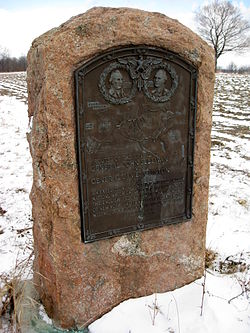
The Sullivan Expedition was organized to unseat the Haudenosaunee Confederacy and prevent its nations from continuing attacks on New York militias and the Continental Army.
1779
The campaign mobilized approximately 6,200 troops, making it a large-scale military operation against Haudenosaunee communities during the Revolutionary War.
1779
The Sullivan campaign devastated Cayuga homelands as part of its effort to eliminate the material base of Haudenosaunee resistance and frontier attacks.
1779
The campaign destroyed an estimated 40 to 50 villages belonging to the Cayuga and other Haudenosaunee nations, causing extensive displacement and loss of homes, crops, and community infrastructure.
1779
After the systematic bloodletting of 1779, affected groups became associated with the Mingo or “Black Mingo.” Their reputation and relationships enabled them to take in displaced kin.
Image source: Mingo
1779
The groups were described as Mingo or “Black Mingo,” a name connected in the source account with the bad reputation they acquired during this period.
1779
In response to the frontier attacks, General George Washington appointed General John Sullivan and James Clinton to lead a retaliatory campaign against the Haudenosaunee Confederacy.
Image source: Sullivan Expedition
1783
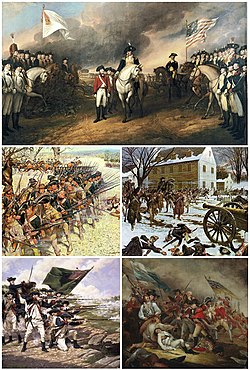
As the American Revolution neared its end, settlers resumed moving west of the Allegheny Mountains. The movement began as a trickle before becoming much more substantial.
Image source: American Revolutionary War
1810
By 1810, westward settlement beyond the Alleghenies had become a flood, increasing pressure on Indigenous lands and communities.
Image source: Territorial evolution of the United States
1831
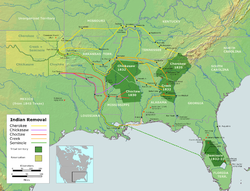
By 1831, Indigenous people remaining on lands east of Ohio were encouraged by bigotry and, at times, forcibly removed to the Indian Territory, in what later became Oklahoma.
Image source: Indian removal
Nov 11, 1794
Under the 1794 treaty, the Haudenosaunee nations ceded much of their land in New York to the United States. The source account characterizes the cession as compelled by their alliance with the defeated British.
Image source: Treaty of Canandaigua
Nov 11, 1794
The New York Cayuga Nation, together with the other Haudenosaunee nations, signed the Pickering Treaty with the United States. The agreement required them to cede much of their New York land after the defeat of their British allies.
1975 - 1999
Since the late twentieth century, individual tribes have pursued land claims, arguing that New York lacked constitutional authority to take or transfer their lands.
Nov 19, 1980
The Cayuga Nation of New York filed an action in the United States District Court for the Northern District of New York. It sought legislative and monetary restitution for land taken by New York during the eighteenth and nineteenth centuries.
1981 - Jan 17, 2000
The land claim proceeded through many years of pre-trial motions before the parties reached a jury trial on damages.
1981
The Seneca-Cayuga Nation was added as a plaintiff to the land claim in 1981, expanding the parties seeking restitution for disputed land transfers.
Jan 18, 2000
A jury trial on damages in the Cayuga and Seneca-Cayuga land claim began in federal court on January 18, 2000.
Feb 17, 2000
The jury trial on damages concluded on February 17, 2000, after considering the claims arising from New York’s eighteenth- and nineteenth-century land transactions.
Oct 2, 2001
The court issued a decision and order awarding $211 million in prejudgment interest and a total award of $247.9 million.
Jun 28, 2005
The United States Court of Appeals for the Second Circuit reversed the trial court’s judgment on June 28, 2005.
May 15, 2006
The Cayuga Indian Nation of New York sought review by the Supreme Court of the United States, but the Court denied review on May 15, 2006.
Image source: Cayuga Indian Nation of New York v. Pataki
1875
George Edward Bomberry became the first Indigenous graduate of McGill University, receiving the M.D. C.M. degree in 1875. He was a physician.
Image source: Cayuga people
1995
In 1995, nearly 450 Cayuga members were reported in New York.
1995
About 45,000 Haudenosaunee lived in Canada in 1995, including more than 39,000 in Ontario and the remainder in Quebec.
1995
Among the six nations and federally recognized units in the United States, total tribal enrollment in 1995 was approximately 30,000.
Image source: Iroquois
2000 - 2099
In the twenty-first century, the combined Cayuga-Seneca Nation in Oklahoma was reported to have approximately 4,892 members.
2000
In the 2000 United States Census, 45,217 respondents identified solely as “Iroquois,” while 80,822 reported Iroquois ancestry. These figures did not necessarily represent enrolled tribal membership.
1975 - 1999
Since the late twentieth century, the Cayuga Nation has acquired portions of its former homeland through land purchases.
Jul 17, 1996
The Nation reclaimed its first land on July 17, 1996, by purchasing 14 acres in Seneca Falls, within its approximately 64,000-acre land claim area.
Aug 2, 1997
A dedication was held on August 2, 1997, for the reclaimed Cayuga land. Members of all the Haudenosaunee Confederacy nations attended.
Dec 2005
In December 2005, the S.H.A.R.E. Farm, including a house, was signed over to the Cayuga Nation. United States citizens had purchased and developed the 70-acre farm in Aurora, New York.
Build a timeline like this one in minutes, for free. Start Yours →
Or browse the full history timeline directory, with more than 3,000 topics.
This Cayuga Nation History timeline was generated with the help of AI, using information found on the internet.
We work hard to keep these timelines accurate, but mistakes do get through. If you spot one, email us at [email protected] and we'll fix it for future visitors.
Generate yours with AI or build it from scratch, for free.
Export your timeline, add your own events, edit or remove AI-generated events, and much more
No credit card required.
15-day money-back guarantee.
You can create an unlimited number of timelines with up to 10 events on each one, customize how they look, export them to PDF, PNG, PowerPoint, CSV, and Excel, and share them with a link. Timelines made with Timeline Maker AI keep every event the generator created, and you can add up to 5 events of your own. Paid plans remove the event limit, add spreadsheet imports and hide Preceden's branding, and the higher-priced plan also adds collaborators, a custom logo and a custom domain.
Yes. You can cancel your subscription from your account page at any time, and you will not be charged again. Your subscription stays active for the rest of the period you already paid for.
Yes. We email you a reminder 15 days before your annual renewal, and we email you a receipt after every payment.
Yes. You can email us within 15 days of any payment, and we will issue you a full refund.
Check out our pricing docs or send us an email anytime: [email protected].