-
Use Cases
-
Resources
-
Pricing
Commercial spaceflight refers to space activities conducted by private companies rather than government agencies. Beginning with early satellite launch contracts and accelerating dramatically after NASA's shift toward private partnerships in the 2000s, companies like SpaceX, Blue Origin, Virgin Galactic, and Boeing have transformed access to orbit. Key milestones include the first privately funded liquid-fueled rocket reaching space, the first commercial crewed flights to the International Space Station, and the emergence of suborbital space tourism. More Less
Dec 24, 1979
% complete
The first Ariane rocket launched successfully from Kourou, French Guiana, establishing Europe's entry into the commercial launch market. Arianespace, founded in 1980, became the world's first commercial space transportation company, capturing a large share of the satellite launch business in the 1980s.
Image source: Ariane 1
Mar 26, 1980
% complete
Arianespace was established as a French company to market and operate Ariane launches commercially. It pioneered the idea of selling launch services to satellite operators worldwide, laying the groundwork for today's global commercial spaceflight industry.
Image source: Arianespace
Nov 26, 2011
% complete
United Launch Alliance, the Boeing-Lockheed Martin joint venture formed in 2006, launched NASA's Mars Science Laboratory on an Atlas V rocket. ULA dominated U.S. national security and science launches until competition from SpaceX disrupted the market in the mid-2010s.
Image source: United Launch Alliance
Jul 22, 1987
% complete
Syrian researcher Muhammed Faris flew to the Mir space station as part of an interkosmos agreement. While government-sponsored, this flight foreshadowed the era of non-professional astronauts flying to orbit, which would later expand into true commercial space tourism.
Image source: Soyuz TM-3
Apr 28, 2001 - May 6, 2001
% complete
American businessman Dennis Tito paid approximately $20 million to fly aboard the Russian Soyuz TM-32 mission to the International Space Station through Space Adventures. His flight marked the beginning of genuine commercial space tourism, proving that private individuals could purchase trips to orbit.
Image source: Dennis Tito
Apr 25, 2002 - May 5, 2002
% complete
South African entrepreneur Mark Shuttleworth paid for a seat on Soyuz TM-34 to the International Space Station, becoming the second self-funded space tourist and the first African citizen in space. He conducted experiments related to AIDS research during his eight-day mission.
Image source: Mark Shuttleworth
Sep 27, 2004
% complete
Richard Branson announced the creation of Virgin Galactic, licensing SpaceShipOne technology to build a fleet of suborbital spacecraft for paying customers. The company sold hundreds of tickets at $200,000 each, becoming one of the most visible symbols of the emerging space tourism industry.
Image source: Virgin Galactic
Jul 11, 2021
% complete
Richard Branson and three crewmates flew aboard VSS Unity to about 86 km altitude, beating Jeff Bezos to space by nine days. The high-profile flight kicked off Virgin Galactic's commercial suborbital tourism operations, though tickets initially cost hundreds of thousands of dollars.
Image source: Virgin Galactic Unity 22
Jul 20, 2021
% complete
On the 52nd anniversary of Apollo 11, Jeff Bezos, his brother Mark, Wally Funk, and Oliver Daemen flew on New Shepard past the Karman line. Daemen, 18, became the youngest person in space, and the flight marked the start of Blue Origin's ticketed suborbital tourism service.
Image source: Blue Origin NS-16
Sep 15, 2021 - Sep 18, 2021
% complete
Jared Isaacman chartered a Crew Dragon for Inspiration4, flying three civilian companions on a three-day free-flight orbit around Earth. The mission raised funds for St. Jude Children's Research Hospital and demonstrated that private citizens could undertake multi-day orbital missions without professional astronauts.
Image source: Inspiration4
May 18, 1996
% complete
The X Prize Foundation offered $10 million to the first privately funded team to launch a reusable crewed spacecraft to 100 kilometers altitude twice within two weeks. The prize catalyzed investment in private human spaceflight and inspired a generation of commercial space ventures.
Image source: Ansari X Prize
Mar 14, 2002
% complete
Elon Musk founded Space Exploration Technologies Corporation (SpaceX) with the goal of reducing space transportation costs and enabling the colonization of Mars. The company would go on to revolutionize the launch industry with reusable rockets and become the dominant Western launch provider.
Image source: SpaceX
Sep 29, 2004 - Oct 4, 2004
% complete
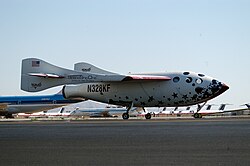
Burt Rutan's Scaled Composites, funded by Paul Allen, flew SpaceShipOne above 100 km twice within five days, winning the $10 million Ansari X Prize. The achievement demonstrated that private companies could build crewed spacecraft and directly led to the development of Virgin Galactic's SpaceShipTwo.
Image source: SpaceShipOne
Jul 12, 2006
% complete
Robert Bigelow's company launched Genesis I, an experimental expandable habitat, into orbit. Bigelow Aerospace pursued private space stations, envisioning orbital hotels and research facilities, and later licensed NASA's TransHab inflatable technology for its B330 modules.
Sep 28, 2008
% complete
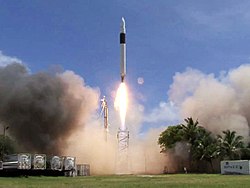
After three failed launches, SpaceX's Falcon 1 became the first privately developed liquid-fueled rocket to reach Earth orbit. The milestone kept SpaceX alive financially and proved that a small private company could achieve orbital launch capability without government development programs.
Image source: Falcon 1
Jun 4, 2010
% complete
SpaceX's Falcon 9 lifted off from Cape Canaveral on its maiden flight, placing a Dragon capsule mockup into orbit. The two-stage rocket became the workhorse of commercial spaceflight, eventually flying dozens of missions per year and pioneering booster reusability.
Image source: Falcon 9
Nov 23, 2015
% complete
Jeff Bezos's Blue Origin launched its New Shepard suborbital rocket to 100 km and landed the booster propulsively in West Texas, weeks before SpaceX's orbital-class landing. The reusable vehicle was designed to carry tourists past the Karman line on short suborbital hops.
Image source: New Shepard
Dec 21, 2015
% complete
Following the launch of eleven Orbcomm satellites, a Falcon 9 first stage descended through the atmosphere and landed vertically at Landing Zone 1 in Cape Canaveral. This historic landing proved rocket reusability was practical and promised dramatic reductions in launch costs.
Image source: Falcon 9 first-stage landing tests
Mar 30, 2017
% complete
SpaceX launched the SES-10 communications satellite using a Falcon 9 first stage recovered from a previous flight, marking the first reflight of an orbital rocket booster. Reusability quickly became central to SpaceX's business model, slashing costs and increasing launch cadence.
Image source: SES-10
Feb 6, 2018
% complete
SpaceX launched the most powerful operational rocket since the Saturn V, sending Elon Musk's personal Tesla Roadster toward heliocentric orbit. The spectacle, watched by millions, demonstrated heavy-lift capability available commercially and showcased both side boosters landing simultaneously.
Image source: Falcon Heavy
Jan 18, 2006
% complete
NASA created the COTS program to fund private companies developing cargo delivery services to the International Space Station. SpaceX and Rocketplane Kistler (later replaced by Orbital Sciences) received agreements, marking NASA's shift toward buying services rather than building its own vehicles.
Image source: Commercial Orbital Transportation Services
Dec 23, 2008
% complete
NASA awarded multibillion-dollar contracts to SpaceX ($1.6 billion) and Orbital Sciences ($1.9 billion) to deliver cargo to the International Space Station. These contracts provided crucial funding that enabled SpaceX to develop the Falcon 9 rocket and Dragon capsule.
Image source: Commercial Resupply Services
Dec 8, 2010
% complete
SpaceX's Dragon became the first commercially built spacecraft to be recovered after reentry from low Earth orbit. The successful demonstration flight under COTS validated SpaceX's approach and cleared the path for operational cargo missions to the space station.
Image source: SpaceX Dragon
May 25, 2012 - May 31, 2012
% complete
During the COTS demonstration mission, Dragon became the first commercial spacecraft to berth with the International Space Station. After delivering cargo and returning safely to Earth, SpaceX began regular operational resupply flights under the CRS contract later that year.
Image source: SpaceX CRS-1
Apr 21, 2013
% complete
Orbital Sciences' Antares rocket launched on its maiden flight from Wallops Island, Virginia, carrying a Cygnus mass simulator. The vehicle enabled Cygnus cargo ships to serve the International Space Station, giving NASA a second commercial resupply provider alongside SpaceX.
Image source: Antares (rocket)
Sep 29, 2013 - Oct 23, 2013
% complete
Orbital Sciences' Cygnus spacecraft berthed with the International Space Station on its demonstration flight, delivering supplies before burning up on reentry. The success made Orbital the second commercial company providing routine cargo services to the station.
Image source: Cygnus (spacecraft)
Sep 16, 2014
% complete
NASA awarded $4.2 billion to Boeing for CST-100 Starliner and $2.6 billion to SpaceX for Crew Dragon to restore American crewed access to orbit. The Commercial Crew Program ended reliance on Russian Soyuz seats and institutionalized public-private partnerships for human spaceflight.
Image source: Commercial Crew Program
Mar 2, 2019 - Mar 8, 2019
% complete
An uncrewed Crew Dragon docked autonomously with the International Space Station and returned safely, validating the spacecraft ahead of crewed flights. The mission brought NASA's commercial crew program to the brink of restoring domestic astronaut launch capability.
Image source: Crew Dragon Demo-1
May 30, 2020 - Aug 2, 2020
% complete
Bob Behnken and Doug Hurley flew Crew Dragon to the International Space Station, the first crewed orbital launch from American soil since 2011 and the first ever by a commercial company. The mission certified SpaceX to fly operational astronaut missions for NASA.
Image source: Crew Dragon Demo-2
Nov 15, 2020 - May 2, 2021
% complete
Four astronauts launched aboard Crew Dragon Resilience for a six-month stay on the International Space Station, the first fully operational commercial crew mission. Regular rotations of astronauts on private spacecraft became routine, transforming human spaceflight logistics.
Image source: SpaceX Crew-1
May 24, 2019
% complete
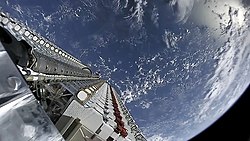
SpaceX deployed 60 prototype Starlink broadband satellites, beginning construction of a megaconstellation intended to provide global internet coverage. Thousands of satellites followed, making Starlink the largest constellation in history and a major revenue source funding SpaceX's Mars ambitions.
Image source: Starlink
Or browse the full history timeline directory, with more than 2,000 topics.
This Commercial Spaceflight timeline was generated with the help of AI, using information found on the internet.
We work hard to keep these timelines accurate, but mistakes do get through. If you spot one, email us at [email protected] and we'll fix it for future visitors.
Generate yours with AI or build it from scratch, for free.
Export your timeline, add your own events, edit or remove AI-generated events, and much more
No credit card required.
Cancel anytime.
Cancel anytime.
You can create an unlimited number of timelines with up to 10 events on each one, customize how they look, export them to PDF, PNG, PowerPoint, CSV, and Excel, and share them with a link. Paid plans raise the event limit and add features like spreadsheet imports and collaborators.
Yes. You can cancel your subscription from your account page at any time, and you will not be charged again. Your subscription stays active for the rest of the period you already paid for.
Yes. We will email you a reminder before the annual renewal, and we will also email you a receipt.
Yes. You can email us within 15 days of any payment, and we will issue you a full refund.
Check out our pricing docs or send us an email anytime: [email protected].