-
Use Cases
-
Resources
-
Pricing
SpaceX (Space Exploration Technologies Corp.) is an American aerospace company founded by Elon Musk in 2002 with the goal of reducing space transportation costs and enabling the colonization of Mars. It developed the Falcon 1, Falcon 9, and Falcon Heavy rockets, the Dragon spacecraft, and is currently developing the fully reusable Starship. SpaceX became the first private company to send a spacecraft to the International Space Station and pioneered the recovery and reuse of orbital rocket boosters. More Less
2000
% complete
After being ousted as the CEO of PayPal in late 2000, Elon Musk started to gain an interest in space exploration ventures.
Oct 2001 - Feb 2002
% complete
Musk and his team travelled twice to Russia, once in October 2001 and again in February 2002 with Michael D., seeking refurbished rockets for Mars missions.
2002
% complete
At first, SpaceX's employees met at hotels in airports, but later the company headquartered at a building at 1310 East Grand Avenue, El Segundo, California.
Jan 1, 2002 - Mar 31, 2002
% complete
In early 2002, Musk met with aerospace engineers at a hotel near Los Angeles International Airport to discuss founding a space launch company, with reportedly some having scoffed at the idea.
Mar 14, 2002
% complete
According to filings, SpaceX was incorporated on March 14, 2002, though various sources suggest its de facto founding date might instead be May 6 or around June.
Image source: SpaceX
Aug 2002
% complete
In August 2002, Gwynne Shotwell was hired as the head of sales for SpaceX. She would later become the company's president and COO.
Image source: Gwynne Shotwell
Aug 2001
% complete
As early as August 2001, Musk publicly expressed his support for making humans an interplanetary species at the Mars Society's annual convention.
2004
% complete
In 2004, company plans called for development of a heavy lift product and even a super-heavy rocket if there was customer demand, with each size increase resulting in a significant decrease in cost per pound to orbit.
2010
% complete
In 2010, Musk's calculations convinced him that the colonization of Mars was possible, strengthening his commitment to interplanetary transport development.
Image source: SpaceX Mars colonization program
2011
% complete
Musk stated in a 2011 interview that he hoped to send humans to Mars' surface within 10–20 years.
Jun 2013
% complete
In June 2013, Musk used the descriptor Mars Colonial Transporter for the privately funded project to design rockets, engines, and capsules to transport humans to Mars. It evolved into the Interplanetary Transport System, then Big Falcon Rocket, and finally Starship, whose full stack was first tested in 2023.
Image source: SpaceX Starship
Mar 2014
% complete
In March 2014, COO Gwynne Shotwell said that once Falcon Heavy and the crew version of Dragon 2 were flying, the engineering team's focus would shift to developing technology supporting Mars mission transport infrastructure.
2002
% complete
The company rented a space at the Mojave Air and Space Port to test turbopumps, but ran into issues: one time, black sooty clouds from the turbopump enveloped the air traffic control tower.
Jan 1, 2003 - Mar 31, 2003
% complete
Since early 2003, when the Malaysian government contacted SpaceX for launching RazakSAT into a near-equatorial orbit, SpaceX knew that Vandenberg was not an ideal launch site.
Image source: RazakSAT
Mar 11, 2003
% complete
At 9:50 P.M. on March 11, 2003, the Merlin engine completed its first ever full firing, lasting about half a second, achieving a thrust of 270,000 N (60,000 lbf) and 93% combustion efficiency.
Image source: SpaceX Merlin
Jan 1, 2004 - Mar 31, 2004
% complete
The Vandenberg Space Launch Complex 3 was licensed to SpaceX in early 2004, and employees began construction of supporting facilities around the launch complex.
Image source: Vandenberg Space Launch Complex 3
Jan 1, 2005 - Mar 31, 2005
% complete
By early 2005, the first Falcon 1 arrived at the launch site via a flatbed truck. Musk had originally hoped to launch by the end of 2003, but late December 2005 would be when the rocket was first ready for flight.
May 2005
% complete
In the first week of May 2005, SpaceX tried to perform its first static fire attempt, but after many aborts and recycling due to software bugs and bad instruments, its liquid oxygen supply ran out and the test was cancelled.
Jun 2005
% complete
In June 2005, construction of the Omelek launch site began, as SpaceX sought an ideal location for launching RazakSAT into a near-equatorial orbit.
Image source: Omelek Island
Nov 26, 2005 - Dec 20, 2005
% complete
The static fire test before the launch on November 26, 2005 was postponed due to a helium and oxygen leak from a faulty valve, and the attempted launch on December 20 was also cancelled due to bad weather.
Image source: Falcon 1
Mar 24, 2006
% complete
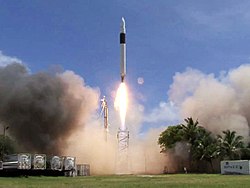
The maiden launch of Falcon 1 happened on March 24, 2006, at 22:30 UTC. A fire damaged the rocket's pressurization system and caused the Merlin engine to flame off at T+29 seconds.
Jul 2008
% complete
The company grew rapidly since its founding, expanding from 160 employees in November 2005 to more than 500 by July 2008, over 1,100 in 2010, and 1,800 in early 2012.
Aug 4, 2008
% complete
On August 4, 2008, SpaceX accepted a further $20 million investment from Founders Fund during a critical period for the young company.
Jun 16, 2009
% complete
On June 16, 2009, SpaceX announced the opening of its Astronaut Safety and Mission Assurance Department, led by a former astronaut who subsequently left the company in late 2011.
Jan 2015
% complete
In January 2015, SpaceX raised $1 billion from Google and Fidelity Investments in exchange for 8.333% of the company, establishing a valuation of approximately $12 billion. Shotwell said in March 2015 the investment was not specifically for the global internet project.
Mar 2021
% complete
In 2020, Abu Dhabi-based International Holding Group bought 94% stakes in Falcon CI IV LP, which had invested in SpaceX. Following the purchase, SpaceX completed an $850 million equity funding round, taking the company's value to nearly $74 billion in March 2021; IHC's stock also surged 75% as of April 2021.
Mar 1, 2013
% complete
On March 1, 2013, a Dragon spacecraft in orbit developed problems with its thrusters. Since spacecraft like Dragon were classified as munitions under arms regulations until November 2014, mission controllers were unable to release more information to the public.
Image source: SpaceX Dragon
Mar 2013
% complete
As of March 2013, SpaceX was running a test program of the low-altitude Grasshopper vertical takeoff, vertical landing demonstrator, plus high-altitude Falcon 9 post-mission booster return tests beginning mid-2013 with every first stage instrumented as a controlled descent test vehicle.
Image source: Falcon 9 prototypes
Jun 28, 2015
% complete
On June 28, 2015, CRS-7 launched a Falcon 9 carrying an unmanned Dragon capsule intended to take supplies to the International Space Station; the vehicle broke apart in flight.
Image source: SpaceX CRS-7
Sep 1, 2016
% complete
On September 1, 2016, a Falcon 9 Full Thrust exploded during propellant fill for a pre-launch static fire test at Cape Canaveral Launch Complex 40. In November 2016, Musk reported the liquid oxygen had become so cold it turned solid and may have breached the helium pressure vessels.
Image source: AMOS-6 (satellite)
Jan 2, 2017 - Jan 14, 2017
% complete
SpaceX concluded its investigation on January 2, 2017, then got back to flying on January 14, 2017, with its launch of Iridium satellites after the launchpad explosion setback.
Feb 19, 2017
% complete
On February 19, 2017, a Falcon 9 carrying CRS-10 conducted the first launch from Kennedy Space Center's Launch Complex 39A, the historic pad used for Apollo and Space Shuttle missions.
Image source: Kennedy Space Center Launch Complex 39A
May 23, 2019
% complete
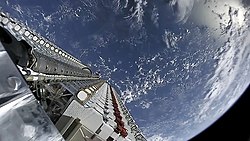
On May 23, 2019, SpaceX deployed the first 60 of around 12,000 satellites planned for its Starlink system, aimed at providing low-latency network communications via a large constellation in low Earth orbit.
Image source: Starlink
May 30, 2020 - Aug 2, 2020
% complete
On May 30, 2020, SpaceX launched NASA astronauts Douglas Hurley and Robert Behnken on Crew Dragon during Demo-2, making SpaceX the first private company to send astronauts to the ISS and marking the first crewed launch from American soil in 9 years. The spacecraft docked on May 31 and returned safely on August 2, 2020.
Image source: Crew Dragon Demo-2
Aug 2020
% complete
In August 2020, SpaceX indicated it was looking to build a resort in South Texas with the intent to turn Boca Chica into a '21st century Spaceport'.
Image source: Starbase, Texas
Apr 20, 2023
% complete
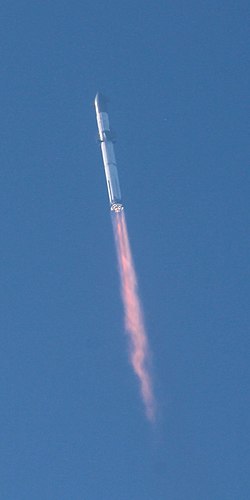
On April 20, 2023, the SpaceX Starship orbital test flight ended in failure, and the rocket's flight termination system was activated four minutes into the flight.
Image source: Starship flight test 13
2025
% complete
In 2025, residents of Boca Chica Village, Texas, home of SpaceX's Starbase private launch site, voted to incorporate themselves into a new city dubbed Starbase, Texas.
Or browse the full history timeline directory, with more than 2,000 topics.
This History of SpaceX timeline was generated with the help of AI, using information found on the internet.
We work hard to keep these timelines accurate, but mistakes do get through. If you spot one, email us at [email protected] and we'll fix it for future visitors.
Generate yours with AI or build it from scratch, for free.
Export your timeline, add your own events, edit or remove AI-generated events, and much more
No credit card required.
Cancel anytime.
Cancel anytime.
You can create an unlimited number of timelines with up to 10 events on each one, customize how they look, export them to PDF, PNG, PowerPoint, CSV, and Excel, and share them with a link. Paid plans raise the event limit and add features like spreadsheet imports and collaborators.
Yes. You can cancel your subscription from your account page at any time, and you will not be charged again. Your subscription stays active for the rest of the period you already paid for.
Yes. We will email you a reminder before the annual renewal, and we will also email you a receipt.
Yes. You can email us within 15 days of any payment, and we will issue you a full refund.
Check out our pricing docs or send us an email anytime: [email protected].