-
Use Cases
-
Resources
-
Pricing
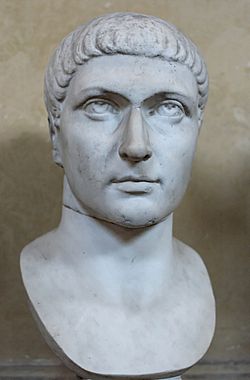
Constantine the Great (c. 272–337 AD) was Roman emperor whose reign transformed the empire. He reunified the divided empire after civil war, founded Constantinople as a new capital in the East, and legalized Christianity through the Edict of Milan in 313 AD, laying the foundation for Christianity's role in European history. More Less
196
The Greek city of Byzantium was extensively rebuilt on Roman patterns of urbanism by Septimius Severus and Caracalla, who had already acknowledged its strategic importance. This made it an attractive site when Constantine later decided to develop a new capital there.
Image source: Byzantium

235 - 284
During the Crisis of the Third Century, senators were marginalised as potential holders of imperial functions, though they could still dispute such positions alongside more upstart bureaucrats. The Senate as a body remained devoid of any significant power.
Image source: Constantine the Great

235
The military chiefs had risen from the ranks since the Crisis of the Third Century but remained outside the Senate. They were included in the Senate only by Constantine's children after his reign.
250
Beginning in the mid-3rd century, Roman emperors began to favour members of the equestrian order over senators, who had previously held a monopoly on the most important offices of the state. This shift reshaped the imperial administration that Constantine would later inherit and reform.
250
In the 3rd century, the production of fiat money to pay for public expenses resulted in runaway inflation. Diocletian tried unsuccessfully to re-establish trustworthy minting of silver coins as well as silver-bronze 'billon' coins, an alloy mostly of base metal.
306 - 337
Constantine pursued campaigns against the tribes on the Roman frontiers—such as the Franks, the Alemanni, the Goths, and the Sarmatians—and resettled territories abandoned by his predecessors during the Crisis of the Third Century with citizens of Roman society.
Jul 25, 310
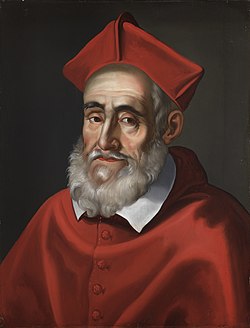
In a speech delivered in Gaul on 25 July 310, an anonymous orator revealed a previously unknown dynastic connection between Constantine and Claudius II, a 3rd-century emperor famed for defeating the Goths and restoring order to the empire.
Image source: Panegyrici Latini

324
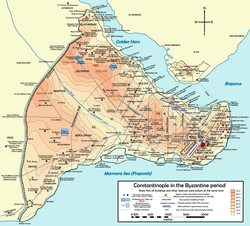
Eventually, Constantine decided to work on the Greek city of Byzantium, which offered the advantage of having already been extensively rebuilt on Roman patterns of urbanism during the preceding century by Septimius Severus and Caracalla, who had acknowledged its strategic importance.
Image source: Constantinople
337
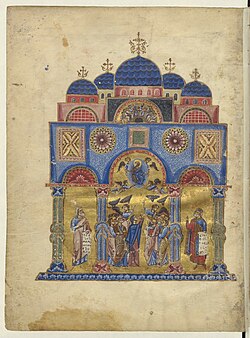
Following his death, Constantine's body was transferred to Constantinople and buried in the Church of the Holy Apostles, in a porphyry sarcophagus that was described in the 10th century by Constantine VII Porphyrogenitus in the De Ceremoniis.
Image source: Church of the Holy Apostles
350
The title of perfectissimus was granted only to mid- or low-level officials by the end of the 4th century, reflecting the administrative reordering begun under Constantine's reforms of the imperial bureaucracy.
This Constantine the Great timeline was generated with the help of AI, using information found on the internet.
We work hard to keep these timelines accurate, but mistakes do get through. If you spot one, email us at [email protected] and we'll fix it for future visitors.
Generate yours with AI or build it from scratch, for free.