-
Use Cases
-
Resources
-
Pricing
Cubism was a groundbreaking avant-garde art movement that emerged in Paris in the early 20th century. Pioneered by Pablo Picasso and Georges Braque, it abandoned traditional perspective and instead depicted subjects as fragmented, geometric forms viewed from multiple angles simultaneously. Cubism profoundly influenced modern art, inspiring movements such as Futurism, Constructivism, and Abstract art. More Less
1904
Paul Cézanne's late works, emphasizing geometric simplification of nature into cones, spheres, and cylinders, were shown in Paris exhibitions. His approach profoundly influenced Picasso and Braque, laying the conceptual groundwork for Cubism's fragmentation of form.
Image source: Paul Cézanne

1904
Pablo Picasso settled in the Bateau-Lavoir studio building in Montmartre, a hub for avant-garde artists and writers. The environment of experimentation and exchange helped incubate the radical ideas that would become Cubism.
Image source: Bateau-Lavoir

1905 - 1906
After his melancholic Blue Period, Picasso entered his Rose Period, then began studying Iberian sculpture and African masks. These non-Western sources inspired simplified, angular forms that would appear in his proto-Cubist works.
Image source: Pablo Picasso

Mar 1906
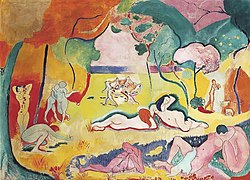
Henri Matisse's large Fauvist canvas shocked Paris audiences with its flattened forms and arbitrary color. Its radical departure from naturalism opened the door for even more extreme experiments by Picasso and others.
Image source: Le bonheur de vivre
Sep 1907
A major memorial retrospective of Paul Cézanne's paintings at the Salon d'Automne exposed young artists to his method of constructing form from color patches and geometric volumes. It became a catalyst for both Picasso and Braque's move toward Cubism.
Image source: Salon d'Automne

1907
Picasso's landmark painting depicted five prostitutes with fractured, mask-like faces and angular bodies influenced by African and Iberian art. Though initially met with shock and confusion, it is widely regarded as the proto-Cubist work that shattered centuries of Western pictorial tradition.
Image source: Les Demoiselles d'Avignon

1908
Inspired by Cézanne's retrospective exhibition and by Picasso's breakthrough, Braque painted 'Grand Nu,' reducing the female figure to faceted planes. This marked his decisive turn toward the geometric language that would define early Cubism.
Image source: Georges Braque

1910
Picasso's portrait of his dealer dissolved the sitter into a lattice of shimmering gray-brown facets, one of the most rigorous examples of high Analytic Cubism. The subject is recognizable only through subtle clues like hands and a watch chain.
Image source: Daniel-Henry Kahnweiler (Picasso)

1910 - 1920
Fernand Léger adapted Cubist fragmentation into bold cylindrical forms celebrating the machine age, seen in works like 'Nude Model in the Studio.' His mechanized aesthetic earned the nickname 'Tubism' and bridged Cubism and Purism.
Image source: Fernand Léger

1911 - 1912
Picasso's 'Ma Jolie,' referencing a popular song and his lover Eva Gouel, pushed Analytic Cubism to its limits, with lettering floating across an almost illegible field of facets. The inclusion of words signaled a shift toward incorporating real-world references.
This Cubism timeline was generated with the help of AI, using information found on the internet.
We work hard to keep these timelines accurate, but mistakes do get through. If you spot one, email us at [email protected] and we'll fix it for future visitors.
Generate yours with AI or build it from scratch, for free.