-
Use Cases
-
Resources
-
Pricing
The Bauhaus was a German school of art, design, and architecture founded by Walter Gropius in Weimar in 1919. It sought to unite fine arts with crafts and functional industrial design, producing a minimalist aesthetic that shaped modern architecture and design worldwide. Forced to relocate to Dessau and later Berlin due to political pressure, it was closed in 1933 under the Nazi regime, but its ideas spread globally through its emigré teachers. More Less
1834 - 1896
% complete
The 19th-century English designer William Morris (1834–1896) argued that art should meet the needs of society and that there should be no distinction between form and function. His ideas deeply influenced Walter Gropius and the founding philosophy of the Bauhaus.
Image source: William Morris
1906
% complete
The roots of the Bauhaus lay in the arts and crafts school founded by the Grand Duke of Saxe-Weimar-Eisenach in 1906, directed by Belgian Art Nouveau architect Henry van de Velde. This institution later merged into the Bauhaus.
Image source: Bauhaus

1907
% complete
The German national designers' organization Deutscher Werkbund was formed in 1907 by Hermann Muthesius to harness the new potentials of mass production, with a mind towards preserving Germany's economic competitiveness with England. Debates among its members over craftsmanship versus mass production shaped the intellectual climate from which the Bauhaus emerged.
Image source: Deutscher Werkbund
Jun 1907
% complete
Beginning in June 1907, Peter Behrens' pioneering industrial design work for the German electrical company AEG successfully integrated art and mass production on a large scale, providing a key precedent for the Bauhaus's later fusion of art and industry.
Image source: Peter Behrens
1915
% complete
When van de Velde was forced to resign in 1915 because he was Belgian, he suggested Gropius, Hermann Obrist, and August Endell as possible successors, setting the stage for Walter Gropius eventually taking leadership of the Weimar schools.
Image source: Henry van de Velde
1920
% complete
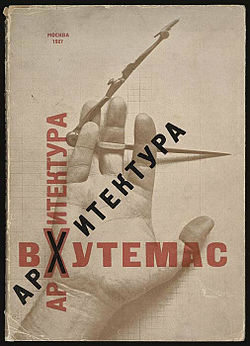
The Vkhutemas, the Russian state art and technical school founded in 1920 in Moscow, has been compared to the Bauhaus. El Lissitzky's book Russia: an Architecture for World Revolution, published in German in 1930, featured several illustrations of Vkhutemas/Vkhutein projects.
Image source: Vkhutemas
1919
% complete
Swiss painter Johannes Itten, German-American painter Lyonel Feininger, and German sculptor Gerhard Marcks, along with Gropius, comprised the faculty of the Bauhaus in 1919, forming the core teaching staff of the new school.
Apr 1, 1919
% complete
The school was founded by Walter Gropius in Weimar on 1 April 1919, as a merger of the Grand Ducal Saxon Academy of Fine Art and the Grand Ducal Saxon School of Arts and Crafts for a newly affiliated architecture department. After delays caused by World War I and lengthy debate, Gropius was made director of the new institution integrating the two schools.
Apr 1919
% complete
In the pamphlet for an April 1919 exhibition entitled Exhibition of Unknown Architects, Gropius proclaimed his goal as being 'to create a new guild of craftsmen, without the class distinctions which raise an arrogant barrier between craftsman and artist.' His neologism Bauhaus references both building and the Bauhütte, a premodern guild of stonemasons.
1920 - 1921
% complete
The first major joint project completed by the Bauhaus was the Sommerfeld House, which was built between 1920 and 1921, demonstrating the school's collaborative approach to design and craftsmanship.
1920 - 1922
% complete
By 1920 the faculty had grown to include Oskar Schlemmer, who headed the theatre workshop, and Swiss painter Paul Klee, joined in 1922 by Russian painter Wassily Kandinsky, a founding member of Der Blaue Reiter.
1922
% complete
A tumultuous year at the Bauhaus, 1922 also saw the move of Dutch painter Theo van Doesburg to Weimar to promote De Stijl ('The Style'), and a visit to the Bauhaus by Russian Constructivist artist and architect El Lissitzky.
Image source: Theo van Doesburg
1923
% complete
In 1923 the Bauhaus exhibited the experimental Haus am Horn, meeting demands for demonstrable achievements. By this time Gropius was no longer evoking craft-driven Expressionist imagery, instead declaring 'we want an architecture adapted to our world of machines, radios and fast cars.'
Image source: Haus am Horn
1923 - 1924
% complete
The school in Weimar experienced political pressure from conservative circles in Thuringian politics, increasingly so after 1923 as political tension rose, foreshadowing the funding cuts that would force the school's relocation.
Oct 1, 1923 - Dec 31, 1923
% complete
From 1919 to 1922 the school was shaped by the pedagogical and aesthetic ideas of Johannes Itten, who taught the Vorkurs or 'preliminary course.' This influence culminated with the addition of Wassily Kandinsky to the faculty and ended when Itten resigned in late 1923.
Image source: Johannes Itten
1924
% complete
After the Social Democrats lost their majority in the 1924 state election, the new conservative Ministry of Education placed the staff on six-month contracts and cut the school's funding in half, threatening its survival in Weimar.
Dec 26, 1924
% complete
The Bauhaus issued a press release on 26 December 1924, setting the closure of the school for the end of March 1925, prompting the search for a new home in a more sympathetic city.
1925
% complete
The Bauhaus moved to Dessau in 1925, where new facilities designed by Gropius were inaugurated in late 1926. The move marked a fresh chapter for the school under more supportive local government.
Image source: Bauhaus Dessau
1926
% complete
Gropius's definitive 1926 Bauhaus building in Dessau was a return to the futuristic Gropius of 1914, with lines more in common with the International style Fagus Factory than earlier works. The school also began offering architecture classes around this time, despite its manifesto proclaiming building as the aim of all creative activity.
Feb 1928
% complete
Meyer became director when Gropius resigned in February 1928, and brought the Bauhaus its two most significant building commissions: five apartment buildings in Dessau and the ADGB Trade Union School in Bernau bei Berlin, both of which still exist.
Image source: Hannes Meyer
1929
% complete
The school turned its first profit under Hannes Meyer's leadership in 1929, reflecting his focus on practical, socially useful design and collaboration with industry.
1930
% complete
Dessau mayor Fritz Hesse fired Meyer in the summer of 1930 due to his Marxist leanings. When he was fired, a number of communist students loyal to him moved to the Soviet Union.
1928
% complete
In 1928, the Hungarian painter Alexander Bortnyik founded a school of design in Budapest called Műhely ('the studio'). Bortnyik was a great admirer of László Moholy-Nagy and had met Walter Gropius in Weimar between 1923 and 1925. Victor Vasarely studied at this school before establishing himself in Paris in 1930.
Image source: Sándor Bortnyik
1935
% complete
When Hitler's chief engineer Fritz Todt began opening the new autobahns in 1935, many of the bridges and service stations were 'bold examples of modernism', and among those submitting designs was Mies van der Rohe.
Image source: Fritz Todt
1953 - 1968
% complete
In 1953, Max Bill, together with Inge Aicher-Scholl and Otl Aicher, founded the Ulm School of Design (Hochschule für Gestaltung – HfG Ulm), a design school in the tradition of the Bauhaus. The school closed in 1968, but the 'Ulm Model' concept continues to influence international design education.
Image source: Ulm School of Design
1974
% complete
The Bauhaus-Dessau Foundation was founded in 1974 as a public institution, supporting preservation and educational efforts related to the Bauhaus legacy in Dessau.
Image source: Bauhaus Dessau
1979
% complete
In 1979 Bauhaus-Dessau College started to organize postgraduate programs with participants from all over the world, an effort supported by the Bauhaus-Dessau Foundation.
1996
% complete
In 1996, four of the major sites associated with the Bauhaus in Germany were inscribed on the UNESCO World Heritage List, with two more added in 2017. That same year, the Technical University of Architecture and Civil Engineering in Weimar changed its name to Bauhaus-University Weimar.
Image source: Bauhaus and its Sites in Weimar, Dessau and Bernau
2003
% complete
In 2003, UNESCO proclaimed Tel Aviv's White City a World Cultural Heritage site, as 'an outstanding example of new town planning and architecture in the early 20th century,' recognizing the unique adaptation of modern international architectural trends—shaped significantly by Bauhaus-trained architects—to local conditions.
Image source: White City, Tel Aviv
2019
% complete
As the centenary of the founding of the Bauhaus, several events, festivals, and exhibitions were held around the world in 2019, marking one hundred years since Gropius founded the school in Weimar.
Apr 12, 2019
% complete
Google honored the Bauhaus for its 100th anniversary on 12 April 2019 with a Google Doodle, celebrating a century since the school's founding in Weimar.
Sep 2019
% complete
The Bauhaus Museum Dessau opened in September 2019, operated by the Bauhaus Dessau Foundation and funded by the State of Saxony-Anhalt and the German Federal government. It is the permanent home of the second-largest Bauhaus collection at 49,000 objects, paying homage to the city's strong Bauhaus heritage dating to 1925.
Image source: Bauhaus Museum Dessau
Sep 6, 2019 - Jan 27, 2020
% complete
Original Bauhaus, The Centenary Exhibition, shown at the Berlinische Galerie from 6 September 2019 to 27 January 2020, presented over 1,000 original works from the Bauhaus-Archiv / Museum für Gestaltung.
Image source: Berlinische Galerie
Sep 2020
% complete
In September 2020, President of the European Commission Ursula von der Leyen introduced the New European Bauhaus (NEB) initiative during her State of the Union address, reviving the Bauhaus spirit as a creative movement linking sustainability, aesthetics, and inclusiveness.
Image source: European Green Deal
2024
% complete
In 2024, the German far-right party Alternative for Germany (AfD) sought to attack celebrations of the Bauhaus because of their view that the Bauhaus did not follow tradition, echoing historical criticism of the school's modernism.
Image source: Alternative for Germany
1930
% complete
Mies was appointed in 1930 and immediately interviewed each student, dismissing those that he deemed uncommitted, seeking to depoliticize the school and preserve its existence under increasing pressure.
Image source: Ludwig Mies van der Rohe
1931
% complete
By 1931, the Nazi Party was becoming more influential in German politics and won a majority on the Dessau city council, directly threatening the future of the Bauhaus in the city.
Image source: Nazi Party
1932
% complete
The Dessau campus was shuttered in 1932, after the Nazi party took over the local government of the Free State of Anhalt, forcing the school to seek refuge in Berlin.
Oct 1, 1932 - Dec 31, 1932
% complete
In late 1932, Mies rented a derelict factory in Berlin (Birkbusch Street 49) with his own money to use as the new Bauhaus, attempting to continue the school as a private institution.
1933 - 1938
% complete
Of 119 teaching staff, c. 15 emigrated between 1933 and 1938. Of the c. 1,250 students enrolled when Hitler came to power in 1933, approximately 900 are thought to have remained in Germany, while others spread Bauhaus ideas worldwide.
Apr 1933
% complete
Although neither the Nazi Party nor Hitler had a cohesive architectural policy before coming to power in 1933, Nazi writers like Wilhelm Frick and Alfred Rosenberg had labelled the Bauhaus 'un-German' and criticized its modernist styles. Despite Gropius's protestations that his work had no subversive political intent, the Berlin Bauhaus was pressured to close in April 1933, and the Gestapo closed down the Berlin school.
Or browse the full history timeline directory, with more than 2,000 topics.
This Bauhaus timeline was generated with the help of AI, using information found on the internet.
We work hard to keep these timelines accurate, but mistakes do get through. If you spot one, email us at [email protected] and we'll fix it for future visitors.
Generate yours with AI or build it from scratch, for free.
Export your timeline, add your own events, edit or remove AI-generated events, and much more
No credit card required.
Cancel anytime.
Cancel anytime.
You can create an unlimited number of timelines with up to 10 events on each one, customize how they look, export them to PDF, PNG, PowerPoint, CSV, and Excel, and share them with a link. Paid plans raise the event limit and add features like spreadsheet imports and collaborators.
Yes. You can cancel your subscription from your account page at any time, and you will not be charged again. Your subscription stays active for the rest of the period you already paid for.
Yes. We will email you a reminder before the annual renewal, and we will also email you a receipt.
Yes. You can email us within 15 days of any payment, and we will issue you a full refund.
Check out our pricing docs or send us an email anytime: [email protected].