
-
Use Cases
-
Resources
-
Pricing
1915
Soon after arriving from France in 1915, Marcel Duchamp and Francis Picabia met the American artist Man Ray.
1916 - 1923
By 1916, Marcel Duchamp, Francis Picabia, and Man Ray had become the centre of radical anti-art activities in the United States.
1917 - 1921
Although Dada was unknown in Georgia until at least 1920, the poets of Le Degré 41 organized along Dadaist lines from 1917 through 1921.
1917 - 1924
Francis Picabia published the Dada periodical 391 for seven years in Barcelona, New York City, Zürich, and Paris.
1917
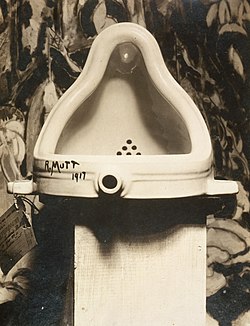
In a 1917 letter to his sister, Duchamp indicated that a female friend using the pseudonym Richard Mutt was centrally involved in sending the porcelain urinal as a sculpture. The work also relates to the scatological aesthetics of Baroness Elsa von Freytag-Loringhoven.
Image source: Fountain (Duchamp)
1917
In 1917, Marcel Duchamp submitted Fountain, a urinal signed R. Mutt, to the Society of Independent Artists exhibition, but the organizers rejected it.
1920 - 1922
Significant Dada activity took place in Yugoslavia alongside Zenitism from 1920 to 1922, led mainly by Dragan Aleksić and involving Mihailo S. Petrov, Ljubomir Micić, and Branko Ve Poljanski.
1921
After fleeing to Paris in 1921, Iliazd collaborated with Dadaists on publications and events.
1922 - 1923
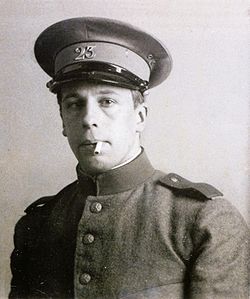
Theo van Doesburg and I.K. Bonset published the short-lived Dutch Dada magazine Mécano from 1922 to 1923.
Image source: Theo van Doesburg
1923 - 1926
The Groningen typographer H. N. Werkman edited The Next Call from 1923 to 1926 and maintained contact with Theo van Doesburg and Kurt Schwitters.
Image source: Hendrik Nicolaas Werkman
1923
Theo van Doesburg and Thijs Rinsema organized the Dutch Dada campaign in 1923. Van Doesburg promoted a leaflet titled What is Dada?, Schwitters read poems, Vilmos Huszár demonstrated a mechanical dancing doll, and Nelly van Doesburg played avant-garde piano compositions.
1923
When Tristan Tzara was banned from holding seminars at Théâtre Michel in 1923, Iliazd booked the venue on his behalf for The Bearded Heart Soirée and designed its flyer.
Jul 1923
The Japanese Dada group was founded in July 1923 by Tomoyoshi Murayama and Yanase Masamu; Tatsuo Okada later joined them.
1915 - 1924
Dada’s principal centres included Zürich from 1916, New York from about 1915 to about 1923, Berlin from about 1918 to 1920, Cologne and Hannover from about 1919 to 1920, and Paris from about 1919 to 1924.
Image source: Dada
Jul 1917 - 1921
With Tristan Tzara at its helm, Zürich Dada published the art and literature review Dada beginning in July 1917. Five editions appeared in Zürich and the final two in Paris.
1918
Richard Huelsenbeck produced a Dada manifesto later in 1918, extending Dada’s program into the politically charged Berlin scene.
1918
Raoul Hausmann published his manifesto Synthethic Cino of Painting in 1918, attacking Expressionism and the art critics who promoted it.
Feb 1918
In February 1918, while the Great War was approaching its climax, Richard Huelsenbeck gave his first Dada speech in Berlin.
Nov 1918
After the First World War ended in the armistice of November 1918, most Zürich Dadaists returned to their home countries, and some began Dada activities in other cities.
1920
After the war, Berlin artists published short-lived political magazines and held the First International Dada Fair, described as their greatest project, in the summer of 1920.
1920
More than 200 works were exhibited at the First International Dada Fair, surrounded by incendiary slogans. Some of those slogans later appeared on the walls of the Nazi Entartete Kunst exhibition in 1937.
1920
In Cologne, Max Ernst, Johannes Theodor Baargeld, and Hans Arp launched a controversial Dada exhibition in 1920 focused on nonsense and anti-bourgeois sentiments.
1920
Dada surged in Paris in 1920 as many of the movement’s originators converged there.
1921
By 1921, most of Dada’s original players had moved to Paris, where the movement experienced its last major incarnation.
1921
The first introduction of Dada artwork to the Parisian public took place at the Salon des Indépendants in 1921.
1923
When the Dada drama was re-staged in 1923 in a more professional production, it provoked a theatre riot initiated by André Breton and heralded the split that produced Surrealism.
1924
Tristan Tzara’s last attempt at a Dadaist drama was his ironic tragedy Handkerchief of Clouds in 1924.
Image source: Tristan Tzara
1916
Dada coalesced among émigré artists and writers in neutral Switzerland during 1916, amid the political turmoil of the First World War.
1916
Hugo Ball and Emmy Hennings founded Cabaret Voltaire in Zürich as a venue for nightly performances, poetry, and manifestos.
1916
Hugo Ball’s Dada Manifesto became the first major written collection of the movement’s principles.
Image source: Dada Manifesto
1916 - 1918
Dada was active during years of political turmoil while European countries were engaged in the First World War; the war’s conclusion in 1918 helped set the stage for a new political order.
Jul 14, 1916
On 14 July 1916, Hugo Ball originated the seminal Dada Manifesto, helping define the movement’s anti-art and anti-bourgeois principles.
1918
Tristan Tzara wrote a second Dada manifesto, published in 1918 and regarded as an important text in Dada reading.
1920
Kurt Schwitters developed what he called sound poems, extending Dada’s experimentation with language, performance, and vocal sound.
1920
Tzara’s 1920 manifesto proposed cutting words from a newspaper and randomly selecting fragments to create poetry, making the synchronous universe an active agent in producing art.
May 26, 1920
Francis Picabia and Georges Ribemont-Dessaignes composed Dada music performed at the Festival Dada in Paris on 26 May 1920.
1920 - 1960
Dada exerted a pervasive influence on twentieth-century music, especially on mid-century avant-garde composers based in New York, including Edgard Varèse, Stefan Wolpe, John Cage, and Morton Feldman.
1924
By 1924 in Paris, Dada was melding into Surrealism, while artists moved on to Surrealism, social realism, and other forms of modernism.
Image source: Surrealism
1959
Butoh, the Japanese dance form originating in 1959, can be connected to Dada’s spirit because one of its founders, Tatsumi Hijikata, was influenced early in his career by Dadaism.
Image source: Butoh
1966
Tsuburaya Productions’ Ultra Series introduced an alien named Dada in episode 28 of the 1966 tokusatsu series Ultraman. The character was inspired by Dadaism and designed by Toru Narita.
1967
A large Dada retrospective was held in Paris in 1967, reflecting the movement’s growing recognition in art history.
Mar 28, 1971
DADA 'Archives du XXe siècle', a 267-minute documentary produced by Jean José Marchand and directed by Philippe Collin and Hubert Knapp, was first broadcast by the RTF on 28 March 1971.
1974
Tom Stoppard used the coincidence of Tristan Tzara, Vladimir Lenin, and James Joyce being in Zürich as a premise for his 1974 play Travesties.
Jan 2002 - Mar 2002
The former Cabaret Voltaire building had fallen into disrepair until it was occupied from January to March 2002 by a group calling itself Neo-Dadaists, led by Mark Divo.
2004
Art-world experts polled by the sponsors of the 2004 Turner Prize, Gordon’s gin, voted Duchamp’s Fountain the most influential work of modern art.
Jan 2006
In January 2006, performance artist Pierre Pinoncelli cracked a replica of Fountain with a hammer in an attempt to pay homage to the spirit of Dada. He had also urinated on a replica in 1993.
2006
In 2006, the Museum of Modern Art in New York City mounted a Dada exhibition in partnership with the National Gallery of Art in Washington, D.C., and the Centre Pompidou in Paris.
May 19, 2016
On 19 May 2016, during the centenary celebrations of Dadaism in Tokyo, the Ultra Monster Dada was invited to meet Swiss Ambassador Urs Bucher.
Or browse the full history timeline directory, with more than 2,500 topics.
This Dada Movement timeline was generated with the help of AI, using information found on the internet.
We work hard to keep these timelines accurate, but mistakes do get through. If you spot one, email us at [email protected] and we'll fix it for future visitors.
Generate yours with AI or build it from scratch, for free.
Export your timeline, add your own events, edit or remove AI-generated events, and much more
No credit card required.
Cancel anytime.
Cancel anytime.
You can create an unlimited number of timelines with up to 10 events on each one, customize how they look, export them to PDF, PNG, PowerPoint, CSV, and Excel, and share them with a link. Paid plans raise the event limit and add features like spreadsheet imports and collaborators.
Yes. You can cancel your subscription from your account page at any time, and you will not be charged again. Your subscription stays active for the rest of the period you already paid for.
Yes. We will email you a reminder before the annual renewal, and we will also email you a receipt.
Yes. You can email us within 15 days of any payment, and we will issue you a full refund.
Check out our pricing docs or send us an email anytime: [email protected].