-
Use Cases
-
Resources
-
Pricing
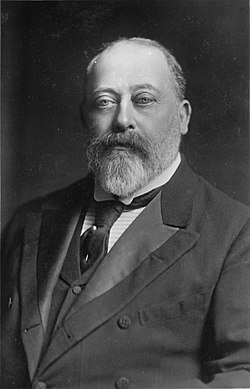
King Edward VII was the eldest son of Queen Victoria and Prince Albert, who reigned as King of the United Kingdom and the British Dominions and Emperor of India from 1901 until his death in 1910. Known as the 'Peacemaker,' he modernized the British monarchy, strengthened diplomatic ties across Europe through royal tours and state visits, and lent his name to the fashionable 'Edwardian era.' Before ascending the throne at age 59, he served as Prince of Wales for nearly six decades, becoming a popular figure despite occasional scandals. More Less
Nov 9, 1841
% complete
Edward was born at 10:48 am on 9 November 1841 at Buckingham Palace, London, the eldest son and second child of Queen Victoria and Prince Albert of Saxe-Coburg and Gotha.
Image source: Edward VII
Dec 8, 1841
% complete
He was created Prince of Wales and Earl of Chester on 8 December 1841, a title he would hold until he became king.
Image source: Prince of Wales
Jan 25, 1842
% complete
Edward was christened Albert Edward at St George's Chapel, Windsor Castle, on 25 January 1842.
Jan 17, 1850
% complete
Edward was created Earl of Dublin on 17 January 1850, adding to his growing list of titles.
Nov 9, 1858
% complete
On his seventeenth birthday, Edward was gazetted colonel and appointed Knight of the Garter on 9 November 1858 — to his disappointment, as he had wanted to earn his commission by examination.
Jan 1859 - Aug 1859
% complete
After an educational trip to Rome undertaken in the first few months of 1859, Edward spent the summer of that year studying at the University of Edinburgh under, among others, the chemist Lyon Playfair.
Jan 1861
% complete
In 1861, Edward transferred to Trinity College, Cambridge, where he was tutored in history by Charles Kingsley, Regius Professor of Modern History.
Dec 14, 1861
% complete
Prince Albert died in December 1861, just two weeks after visiting Edward at Cambridge to discuss the latter's relationship with Alexandra. Queen Victoria blamed Edward for his father's death.
Image source: Prince Albert of Saxe-Coburg and Gotha
Jan 1863
% complete
In 1863, Edward renounced his succession rights to the Duchy of Saxe-Coburg and Gotha in favour of his younger brother Alfred.
May 24, 1867
% complete
Edward was made a Knight of the Thistle on 24 May 1867, one of several honours conferred on him during his life.
Image source: Order of the Thistle
Jul 1860 - Nov 1860
% complete
In 1860, Edward undertook the first tour of North America by a Prince of Wales. The visit proved a popular success; prayers for the royal family were said in Trinity Church, New York, for the first time since 1776.
Image source: Edward VII
Feb 1864
% complete
Edward annoyed his mother by siding with Denmark on the Schleswig-Holstein Question in 1864 and in the same year annoyed her again by making a special effort to meet Giuseppe Garibaldi, the Italian general and revolutionary.
Image source: Schleswig–Holstein question
Sep 1869 - Feb 1870
% complete
In 1869, Sir Charles Mordaunt threatened to name Edward as co-respondent in his divorce suit. Ultimately he did not do so, but Edward was called as a witness in the case in early 1870.
Image source: Harriet Mordaunt
Sep 1870
% complete
In 1870 republican sentiment in Britain was given a boost when Napoleon III was defeated in the Franco-Prussian War and the French Third Republic was declared.
Image source: Republicanism in the United Kingdom
May 1871
% complete
Edward pioneered royal public appearances as they are understood today, including opening the Thames Embankment in 1871, though his mother did not allow him an active role in running the country until 1898.
Image source: Thames Embankment
Nov 1871 - Dec 1871
% complete
During the winter of 1871, a near-fatal bout of typhoid fever led to an improvement in both Edward's popularity with the public and his relationship with his mother.
Sep 26, 1875 - May 11, 1876
% complete
On 26 September 1875, Edward set off for India on an extensive eight-month tour, visiting Malta, Brindisi and Greece en route. He returned to England on 11 May 1876 after stopping off at Portugal. The tour proved a popular success.
May 1883
% complete
In 1883, Edward opened the Royal College of Music with the words, "Class can no longer stand apart from class..." reflecting his belief in broadening access.
Image source: Royal College of Music
Jan 20, 1886
% complete
Edward continued his pioneering public appearances, opening the Mersey Railway Tunnel in 1886. From that same year, Foreign Secretary Lord Rosebery sent him Foreign Office despatches.
Image source: Mersey Tunnels
Jan 1891
% complete
In 1891 Edward was embroiled in the royal baccarat scandal, when it was revealed he had played an illegal card game for money the previous year.
Image source: Royal baccarat scandal
Jan 1892
% complete
From 1892, some Cabinet papers were opened to Edward, gradually giving him more insight into government affairs during his mother's widowhood.
Jun 30, 1894
% complete
Edward opened Tower Bridge in 1894 as part of his pioneering role in royal public appearances, though he still lacked an active political role until 1898.
Image source: Tower Bridge
Jun 1896 - Sep 1896
% complete
In 1896, Edward's horse Persimmon won both the Derby and the St Leger, delighting the horse-racing prince.
Image source: Persimmon (horse)
Jan 1900 - Dec 1900
% complete
In 1900, Persimmon's brother, Diamond Jubilee, won five races, including the Triple Crown of Derby, St Leger and 2000 Guineas, plus the Newmarket Stakes and Eclipse Stakes.
Image source: Diamond Jubilee (horse)
Apr 4, 1900
% complete
On his way to Denmark through Belgium on 4 April 1900, Edward was the victim of an attempted assassination when 15-year-old Jean-Baptiste Sipido shot at him in protest over the Second Boer War.
Image source: Jean-Baptiste Sipido
Sep 24, 1861
% complete
In September 1861, Edward was sent to Germany to watch military manoeuvres but actually to meet Princess Alexandra of Denmark. They met at Speyer on 24 September under the auspices of his elder sister Victoria, Crown Princess of Prussia.
Image source: Alexandra of Denmark
Sep 9, 1862
% complete
As soon as Edward returned to Britain, preparations were made for his engagement, which was sealed at Laeken in Belgium on 9 September 1862.
Mar 10, 1863
% complete
Edward married Alexandra at St George's Chapel, Windsor Castle, on 10 March 1863. The couple had six children.
Image source: Wedding of Prince Albert Edward and Princess Alexandra
Nov 15, 1863
% complete
When Alexandra's father, King Christian IX, inherited the throne of Denmark in November 1863, the German Confederation took the opportunity to invade and annex Schleswig-Holstein.
Image source: Christian IX of Denmark
Apr 6, 1871
% complete
In 1871, Edward's youngest son, Alexander John, died just 24 hours after being born.
Image source: Alexander Stewart, Duke of Albany
Jan 14, 1892
% complete
In late 1891, Edward's eldest son, Albert Victor, was engaged to Princess Victoria Mary of Teck. Just weeks later, in early 1892, Albert Victor died of pneumonia.
Image source: Prince Albert Victor, Duke of Clarence and Avondale
Jan 22, 1901
% complete
When Queen Victoria died on 22 January 1901, Edward became King of the United Kingdom, Emperor of India and, in an innovation, King of the British Dominions.
Jun 1902 - Aug 1902
% complete
In 1902, the Shah of Persia, Mozzafar-al-Din, visited England expecting to receive the Order of the Garter, creating diplomatic awkwardness over honours protocol.
Image source: Mozaffar ad-Din Shah Qajar
Jun 26, 1902
% complete
Edward's coronation had originally been scheduled for 26 June 1902 but was postponed when he required emergency abdominal surgery days beforehand.
Image source: Coronation of Edward VII and Alexandra
Aug 9, 1902
% complete
Edward was crowned at Westminster Abbey on 9 August 1902 by the Archbishop of Canterbury, Frederick Temple.
May 1903
% complete
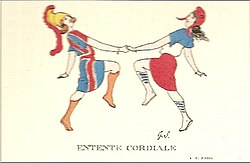
One of Edward's most important foreign trips was an official visit to France in May 1903 as the guest of President Émile Loubet, laying the groundwork for improved Anglo-French relations.
Image source: Entente Cordiale
Apr 1904
% complete
The Entente was negotiated in 1904 between French foreign minister Théophile Delcassé and British foreign secretary Lord Lansdowne. It marked the end of centuries of Anglo-French rivalry and Britain's splendid isolation from Continental affairs.
Jun 1904
% complete
In 1904, Wilhelm II and Edward met during an Anglo-German summit in Kiel, amid shifting European alliances.
Image source: Wilhelm II
Apr 1908
% complete
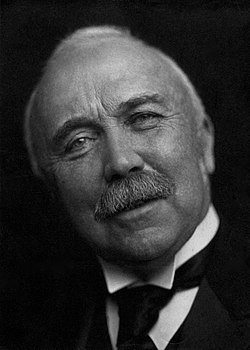
In April 1908, during Edward's annual stay at Biarritz, he accepted the resignation of British Prime Minister Sir Henry Campbell-Bannerman, appointing H.H. Asquith in his place.
Image source: Henry Campbell-Bannerman
Jun 1908
% complete
In June 1908, Edward became the first reigning British monarch to visit the Russian Empire, meeting Tsar Nicholas II at Reval, despite having refused to visit in 1906 amid strained relations.
May 26, 1909
% complete
After the King's horse Minoru won the Derby on 26 July 1909, Edward returned to the racetrack the following day and laughed when a man shouted: "Now, King."
Image source: Minoru (horse)
Oct 1909
% complete
Admiral Beresford's campaign against Fisher split the navy, and Fisher announced his resignation in late 1909, although the bulk of his policies were retained.
Image source: John Fisher, 1st Baron Fisher
Nov 5, 1909 - Nov 30, 1909
% complete
The Finance Bill passed the Commons on 5 November 1909 but was rejected by the Lords on 30 November, who claimed they were entitled to oppose it as it lacked an electoral mandate, triggering a constitutional crisis.
Image source: People's Budget
Jan 1910
% complete
Talk of removing the Lords' veto played a major role in the January 1910 election, fought against the backdrop of the constitutional crisis.
Image source: January 1910 United Kingdom general election
Jan 25, 1910
% complete
The King persuaded Sir Arthur Wilson to return to active duty, and Wilson became First Sea Lord on 25 January 1910, resolving the Fisher-Beresford feud's aftermath.
Image source: Sir Arthur Wilson, 3rd Baronet
Apr 14, 1910
% complete
On 14 April, the Commons passed resolutions that would form the basis for the Parliament Act 1911: removing the Lords' veto over money bills, replacing their veto of other bills with a delaying power, and reducing Parliament's term to five years.
Image source: Parliament Act 1911
Jan 1907 - Dec 1907
% complete
In 1907, a rodent ulcer, a type of cancer affecting the skin next to his nose, was cured with radium, one of the earliest uses of radiotherapy.
Feb 1909
% complete
Edward suffered a momentary loss of consciousness during a state visit to Berlin in February 1909, an early sign of declining health.
Mar 1910
% complete
In March 1910, Edward collapsed while staying at Biarritz, suffering from severe bronchitis, and his health rapidly declined thereafter.
May 6, 1910
% complete
Edward died on 6 May 1910 at Buckingham Palace, aged 68, in the midst of the constitutional crisis over the House of Lords' veto. His son George V succeeded him.
Image source: Death and state funeral of Edward VII
May 20, 1910
% complete
His funeral, held on 20 May 1910, marked "the greatest assemblage of royalty and rank ever gathered in one place and, of its kind, the last", according to Barbara Tuchman in The Guns of August.
Aug 18, 1911
% complete
The constitutional crisis that began under Edward was resolved by the Parliament Act 1911, passed after his death, which restricted the power of the unelected House of Lords.
1927
% complete
Publication of the official biography of Edward was delayed until 1927 by its author, Sidney Lee, who feared German propagandists would portray Edward as an anti-German warmonger.
Image source: Sidney Lee
Or browse the full history timeline directory, with more than 2,000 topics.
This Edward VII timeline was generated with the help of AI, using information found on the internet.
We work hard to keep these timelines accurate, but mistakes do get through. If you spot one, email us at [email protected] and we'll fix it for future visitors.
Generate yours with AI or build it from scratch, for free.
Export your timeline, add your own events, edit or remove AI-generated events, and much more
No credit card required.
Cancel anytime.
Cancel anytime.
You can create an unlimited number of timelines with up to 10 events on each one, customize how they look, export them to PDF, PNG, PowerPoint, CSV, and Excel, and share them with a link. Paid plans raise the event limit and add features like spreadsheet imports and collaborators.
Yes. You can cancel your subscription from your account page at any time, and you will not be charged again. Your subscription stays active for the rest of the period you already paid for.
Yes. We will email you a reminder before the annual renewal, and we will also email you a receipt.
Yes. You can email us within 15 days of any payment, and we will issue you a full refund.
Check out our pricing docs or send us an email anytime: [email protected].