-
Use Cases
-
Resources
-
Pricing
The Emancipation Proclamation was an executive order issued by President Abraham Lincoln during the American Civil War. It declared that all enslaved people in the Confederate states 'in rebellion' were to be set free, transforming the war into a fight for freedom and paving the way for the abolition of slavery through the Thirteenth Amendment. More Less
1777 - 1804
% complete
Between 1777 and 1804, every Northern state provided for the immediate or gradual abolition of slavery, creating a growing divide between free and slave states.
Image source: Emancipation Proclamation
1787
% complete
The United States Constitution of 1787 did not use the word 'slavery' but included several provisions about unfree persons, shaping the legal framework within which slavery persisted for decades.
1850
% complete
The Fugitive Slave Act of 1850 required individuals to return runaway slaves to their owners, intensifying national tensions over the institution of slavery.
Image source: Fugitive Slave Act of 1850
May 1861
% complete
Union general Benjamin Butler declared that three slaves who escaped to Union lines were contraband of war and refused to return them, saying he was under no constitutional obligations to a foreign country, which Virginia now claimed to be.
Image source: Contraband (American Civil War)
Aug 6, 1861
% complete
The First Confiscation Act freed slaves by confiscation and court proceedings who were employed against the Government and lawful authority of the United States.
Dec 1861
% complete
In December 1861, Lincoln sent his first annual message to Congress, then typically given in writing rather than delivered as a speech.
Jan 1862
% complete
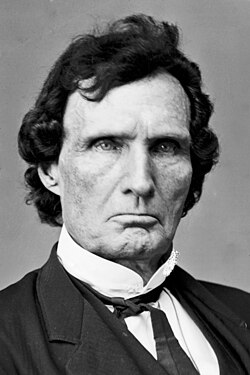
Thaddeus Stevens, the Republican leader in the House, called for total war against the rebellion to include emancipation of slaves, arguing that emancipation would ruin the rebel economy by forcing the loss of enslaved labor.
Image source: Thaddeus Stevens
Mar 13, 1862
% complete
Congress approved an act prohibiting all officers or persons in the military or naval service of the United States from returning fugitive slaves to their owners.
Image source: Act Prohibiting the Return of Slaves
Apr 16, 1862
% complete
Pursuant to a law signed by Lincoln, slavery was abolished in the District of Columbia on April 16, 1862, and owners were compensated for their losses.
Jun 19, 1862
% complete
Congress passed a bill on June 9, 1862 prohibiting slavery in all current and future United States territories, and Lincoln signed it into law on June 19. The act repudiated the Supreme Court's 1857 Dred Scott decision.
Jul 1862
% complete
Lincoln first discussed the draft Emancipation Proclamation with his cabinet in July 1862, beginning the process that would lead to its issuance.
Jul 17, 1862
% complete
The Second Confiscation Act freed slaves within any place occupied by rebel forces and afterwards occupied by Union forces, explicitly providing that covered slaves would be permanently freed. Lincoln maintained that while Congress lacked power to free all slaves, he as commander in chief could do so as a military measure.
Aug 1862
% complete
Republican editor Horace Greeley of the New-York Tribune wrote a famous editorial demanding a more aggressive attack on the Confederacy and faster emancipation of the slaves.
Image source: Horace Greeley
Sep 1862
% complete
In September 1862, the Battle of Antietam gave Lincoln the victory he needed to issue the Preliminary Emancipation Proclamation from a position of strength.
Image source: Battle of Antietam
Sep 7, 1862
% complete
A mass rally in Chicago on September 7, 1862 demanded immediate and universal emancipation of slaves, reflecting growing public pressure on Lincoln.
Sep 25, 1862
% complete
Robert Gould Shaw was skeptical of the announcement and wrote to his mother, 'So the "Proclamation of Emancipation" has come at last, or rather, its forerunner.'
Image source: Robert Gould Shaw
Sep 22, 1862
% complete
Five days after Antietam, Lincoln called his cabinet into session and issued the Preliminary Emancipation Proclamation (Proclamation 93), declaring that on January 1, 1863 he would free the slaves in states still in rebellion.
Oct 15, 1862 - Nov 15, 1862
% complete
From mid-October to mid-November 1862, Lincoln sent personal envoys to Louisiana, Tennessee, and Arkansas, actions suggesting he still considered saving the Union without freeing any slave a possibility.
Nov 1862
% complete
In the 1862 elections, the Democrats gained 28 seats in the House as well as the governorship of New York, adding political pressure around the pending proclamation.
Image source: 1862 United States elections
Dec 1862
% complete
Out of concern that Lincoln might not issue the Final Emancipation Proclamation, John Murray Forbes published pamphlets including the text of the Preliminary Proclamation and announcing the forthcoming final proclamation to take effect January 1st, 1863.
Image source: John Murray Forbes
Dec 1, 1862
% complete
In his Annual Message to Congress of December 1, 1862, Lincoln proposed an amendment to the Constitution providing that any state abolishing slavery before January 1, 1900 would receive compensation from the United States.
Dec 31, 1862
% complete
On New Year's Eve in 1862, African Americans – enslaved and free – gathered across the United States to hold Watch Night ceremonies for 'Freedom's Eve', looking toward midnight and the promised fulfillment of the Proclamation.
Image source: New Year's Eve
Jan 1, 1863
% complete
As promised, Lincoln issued the Final Emancipation Proclamation (Proclamation 95) on January 1, 1863, freeing slaves in the ten states still in rebellion: South Carolina, Mississippi, Florida, Alabama, Georgia, Louisiana, Texas, Virginia, Arkansas, and North Carolina, with specific exemptions for areas under Union control.
Feb 1863
% complete
In a speech at Cooper Union published in the New-York Tribune, Frederick Douglass called the Proclamation 'the greatest event of our nation's history, if not the greatest event of the century.'
Image source: Frederick Douglass
May 1863
% complete
A few months after the Proclamation took effect, the Confederacy passed a law demanding 'full and ample retaliation' against the United States in response to emancipation.
Aug 6, 1863
% complete
Giuseppe Garibaldi wrote to Lincoln: 'Posterity will call you the great emancipator, a more enviable title than any crown could be, and greater than any merely mundane treasure.'
Image source: Giuseppe Garibaldi
Nov 19, 1863
% complete
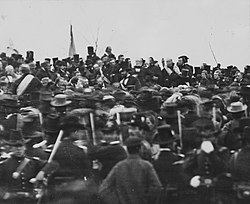
Lincoln's Gettysburg Address made indirect reference to the Proclamation and the ending of slavery as a war goal with the phrase 'new birth of freedom'.
Image source: Gettysburg Address
Dec 1863
% complete
In December 1863, Lincoln issued his Proclamation of Amnesty and Reconstruction, which dealt with the ways the rebel states could reconcile with the Union.
Nov 1, 1864
% complete
A new state constitution abolishing slavery in Maryland went into effect on November 1, 1864, ending slavery in one of the border states exempted from the Proclamation.
Dec 1864
% complete
By December 1864, the Lincoln plan abolishing slavery had been enacted not only in Louisiana, but also in Arkansas and Tennessee, following his moderate reconstruction proposal of 1863.
Jan 1, 1865 - Mar 31, 1865
% complete
In early 1865, Tennessee adopted an amendment to its constitution prohibiting slavery, extending emancipation beyond the reach of the Proclamation itself.
Jan 11, 1865
% complete
Slavery in Missouri ended when a state convention approved an ordinance abolishing slavery by a vote of 60-4, and Governor Thomas C. Fletcher immediately proclaimed it.
Image source: History of slavery in Missouri
Jan 31, 1865
% complete
The Senate had passed the 13th Amendment by the necessary two-thirds vote on April 8, 1864; the House of Representatives did the same on January 31, 1865, sending it to the state legislatures for ratification.
Image source: Thirteenth Amendment to the United States Constitution
Dec 6, 1865
% complete
The required ratification by three-fourths of the states was completed on December 6, 1865, and proclaimed twelve days later, banning slavery throughout the United States. In Delaware and Kentucky, slavery continued until the amendment took effect on December 18, 1865.
Sep 12, 1962
% complete
Martin Luther King Jr. gave an 'Emancipation Proclamation Centennial Address' in New York City, placing the Proclamation alongside the Declaration of Independence as an 'imperishable' contribution to civilization.
Jun 11, 1963
% complete
President Kennedy spoke on national television about civil rights during the centennial year of the Emancipation Proclamation, pushing for civil rights legislation until his assassination on November 22, 1963.
Image source: John F. Kennedy Jr.
Aug 16, 1963
% complete
A United States commemorative stamp marking the Emancipation Proclamation was issued on August 16, 1963, the opening day of the Century of Negro Progress Exhibition in Chicago, Illinois.
Aug 28, 1963
% complete
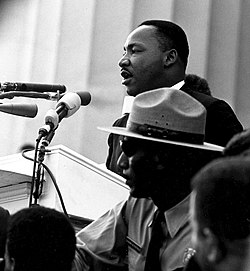
King's most famous invocation of the Emancipation Proclamation came in a speech from the steps of the Lincoln Memorial at the 1963 March on Washington for Jobs and Freedom, often referred to as the 'I Have a Dream' speech.
Image source: I Have a Dream
Mar 15, 1965
% complete
President Lyndon B. Johnson again invoked the Proclamation in a speech presenting the Voting Rights Act at a joint session of Congress, noting that a century had passed since the Negro was freed yet equality remained unfulfilled.
Or browse the full history timeline directory, with more than 2,000 topics.
This Emancipation Proclamation timeline was generated with the help of AI, using information found on the internet.
We work hard to keep these timelines accurate, but mistakes do get through. If you spot one, email us at [email protected] and we'll fix it for future visitors.
Generate yours with AI or build it from scratch, for free.
Export your timeline, add your own events, edit or remove AI-generated events, and much more
No credit card required.
Cancel anytime.
Cancel anytime.
You can create an unlimited number of timelines with up to 10 events on each one, customize how they look, export them to PDF, PNG, PowerPoint, CSV, and Excel, and share them with a link. Paid plans raise the event limit and add features like spreadsheet imports and collaborators.
Yes. You can cancel your subscription from your account page at any time, and you will not be charged again. Your subscription stays active for the rest of the period you already paid for.
Yes. We will email you a reminder before the annual renewal, and we will also email you a receipt.
Yes. You can email us within 15 days of any payment, and we will issue you a full refund.
Check out our pricing docs or send us an email anytime: [email protected].