-
Use Cases
-
Resources
-
Pricing
Desiderius Erasmus of Rotterdam (c. 1466–1536) was a Dutch Renaissance humanist, Catholic priest, theologian, and scholar. Known as the 'Prince of the Humanists,' he championed education, critical scholarship, and reform of the Church through his writings, including 'The Praise of Folly' and his Greek New Testament. His ideas laid intellectual groundwork for both the Reformation and modern humanism, though he remained committed to church unity. More Less
Oct 28, 1466
% complete
Desiderius Erasmus Roterodamus was born, likely out of wedlock, to a priest and a physician's daughter in Rotterdam. His illegitimate birth would shape his early life and later influence his satirical writings about clerical corruption.
Image source: Erasmus
1478 - 1484
% complete
Erasmus was sent to school with the Brethren of the Common Life at Deventer, where he absorbed the devotio moderna movement's emphasis on inner piety and personal spiritual discipline.
1484
% complete
Erasmus's mother died of the plague, followed shortly by his father, leaving him orphaned as a teenager and dependent on guardians who pressured him toward monastic life.
1487
% complete
Erasmus entered the Augustinian canons' monastery at Steyn near Gouda, where he was ordained and began his serious engagement with Latin classics, though he later described monastic life with distaste.
1491
% complete
Erasmus was ordained a priest, though he never functioned as one in a parish; he increasingly saw scholarship rather than pastoral ministry as his vocation.
1493
% complete
Erasmus left the monastery to serve as secretary to Henry of Bergen, Bishop of Cambrai, gaining freedom from convent life and an entry into humanist circles.
1495 - 1499
% complete
Erasmus studied scholastic theology in Paris under harsh conditions, developing a lasting dislike for scholasticism and forming friendships that spread his reputation as a rising humanist scholar.
Image source: Collège de Montaigu
1499
% complete
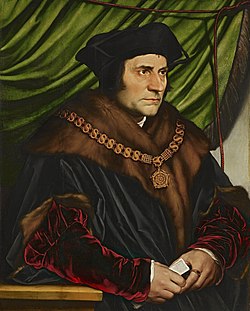
Invited by William Blount, Lord Mountjoy, Erasmus traveled to England, where he met John Colet and Thomas More, beginning lifelong friendships that anchored his connection to English humanism.
Image source: Thomas More
1506
% complete
Erasmus traveled to Italy, receiving a Doctor of Divinity degree from the University of Turin and encountering Italian Renaissance scholars who deepened his philological approach.
1509
% complete
In Rome Erasmus was welcomed by leading churchmen and reportedly offered a position by Pope Julius II, but he left for England upon news of Henry VIII's accession, preferring scholarly independence.
1511 - 1515
% complete
Erasmus taught Greek at Queens' College, Cambridge, helping introduce the study of Greek to England while working on major editions of classical and biblical texts.
Image source: University of Cambridge
1521
% complete
Erasmus moved to Basel, Switzerland, partnering with printer Johann Froben, making the city Europe's premier center of humanist publishing during his most productive years.
Image source: Basel
1500
% complete
Erasmus published the Adagia (Collectanea), a collection of classical proverbs with commentary, which became enormously popular and grew through expanded editions throughout his life.
Image source: Adagia
1509 - 1511
% complete
During a stay in London, Erasmus wrote Moriae Encomium (Praise of Folly), a brilliant satire in which Folly herself praises foolishness, mocking superstition, corrupt clergy, and worldly scholars.
Image source: In Praise of Folly
1516
% complete
Erasmus dedicated The Education of a Christian Prince to young Charles V, arguing that rulers should be educated in virtue, peace, and Christian ethics — a foundational text of humanist political thought.
Image source: The Education of a Christian Prince
Mar 1516
% complete
Erasmus published the first printed Greek New Testament, Novum Instrumentum omne, in Basel with Johann Froben, revolutionizing biblical study despite textual errors and enabling vernacular translations.
Image source: Novum Instrumentum omne
1519 - 1524
% complete
Erasmus issued paraphrases of the books of the New Testament, rendering scripture into flowing Latin prose so laypeople could grasp its moral meaning without technical theology.
Image source: Paraphrase of Erasmus
1519 - 1533
% complete
Erasmus expanded his Colloquies, lively dialogues on religion and society that attacked abuses like indulgences and pilgrimages, becoming among the most-read works of the century.
Image source: Colloquies
1535
% complete
Erasmus completed Ecclesiastes sive Concionator Evangelicus, a vast manual on preaching that synthesized his lifelong program of renewing Christian teaching through eloquence and scriptural learning.
Oct 31, 1517
% complete
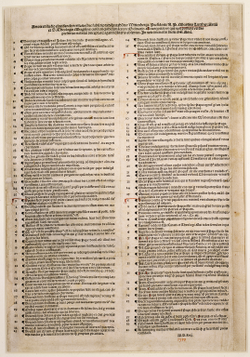
Luther's protest against indulgences ignited the Reformation; many blamed Erasmus as 'the egg Luther hatched,' though Erasmus insisted reform should come through peaceful scholarship.
Image source: Ninety-five Theses
1520
% complete
Despite sympathy for reform, Erasmus refused to join Luther, warning against schism and violence; he sought to remain loyal to the Catholic Church while criticizing its corruptions.
Sep 1524
% complete
Erasmus published De libero arbitrio defending free will, provoking Luther's fierce reply On the Bondage of the Will; this exchange became the definitive split between Erasmian reform and Lutheran theology.
Image source: Erasmus
1529
% complete
When Basel adopted the Reformation and banned Catholic worship, Erasmus moved to Freiburg im Breisgau, remaining formally within the Catholic Church while refusing to condemn reformers harshly.
1535
% complete
Pope Paul III offered Erasmus a cardinalate in hopes of winning his prestige for Catholic reform, but Erasmus declined, citing age and ill health and cherishing his independence.
Jul 12, 1536
% complete
Erasmus died in Basel of dysentery, reportedly saying 'Liever God' ('Dear God'); despite Basel's Reformed government, he was buried with honor in Basel Minster.
1559
% complete
Pope Paul IV placed Erasmus's works on the Index of Prohibited Books, reflecting how Counter-Reformation authorities viewed his critical writings as dangerously sympathetic to heresy.
Image source: Index Librorum Prohibitorum
1622
% complete
Rotterdam honored its most famous son with a bronze statue by Hendrick de Keyser, the earliest known bronze public statue in the Netherlands, celebrating Erasmus's enduring civic pride.
Image source: Statue of Erasmus
1703 - 1706
% complete
The Leiden Opera omnia gathered Erasmus's writings in ten volumes, cementing his status as a foundational figure of European letters studied across confessional boundaries.
1969
% complete
Scholars began publishing a new critical edition of Erasmus's Opera Omnia in Amsterdam and Leiden, revitalizing modern Erasmus studies and revealing the breadth of his correspondence and scholarship.
Image source: Dutch philosophy
Or browse the full history timeline directory, with more than 2,000 topics.
This Erasmus timeline was generated with the help of AI, using information found on the internet.
We work hard to keep these timelines accurate, but mistakes do get through. If you spot one, email us at [email protected] and we'll fix it for future visitors.
Generate yours with AI or build it from scratch, for free.
Export your timeline, add your own events, edit or remove AI-generated events, and much more
No credit card required.
Cancel anytime.
Cancel anytime.
You can create an unlimited number of timelines with up to 10 events on each one, customize how they look, export them to PDF, PNG, PowerPoint, CSV, and Excel, and share them with a link. Paid plans raise the event limit and add features like spreadsheet imports and collaborators.
Yes. You can cancel your subscription from your account page at any time, and you will not be charged again. Your subscription stays active for the rest of the period you already paid for.
Yes. We will email you a reminder before the annual renewal, and we will also email you a receipt.
Yes. You can email us within 15 days of any payment, and we will issue you a full refund.
Check out our pricing docs or send us an email anytime: [email protected].