
-
Use Cases
-
Resources
-
Pricing
Euclid, often referred to as the 'Father of Geometry,' was an ancient Greek mathematician who lived around 300 BCE in Alexandria, Egypt. He is best known for his seminal work 'Elements,' one of the most influential textbooks in the history of mathematics. His systematic approach to geometry laid the groundwork for mathematical teaching for over two millennia. More Less
300 BC
Considered the 'father of geometry', Euclid is chiefly known for the Elements treatise, which established the foundations of geometry that largely dominated the field until the early 19th century. Very little is known of his life.
Image source: Euclid

1800 - 1830
The geometrical system established by the Elements long dominated the field until the early 19th century; today it is often referred to as 'Euclidean geometry' to distinguish it from other non-Euclidean geometries discovered in the early 19th century.
Image source: Non-Euclidean geometry

2026
Among Euclid's many namesakes are the European Space Agency's (ESA) Euclid space telescope, the lunar crater Euclides, and the minor planet 4354 Euclides, reflecting the enduring influence of the ancient geometer.
Image source: Euclid (spacecraft)

300 BC - 201 BC
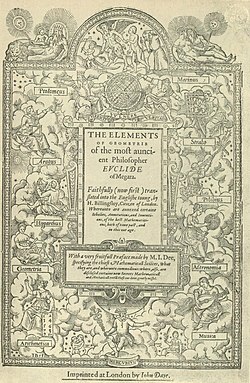
The Elements is speculated to have been at least partly in circulation by the 3rd century BC, as Archimedes and Apollonius take several of its propositions for granted; however, Archimedes employs an older variant of the theory of proportions than the one found in the Elements.
Image source: Euclid's Elements
150
The oldest extant direct citations to the Elements in works whose dates are firmly known are from the 2nd century AD, by Galen and Alexander of Aphrodisias; by this time it was a standard school text.
200
Alongside Galen, Alexander of Aphrodisias provided one of the oldest extant direct citations to the Elements in works whose dates are firmly known, confirming that by this time it was a standard school text.
Image source: Alexander of Aphrodisias

1900 - 1970
Book 2 of the Elements is traditionally understood as concerning 'geometric algebra', though this interpretation has been heavily debated since the 1970s; critics describe the characterization as anachronistic, since the foundations of even nascent algebra occurred many centuries later.
200 BC
The earliest original reference to Euclid appears in Apollonius' prefatory letter to the Conics (early 2nd century BC), where Apollonius notes that Euclid had not fully made the synthesis of the locus on three and four lines.
30 AD
Valerius Maximus, the 1st century AD Roman compiler of anecdotes, mistakenly substituted Euclid's name for Eudoxus (4th century BC) as the mathematician to whom Plato sent those asking how to double the cube.
320
A few anecdotes about Euclid come from Pappus of Alexandria in the early 4th century AD, forming part of the sparse traditional narrative about the mathematician's life.
Image source: Pappus of Alexandria

This Euclid timeline was generated with the help of AI, using information found on the internet.
We work hard to keep these timelines accurate, but mistakes do get through. If you spot one, email us at [email protected] and we'll fix it for future visitors.
Generate yours with AI or build it from scratch, for free.


