-
Use Cases
-
Resources
-
Pricing
The Exodus is the foundational narrative of the Hebrew Bible describing the Israelites' liberation from slavery in Egypt under Moses' leadership. It encompasses the Ten Plagues, the Passover, the crossing of the Red Sea, the giving of the Law at Mount Sinai, and forty years of wandering in the wilderness before reaching Canaan. More Less
1650 BC
% complete
Joseph, the son of Jacob who had saved Egypt from famine, died at the age of 110. Before his death he made the Israelites promise to carry his bones back to Canaan when God delivered them, a promise fulfilled centuries later during the Exodus.
Image source: Joseph (Genesis)
1550 BC
% complete
A new pharaoh who did not know Joseph came to power and, fearing the growing Israelite population, enslaved them with brutal forced labor. The Israelites were put to work building store cities Pithom and Raamses, yet they continued to multiply.
Image source: The Exodus
1530 BC
% complete
Fearing further growth of the Hebrew population, Pharaoh commanded the Hebrew midwives Shiphrah and Puah to kill all newborn Israelite boys. When they refused out of fear of God, Pharaoh ordered every male infant thrown into the Nile.
Image source: Pharaoh's daughter (Exodus)
1526 BC
% complete
To save her infant son from Pharaoh's decree, Moses' mother placed him in a papyrus basket on the Nile. Pharaoh's daughter discovered him and raised him as her own in the Egyptian royal court, unknowingly preserving the future deliverer of Israel.
Image source: Moses
1486 BC
% complete
After killing an Egyptian taskmaster who was beating a Hebrew slave, Moses fled Pharaoh's wrath to Midian. There he rescued the daughters of Jethro at a well, married Zipporah, and spent forty years as a shepherd.
1446 BC
% complete
At Mount Horeb, God appeared to Moses in a bush that burned without being consumed. God revealed his name as 'I AM WHO I AM' (Yahweh) and commissioned Moses to return to Egypt and lead the Israelites out of slavery.
Image source: Burning bush
1446 BC
% complete
Because Moses protested that he was slow of speech, God appointed his brother Aaron to serve as his prophet and spokesman. The brothers met in the wilderness, embraced, and together presented God's message to the Israelite elders, who believed and worshiped.
Image source: Aaron
1446 BC
% complete
Moses and Aaron stood before Pharaoh demanding, 'Let my people go.' Pharaoh refused and instead increased the Israelites' burdens by requiring brick production without providing straw, deepening the people's suffering and despair.
1446 BC
% complete
When Pharaoh demanded a sign, Aaron cast down his staff before Pharaoh and it became a serpent. Although Pharaoh's magicians replicated the feat through their secret arts, Aaron's serpent swallowed theirs, demonstrating God's superior power.
Image source: Staff of Moses
1446 BC
% complete
Aaron struck the Nile with his staff and its waters turned to blood, killing fish and making the river undrinkable throughout Egypt. Pharaoh's magicians duplicated the sign, and Pharaoh hardened his heart and refused to release the Israelites.
Image source: Plagues of Egypt
1446 BC
% complete
Egypt was overrun by successive plagues: frogs swarmed from the Nile, dust became gnats, and dense swarms of flies ruined the land. From the fourth plague onward, God spared the land of Goshen where the Israelites lived, distinguishing them from the Egyptians.
1446 BC
% complete
A deadly pestilence struck all the livestock of Egypt — horses, donkeys, camels, cattle, sheep, and goats — while not one animal belonging to the Israelites died. Even after this devastating loss, Pharaoh refused to let the people go.
1446 BC
% complete
Moses tossed soot from a furnace into the air, and it became fine dust causing festering boils on people and animals throughout Egypt. For the first time, even Pharaoh's magicians could not stand before Moses because of the outbreak on their own bodies.
1446 BC
% complete
God sent thunder and hail mingled with fire, the worst storm in Egypt's history, destroying crops, trees, and livestock left in the fields. Only in Goshen was there no hail. Pharaoh briefly confessed his sin but hardened his heart once the storm ceased.
1446 BC
% complete
An east wind brought locusts that devoured every remaining plant and crop in Egypt. This was followed by three days of palpable darkness over all the land while the Israelites had light in their dwellings. Pharaoh still refused full release.
1446 BC
% complete
At midnight, the Lord struck down every firstborn in Egypt, from Pharaoh's heir to the firstborn of captives and cattle. Every household without the protective blood of the lamb suffered loss, including Pharaoh's own house, breaking Egypt's resistance at last.
Image source: Passover
1446 BC
% complete
Before the final plague, God commanded each Israelite household to sacrifice an unblemished lamb and mark their doorposts with its blood. They ate the meal in haste, dressed for travel. The blood caused the destroyer to pass over their homes, sparing their firstborn.
1446 BC
% complete
After the death of the firstborn, Pharaoh summoned Moses and Aaron by night and ordered the Israelites to leave Egypt immediately. About six hundred thousand men, besides women and children, departed from Rameses after 430 years in Egypt, taking silver, gold, clothing, and unleavened bread.
1446 BC
% complete
God guided the fleeing Israelites through the wilderness with a pillar of cloud by day and a pillar of fire by night. Rather than taking the direct coastal road, God led them toward the Red Sea, deliberately setting the stage for a decisive confrontation with Pharaoh.
Image source: Pillars of fire and cloud
1446 BC
% complete
Regretting his decision, Pharaoh mobilized six hundred chariots and his entire army to recapture the Israelites. Trapped between the approaching forces and the Red Sea, the terrified people cried out, and Moses reassured them: 'The Lord will fight for you.'
Image source: Crossing the Red Sea
1446 BC
% complete
Moses stretched out his staff, and a strong east wind divided the sea, allowing the Israelites to cross on dry ground with walls of water on either side. The pursuing Egyptian army followed into the seabed, but the waters returned and drowned Pharaoh's entire force.
1446 BC
% complete
On the far shore of the sea, Moses and the Israelites sang a triumphant song of praise: 'I will sing to the Lord, for he has triumphed gloriously; horse and rider he has thrown into the sea.' Miriam led the women in dance with tambourines.
Image source: Song of the Sea
1446 BC
% complete
Three days into the wilderness, the Israelites found only bitter water at Marah and grumbled against Moses. God showed him a piece of wood which, when thrown into the water, made it sweet — the first of many tests of Israel's trust in the desert.
Image source: Marah (Bible)
1446 BC
% complete
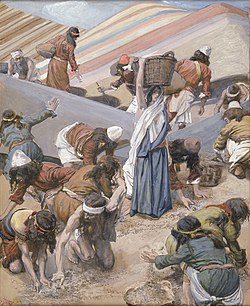
With food supplies exhausted, God rained bread from heaven — manna — each morning, and sent flocks of quail each evening. The people were instructed to gather only enough for each day, learning dependence on God's daily provision for forty years.
Image source: Manna
1446 BC
% complete
Thirsty and quarrelsome at Rephidim, the people demanded water and tested God, naming the place Massah and Meribah. God told Moses to strike the rock at Horeb, and water gushed out abundantly for the entire congregation and their livestock.
1446 BC
% complete
The Amalekites attacked Israel at Rephidim in the nation's first military battle. As long as Moses held up his hands with the staff of God, Israel prevailed; Aaron and Hur supported his arms until sunset, securing victory over the enemy.
Image source: Amalek
1446 BC
% complete
In the third month after leaving Egypt, the Israelites encamped before Mount Sinai. God descended on the mountain in thunder, lightning, smoke, and fire, and called Moses up to receive his covenant. The mountain was fenced off lest anyone touch it and die.
Image source: Mount Sinai (Bible)
1446 BC
% complete
God spoke the Ten Commandments aloud to all Israel: commands to worship no other gods, make no idols, honor God's name, keep the Sabbath, honor parents, and refrain from murder, adultery, theft, false witness, and coveting. These laws formed the heart of the Mosaic covenant.
Image source: Ten Commandments
1446 BC
% complete
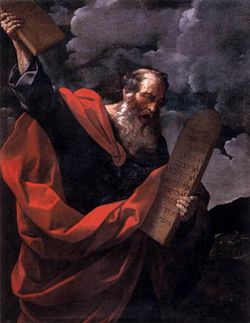
While Moses was on the mountain forty days, the people pressured Aaron to make a golden calf and worshiped it. God threatened destruction, but Moses interceded; upon descending, he shattered the tablets, destroyed the idol, and later received new tablets, renewing the covenant.
Image source: Golden calf
Or browse the full history timeline directory, with more than 2,000 topics.
This Exodus timeline was generated with the help of AI, using information found on the internet.
We work hard to keep these timelines accurate, but mistakes do get through. If you spot one, email us at [email protected] and we'll fix it for future visitors.
Generate yours with AI or build it from scratch, for free.
Export your timeline, add your own events, edit or remove AI-generated events, and much more
No credit card required.
Cancel anytime.
Cancel anytime.
You can create an unlimited number of timelines with up to 10 events on each one, customize how they look, export them to PDF, PNG, PowerPoint, CSV, and Excel, and share them with a link. Paid plans raise the event limit and add features like spreadsheet imports and collaborators.
Yes. You can cancel your subscription from your account page at any time, and you will not be charged again. Your subscription stays active for the rest of the period you already paid for.
Yes. We will email you a reminder before the annual renewal, and we will also email you a receipt.
Yes. You can email us within 15 days of any payment, and we will issue you a full refund.
Check out our pricing docs or send us an email anytime: [email protected].