-
Use Cases
-
Resources
-
Pricing
Expressionism was an artistic and cultural movement that emerged in Germany in the early 20th century, emphasizing subjective emotion over realistic depiction. It influenced painting, literature, theater, film, architecture, and music, with artists distorting form and color to evoke intense emotional experiences. More Less
1850
% complete
While the word 'expressionist' was used in the modern sense as early as 1850, its origin is sometimes traced to paintings exhibited in 1901 in Paris by the obscure artist Julien-Auguste Hervé, which he called Expressionismes.
1855 - 1891
% complete
The American poet Walt Whitman's Leaves of Grass (1855–1891) became an important precursor of Expressionism, with its free verse and intense personal expression influencing the movement's emphasis on individual emotional experience.
Image source: Leaves of Grass
1883 - 1892
% complete
Friedrich Nietzsche's philosophical novel Thus Spoke Zarathustra (1883–1892) was an important precursor of Expressionism, inspiring the movement's emphasis on self-expression, individual will, and the rejection of conventional values.
Image source: Thus Spoke Zarathustra
1901
% complete
The origin of the term Expressionism is sometimes traced to paintings exhibited in 1901 in Paris by the obscure artist Julien-Auguste Hervé, which he called Expressionismes—an early use of the word in an artistic context.
1910
% complete
An alternative view holds that the term Expressionism was coined by the Czech art historian Antonin Matějček in 1910 as the opposite of Impressionism: 'An Expressionist wishes, above all, to express himself.'
1913
% complete
Although the term had earlier uses, Expressionism did not firmly establish itself until 1913, when it became widely recognized as the name of the modernist movement originating in Northern Europe around the beginning of the 20th century.
Image source: Expressionism
1895
% complete
Frank Wedekind's 'Lulu' play Erdgeist (Earth Spirit), first performed in 1895, was an important precursor of Expressionist drama. Its raw psychological intensity influenced the development of Expressionist theatre.
1898 - 1901
% complete
The later plays of Swedish dramatist August Strindberg, including the trilogy To Damascus (1898–1901), A Dream Play (1902), and The Ghost Sonata (1907), were key precursors of Expressionism with their dreamlike, subjective structures.
Image source: August Strindberg
1904
% complete
Frank Wedekind's Die Büchse der Pandora (Pandora's Box), published in 1904, completed his influential 'Lulu' plays, whose frank treatment of sexuality and psychological depth made them vital precursors of Expressionist drama.
Image source: Frank Wedekind
1909
% complete
Oskar Kokoschka's 1909 playlet Murderer, The Hope of Women is often termed the first Expressionist drama, marking a milestone in the movement's expansion into theatre with its violent, abstracted emotional language.
Image source: Oskar Kokoschka
1920
% complete
Paul Wegener's The Golem: How He Came into the World (1920) was another cornerstone of German Expressionist cinema, using stylized sets and atmosphere to convey dread and emotion.
Image source: The Golem: How He Came into the World
1920
% complete
Caligari (1920) became a landmark of German Expressionist cinema, with its distorted sets and psychological themes defining the visual style of the movement on film.
Image source: The Cabinet of Dr. Caligari
1922
% complete
F.W. Murnau's Nosferatu, a Symphony of Horror (1922) brought Expressionist style to horror cinema, with its use of shadow and distortion creating one of the most iconic films of the era.
Image source: Nosferatu
1924
% complete
F.W. Murnau's The Last Laugh (1924) exemplified Expressionist filmmaking techniques, including the famous 'unchained camera,' demonstrating the movement's influence on cinematic language.
Image source: The Last Laugh (1924 film)
1927
% complete
Fritz Lang's Metropolis (1927) was a monumental Expressionist science-fiction film depicting a dehumanizing industrial future, reflecting the movement's reaction to industrialization and urban growth.
Image source: Metropolis (1927 film)
1927
% complete
F.W. Murnau's Sunrise: A Song of Two Humans (1927) prominently featured Expressionist stylistic devices in classic Hollywood cinema, suggesting the impact of the new wave of German filmmakers on American movies.
Image source: Sunrise: A Song of Two Humans
1905
% complete
In 1905, a group of four German artists led by Ernst Ludwig Kirchner formed Die Brücke (the Bridge) in Dresden. The group became one of the two foundational collectives of German Expressionism, seeking to bridge old and new artistic traditions through bold color and distorted forms.
Image source: Die Brücke
1910
% complete
Der Sturm, published by Herwarth Walden starting in 1910, became one of the two leading Expressionist journals in Berlin, promoting avant-garde art and literature and helping define the movement for the public.
Image source: Der Sturm
1911
% complete
A few years after Die Brücke, in 1911, a like-minded group of young artists formed Der Blaue Reiter (The Blue Rider) in Munich. The name came from Wassily Kandinsky's painting Der Blaue Reiter of 1903. The group embraced spiritual and abstract approaches to art.
Image source: Der Blaue Reiter
1911
% complete
Die Aktion, edited by Franz Pfemfert, first appeared in 1911 and became one of the two leading Expressionist journals published in Berlin alongside Der Sturm, championing literary and political Expressionism.
Image source: Die Aktion
1947
% complete
Norris Embry (1921–1981) studied with Oskar Kokoschka in 1947 and during the next 43 years produced a large body of work in the Expressionist tradition, sustaining the movement in late 20th-century America.
1950 - 1965
% complete
From 1950 to 1965, the Expressionist movement was joined by Theophilus Brown, Paul Wonner, Hassel Smith, Nathan Oliveira, Jay DeFeo, Joan Brown, Manuel Neri, Frank Lobdell, and Roland Peterson, who developed distinct styles considered part of Expressionism.
1911
% complete
Béla Bartók was a significant Expressionist composer in his early works of the second decade of the 20th century, beginning with the one-act opera Bluebeard's Castle (1911), followed by The Wooden Prince (1917) and The Miraculous Mandarin (1919).
Image source: Bluebeard's Castle
1921
% complete
German composer Paul Hindemith created an operatic version of Oskar Kokoschka's playlet Murderer, The Hope of Women, which premiered in 1921, extending Expressionist drama into the realm of opera.
Image source: Paul Hindemith
1913
% complete
The ideas of German Expressionism influenced the work of American artist Marsden Hartley, who met Kandinsky in Germany in 1913, helping transmit Expressionist aesthetics across the Atlantic.
Image source: Marsden Hartley
1920
% complete
Katherine Sophie Dreier and Marcel Duchamp were likely among the first to attempt to introduce 'modern art' to New York with the founding of the Société Anonyme in 1920, paving the way for American exposure to Expressionism.
Image source: Société Anonyme (art)
1929
% complete
William Henry Fox, director of the Brooklyn Museum, continued the pioneering efforts of the Société Anonyme in 1929 by advocating for the promotion of modern, and in particular, Expressionist art in America.
Image source: Brooklyn Museum
1937
% complete
It was not until the Munich exhibition 'Entartete Kunst' in 1937 that a drastic shift occurred in the United States: Expressionist works began to be increasingly acquired and exhibited by American museums, presented as an expression of a resistant culture opposed to an authoritarian regime hostile to freedom.
Image source: Degenerate art
1939
% complete
In late 1939, at the beginning of World War II, New York City received many European artists, further spreading Expressionist ideas and practices in America during the war years.
1914
% complete
Bruno Taut's Glass Pavilion at the 1914 Cologne Werkbund Exhibition is one of two specific buildings identified as Expressionist architecture, celebrated for its crystalline forms and utopian vision of glass architecture.
Image source: Bruno Taut
1921
% complete
Erich Mendelsohn's Einstein Tower in Potsdam, Germany, completed in 1921, is the second building specifically identified as Expressionist architecture, with its sculptural, organic form embodying the movement's architectural ideals.
Image source: Einstein Tower
1941
% complete
In his influential book Space, Time and Architecture (1941), architectural critic and historian Sigfried Giedion dismissed Expressionist architecture as merely a part of the development of functionalism, shaping its historical reputation.
1953
% complete
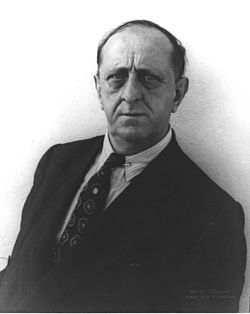
In Mexico, in 1953, German émigré Mathias Goeritz published the Arquitectura Emocional ('Emotional Architecture') manifesto, declaring that 'architecture's principal function is emotion'—an Expressionist revival in postwar architecture.
Image source: Mathias Goeritz
1957 - 1958
% complete
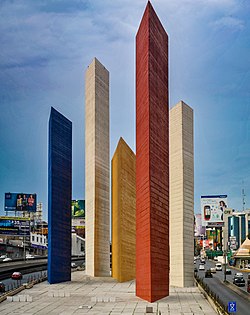
Goeritz collaborated with Luis Barragán on the Torres de Satélite (1957–58) in Mexico City, guided by Goeritz's principles of Arquitectura Emocional, realizing Emotional Architecture in monumental form.
Image source: Torres de Satélite
Or browse the full history timeline directory, with more than 2,000 topics.
This Expressionism timeline was generated with the help of AI, using information found on the internet.
We work hard to keep these timelines accurate, but mistakes do get through. If you spot one, email us at [email protected] and we'll fix it for future visitors.
Generate yours with AI or build it from scratch, for free.
Export your timeline, add your own events, edit or remove AI-generated events, and much more
No credit card required.
Cancel anytime.
Cancel anytime.
You can create an unlimited number of timelines with up to 10 events on each one, customize how they look, export them to PDF, PNG, PowerPoint, CSV, and Excel, and share them with a link. Paid plans raise the event limit and add features like spreadsheet imports and collaborators.
Yes. You can cancel your subscription from your account page at any time, and you will not be charged again. Your subscription stays active for the rest of the period you already paid for.
Yes. We will email you a reminder before the annual renewal, and we will also email you a receipt.
Yes. You can email us within 15 days of any payment, and we will issue you a full refund.
Check out our pricing docs or send us an email anytime: [email protected].