-
Use Cases
-
Resources
-
Pricing
Francis Bacon (1561–1626) was an English philosopher, statesman, and author who served as Lord Chancellor of England. Often called the 'Father of the Scientific Method,' he championed empiricism and inductive reasoning, arguing that knowledge should be built through systematic observation and experimentation rather than relying on ancient authority. His major works, including Novum Organum and The Advancement of Learning, laid the intellectual groundwork for the modern scientific revolution. More Less
Jan 22, 1561
% complete
Francis Bacon was born at York House near the Strand in London, the son of Sir Nicholas Bacon, Lord Keeper of the Great Seal, and his second wife Anne (Cooke) Bacon, daughter of Renaissance humanist Anthony Cooke.
Image source: Francis Bacon
Apr 5, 1573 - 1576
% complete
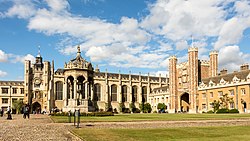
At age 12 Bacon entered Trinity College, Cambridge, living there for three years with his older brother Anthony under the tutelage of John Whitgift, future Archbishop of Canterbury.
Image source: Trinity College, Cambridge
Jun 27, 1576
% complete
Bacon and Anthony entered de societate magistrorum at Gray's Inn on 27 June 1576, beginning his legal training.
Image source: Gray's Inn
1579
% complete
To support himself after his father's death, Bacon took up residence in law at Gray's Inn, his income supplemented by a grant from his mother: the manor of Marks near Romford in Essex, generating a rent of £46.
Feb 1579
% complete
The sudden death of his father in February 1579 prompted Bacon to return to England from abroad, leaving him without a substantial inheritance.
1580
% complete
Through his uncle Lord Burghley, Bacon applied for a post at court that might enable him to pursue a life of learning, but his application failed.
1598
% complete
In 1598 Bacon was arrested for debt, a low point during his years of struggling finances.
May 10, 1606
% complete
Bacon married on 10 May 1606; among letters written about this period were ones composed during his courtship and one on his wedding day.
Apr 9, 1626
% complete
Bacon died of pneumonia at Highgate outside London on 9 April 1626, at Arundel House, the country residence of his friend the Earl of Arundel. William Rawley's biography records he died in the early morning of Easter Sunday, aged about 65. Having no heirs, both his titles became extinct on his death.
1581
% complete
Bacon's parliamentary career began when he was elected MP for Bossiney, Cornwall, in a by-election in 1581.
1584
% complete
In 1584 Bacon took his seat in Parliament for Melcombe in Dorset.
1586
% complete
Bacon took his seat for Taunton in 1586, and in the Parliament of 1586 he openly urged execution for the Catholic Mary, Queen of Scots. He also became a bencher at Gray's Inn that year.
Image source: Mary, Queen of Scots
1588
% complete
In 1588 Bacon became MP for Liverpool; he would later sit for Middlesex in 1593.
Feb 1593
% complete
Bacon took his third parliamentary seat for Middlesex when Elizabeth summoned Parliament in February 1593 to investigate a Roman Catholic plot against her.
Image source: Middlesex (constituency)
Apr 1614
% complete
The so-called Prince's Parliament of April 1614 objected to Bacon's presence in the seat for Cambridge University and to various royal plans he had supported.
Image source: Addled Parliament
1582
% complete
After working quietly at Gray's Inn for two years following his failed court application, Bacon was admitted as an outer barrister in 1582.
1587
% complete
Bacon was elected a Reader in 1587, delivering his first set of lectures in Lent the following year.
1594
% complete
When the office of Attorney General fell vacant in 1594, Lord Essex's influence proved insufficient to secure it for Bacon, and it went to Sir Edward Coke.
Image source: Edward Coke
1597
% complete
In 1597 Bacon became the first recipient of the Queen's Counsel designation when Elizabeth I reserved him as her legal counsel. He was also given a patent giving him precedence at the Bar that year, and first sat as MP for Ipswich.
Image source: King's Counsel
1616
% complete
Bacon and Gray's Inn had produced The Masque of Flowers to celebrate the wedding of Robert Carr, 1st Earl of Somerset, and Frances Howard, and in 1616 he successfully prosecuted them both for murder.
Image source: Frances Carr, Countess of Somerset
1589
% complete
In 1589 Bacon received the valuable appointment of reversion to the Clerkship of the Star Chamber, worth £1,600 a year, though he did not formally take office until 1608.
Image source: Star Chamber
1591
% complete
By 1591 Bacon acted as the Earl of Essex's confidential adviser, though Essex's later influence would not be enough to secure Bacon high office.
Image source: Robert Devereux, 2nd Earl of Essex
1592
% complete
Commissioned in 1592 to answer Jesuit Robert Parsons' anti-government polemic, Bacon titled his tract Certain Observations Made upon a Libel, identifying England with democratic Athens against belligerent Spain.
1595
% complete
Bacon likewise failed to secure the lesser office of Solicitor General in 1595, with the Queen pointedly appointing Sir Thomas Fleming instead.
Image source: Thomas Fleming (judge)
1601
% complete
Bacon improved his relationship with the Queen by severing ties with Essex, a shrewd move as Essex was executed for treason in 1601. Bacon also sat again for Ipswich that year.
1603
% complete
After the accession of James I in 1603, Bacon was knighted, beginning his rise under the new king.
Image source: Knight Bachelor
Jun 1607
% complete
In June 1607 Bacon was at last rewarded with the office of Solicitor General, and in 1608 he began working as Clerk of the Star Chamber, finally taking up the post promised in 1589.
1609 - 1610
% complete
Bacon submitted his government report on 'The Virginia Colony' in 1609, and some scholars believe he largely drafted charters of government for Virginia in 1609 and 1612. In 1610 he received a charter forming a company of adventurers that sent John Guy to found a colony in Newfoundland.
Image source: Cuper's Cove
1613
% complete
In 1613 Bacon was finally appointed Attorney General, after advising the King to shuffle judicial appointments.
Image source: Attorney General for England and Wales
Mar 1617 - Apr 1617
% complete
Continuing to enjoy the King's favour, Bacon was appointed in March 1617 as temporary Regent of England for a period of about a month.
Jul 12, 1618
% complete
In 1618 Bacon was made Lord Chancellor, and on 12 July 1618 King James created him Baron Verulam of Verulam in the Peerage of England; he then became known as Francis, Lord Verulam.
1621
% complete
Bacon's public career ended in disgrace in 1621 amid charges of corruption; his censure by Parliament was recorded by Simonds D'Ewes in a diary entry for 3 May 1621.
Jan 27, 1621
% complete
Mediating between throne and Parliament, Bacon was further elevated in the same peerage as Viscount St Alban on 27 January 1621.
Image source: Francis Bacon
1626
% complete
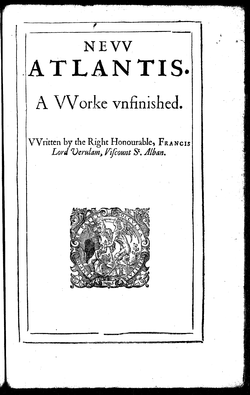
New Atlantis, Bacon's unfinished utopian work depicting a society devoted to scientific discovery, was published in 1626. It has been linked by scholars to Johann Valentin Andreae's Description of the Republic of Christianopolis (1619).
Image source: New Atlantis
1660
% complete
During the Restoration, Bacon was commonly invoked as a guiding spirit of the Royal Society founded under Charles II in 1660, cementing his reputation as a father of modern science.
Image source: Royal Society
1733 - 1750
% complete
During the 18th-century French Enlightenment, Bacon's non-metaphysical approach to science became more influential than Descartes' dualism. In 1733 Voltaire introduced him to a French audience as the 'father' of the scientific method, an understanding widespread by the 1750s.
Image source: Voltaire
1800 - 1900
% complete
In the 19th century, Bacon's emphasis on induction was revived and developed by William Whewell, among others, reaffirming his importance to the philosophy of science.
Image source: William Whewell
1850
% complete
First proposed in the mid-19th century, the fringe Baconian theory contends that Bacon wrote at least some, possibly all, of the plays conventionally attributed to William Shakespeare.
Image source: Baconian theory of Shakespeare authorship
1902
% complete
In 1902 Hugo von Hofmannsthal published a fictional letter addressed to Bacon and dated 1603, about a writer experiencing a crisis of language.
1910
% complete
In 1910 Newfoundland issued a postage stamp commemorating Bacon's role in establishing the colony, describing him as 'the guiding spirit in Colonization Schemes in 1610'.
Image source: Postage stamps and postal history of Newfoundland
Or browse the full history timeline directory, with more than 2,000 topics.
This Francis Bacon timeline was generated with the help of AI, using information found on the internet.
We work hard to keep these timelines accurate, but mistakes do get through. If you spot one, email us at [email protected] and we'll fix it for future visitors.
Generate yours with AI or build it from scratch, for free.
Export your timeline, add your own events, edit or remove AI-generated events, and much more
No credit card required.
Cancel anytime.
Cancel anytime.
You can create an unlimited number of timelines with up to 10 events on each one, customize how they look, export them to PDF, PNG, PowerPoint, CSV, and Excel, and share them with a link. Paid plans raise the event limit and add features like spreadsheet imports and collaborators.
Yes. You can cancel your subscription from your account page at any time, and you will not be charged again. Your subscription stays active for the rest of the period you already paid for.
Yes. We will email you a reminder before the annual renewal, and we will also email you a receipt.
Yes. You can email us within 15 days of any payment, and we will issue you a full refund.
Check out our pricing docs or send us an email anytime: [email protected].