-
Use Cases
-
Resources
-
Pricing
1122
% complete
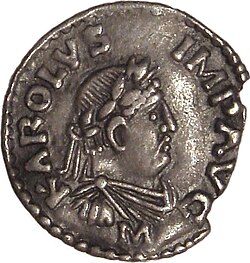
Frederick I, later nicknamed Barbarossa ('Redbeard'), was born around 1122 into the Hohenstaufen dynasty. As the son of Frederick II, Duke of Swabia, and Judith of Bavaria, he was positioned from birth within the highest circles of German nobility.
Image source: Frederick Barbarossa
1147 - 1149
% complete
As a young duke, Frederick accompanied his uncle King Conrad III on the Second Crusade. Though the crusade ended in failure near Damascus, Frederick gained military experience and built a reputation for courage among the German nobility.
Image source: Second Crusade
1147
% complete
Around the time he became Duke of Swabia, Frederick married Adela of Vohburg, a Bavarian noblewoman, strengthening his ties in southern Germany. The marriage was later annulled after he became king.
Apr 6, 1147
% complete
Frederick's father died in 1147, leaving the young Frederick as Duke of Swabia. This inheritance gave him his first substantial territorial power base within the Holy Roman Empire.
Image source: Frederick II of Swabia
Mar 4, 1152
% complete
After Conrad III's death, the German princes elected Frederick as King of Germany in Frankfurt, bypassing Conrad's young son. His election was notable for uniting warring factions of Welfs and Hohenstaufens behind him.
Image source: King of the Romans
Mar 9, 1152
% complete
Frederick was crowned King of the Romans at Aachen Cathedral, following the tradition of Charlemagne. Aachen would remain an important symbolic center throughout his reign.
Image source: Aachen Cathedral
Jun 9, 1156
% complete
Frederick married Beatrice, heiress of the County of Burgundy, adding vast territories in southeastern France to imperial influence and producing numerous children who secured the Hohenstaufen succession.
Image source: Beatrice I of Burgundy
Oct 1154
% complete
Frederick crossed the Alps for the first time as king to be crowned Holy Roman Emperor by Pope Adrian IV, also intervening in disputes among Italian cities and with the Norman Kingdom of Sicily.
Jun 18, 1155
% complete
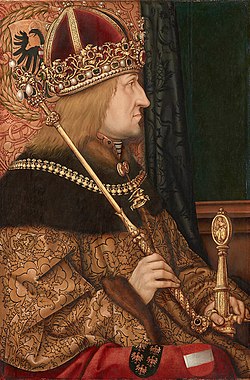
Pope Adrian IV crowned Frederick as Holy Roman Emperor in St. Peter's Basilica in Rome. The ceremony was marred by unrest and a Roman republican uprising that Frederick's forces suppressed.
Image source: Holy Roman Emperor
Nov 11, 1158
% complete
At the Diet of Roncaglia near Piacenza, legal experts declared the emperor's sovereign rights over northern Italy, including control of tolls, mints, and courts. This provoked fierce resistance from the Lombard cities.
Image source: Diet of Roncaglia
1162
% complete
After a long siege, Frederick captured Milan and ordered its destruction in March 1162. The city's walls were razed and inhabitants dispersed, demonstrating the harshness of his imperial policy in Lombardy.
Image source: List of sieges
1167
% complete
Northern Italian cities, including Milan, Venice, and Padua, formed the Lombard League to resist imperial domination. Backed by Pope Alexander III, it became the main obstacle to Frederick's ambitions in Italy.
Image source: Lombard League
Aug 1167
% complete
Malaria swept through Frederick's forces during his fourth Italian campaign, killing thousands including key princes, forcing him to retreat across the Alps in disarray and weakening his position dramatically.
May 29, 1176
% complete
The Lombard League decisively defeated Frederick's army at Legnano, where infantry formations broke the famous German knights. It was one of Barbarossa's greatest defeats and forced him to negotiate peace with the Italian communes.
Image source: Battle of Legnano
1183
% complete
The Peace of Constance recognized the Lombard cities' rights to elect their own officials and govern themselves while acknowledging nominal imperial suzerainty, effectively ending Frederick's attempts at direct rule in northern Italy.
Image source: Peace of Constance
1184
% complete
Frederick campaigned again in central Italy, celebrating the Feast of Swords at Verona with his son Henry and receiving homage from Tuscan cities, though his plans to consolidate power were increasingly constrained.
Image source: Tuscany
Sep 17, 1156
% complete
Through the Privilegium Minus, issued at the imperial diet at Regensburg, Frederick elevated Austria to a duchy independent of Bavaria, granted to the Babenberg dynasty, reshaping the political geography of southeastern Europe.
Image source: Duchy of Austria
1157
% complete
In 1157 Frederick led an expedition against Duke Bolesław IV of Poland, forcing him to do homage and pay tribute, reasserting imperial influence over Poland which had lapsed under his predecessors.
Image source: History of Poland during the Piast dynasty
1159
% complete
Following Adrian IV's death, a papal schism broke out. Frederick supported antipopes against Alexander III, plunging empire and papacy into conflict that dominated much of his reign.
Image source: Antipope Paschal III
Dec 29, 1165
% complete
Frederick promoted the canonization of Charlemagne, his great model, by the antipope he backed. The act emphasized his self-image as heir to the Carolingian empire and boosted imperial prestige despite lacking universal recognition.
Image source: Charlemagne
Aug 15, 1169
% complete
Frederick had his five-year-old son Henry crowned King of the Romans at Aachen, securing dynastic succession early and ensuring continuity of Hohenstaufen rule.
Image source: Henry VI, Holy Roman Emperor
1177
% complete
Frederick formally reconciled with Pope Alexander III at Venice, ending the papal schism. He knelt before the pope in a gesture symbolizing the end of nearly two decades of church-state conflict.
Image source: Treaty of Venice
Mar 5, 1179
% complete
Pope Alexander III convened the Third Lateran Council, which condemned the antipopes and reformed the church. Its decrees further solidified the papal position that Frederick had been forced to accept.
1180
% complete
After Henry the Lion refused to join the Italian campaigns, Frederick convened diets that declared him deposed, confiscating his Saxon and Bavarian duchies and redistributing them to loyal vassals, breaking the power of the Welfs.
Image source: Henry the Lion
Jan 27, 1186
% complete
Frederick arranged the marriage of his son Henry to Constance, aunt and heiress of King William II of Sicily, laying the groundwork for the eventual union of the imperial crown with the Norman kingdom of Sicily.
Oct 29, 1187
% complete
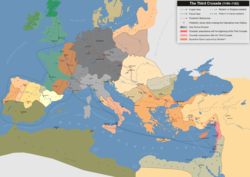
After Saladin destroyed the crusader army at Hattin and captured Jerusalem, Pope Gregory VIII called for a new crusade. Frederick, then nearly seventy, took the cross as one of the first European monarchs to respond.
Image source: Third Crusade
Mar 27, 1188
% complete
At the 'Court of Jesus' in Mainz, thousands of knights took the crusader vow alongside the emperor. Frederick spent the following year raising funds, securing peace in Europe, and preparing a massive army.
May 11, 1189
% complete
Frederick led what may have been the largest crusading army ever assembled out of Regensburg on the overland route through Hungary, Byzantium, and Anatolia, numbering possibly tens of thousands of men.
May 18, 1190
% complete
Despite harassment by Seljuk forces and treacherous Byzantine diplomacy, Frederick stormed and captured the Seljuk capital of Iconium in Konya, a remarkable victory late in the arduous march through Asia Minor.
Image source: Battle of Iconium (1190)
Jun 10, 1190
% complete
While crossing the Saleph River (Göksu) in Cilicia, possibly to bathe, the aged emperor drowned. His death shattered the morale of his army; most German crusaders returned home or died, though a remnant reached the siege of Acre under his son.
1200
% complete
German legend held that Barbarossa did not die but sleeps beneath Kyffhäuser mountain, awaiting Germany's hour of need. The myth became a powerful national symbol, inspiring art and politics into the 19th century.
Image source: Kyffhäuser Monument
Or browse the full history timeline directory, with more than 2,000 topics.
This Frederick Barbarossa timeline was generated with the help of AI, using information found on the internet.
We work hard to keep these timelines accurate, but mistakes do get through. If you spot one, email us at [email protected] and we'll fix it for future visitors.
Generate yours with AI or build it from scratch, for free.
Export your timeline, add your own events, edit or remove AI-generated events, and much more
No credit card required.
Cancel anytime.
Cancel anytime.
You can create an unlimited number of timelines with up to 10 events on each one, customize how they look, export them to PDF, PNG, PowerPoint, CSV, and Excel, and share them with a link. Paid plans raise the event limit and add features like spreadsheet imports and collaborators.
Yes. You can cancel your subscription from your account page at any time, and you will not be charged again. Your subscription stays active for the rest of the period you already paid for.
Yes. We will email you a reminder before the annual renewal, and we will also email you a receipt.
Yes. You can email us within 15 days of any payment, and we will issue you a full refund.
Check out our pricing docs or send us an email anytime: [email protected].