-
Use Cases
-
Resources
-
Pricing
George Orwell (1903–1950), born Eric Arthur Blair, was an English novelist, essayist, and journalist renowned for his sharp critiques of totalitarianism and social injustice. His most famous works, Animal Farm (1945) and Nineteen Eighty-Four (1949), remain essential reading for understanding propaganda, surveillance, and political power. More Less
Jun 25, 1903
% complete
Eric Arthur Blair, later known as George Orwell, was born in Motihari, Bengal Presidency, British India, where his father worked in the Opium Department of the Indian Civil Service.
1904
% complete
Orwell's mother moved with him and his sisters to England, settling at Henley-on-Thames, while his father remained in India until 1912.
Sep 1911 - Dec 1916
% complete
Orwell attended St Cyprian's School in Eastbourne on a scholarship, an experience he later described critically in his essay 'Such, Such Were the Joys'.
Image source: St Cyprian's School
1917
% complete
Orwell won a scholarship to Eton College, where he studied from 1917 to 1921 and was taught briefly by Aldous Huxley.
Image source: Eton College
1922 - 1927
% complete
Orwell served five years with the Indian Imperial Police in Burma. His growing disgust with imperialism led him to resign and shaped works like 'Burmese Days' and the essay 'Shooting an Elephant'.
1928 - 1929
% complete
After returning to Europe, Orwell deliberately lived in poverty, working as a dishwasher in Paris and tramping in London, experiences that informed his first book.
Image source: Down and Out in Paris and London
Sep 1938 - Mar 1939
% complete
Diagnosed with tuberculosis, Orwell spent several months recovering in Marrakech, Morocco, writing 'Coming Up for Air' during this period.
Image source: George Orwell
Oct 1944
% complete
Orwell and his wife Eileen adopted a baby boy named Richard, whom they raised at their cottage home in Islington and later on Jura.
Mar 29, 1945
% complete
Eileen O'Shaughnessy, Orwell's wife since 1936 and collaborator on many projects, died unexpectedly during an operation, leaving Orwell devastated.
Image source: Eileen Blair
May 1946
% complete
Seeking isolation to write, Orwell rented a remote farmhouse on the Scottish island of Jura, where he would complete his final novel.
Image source: Barnhill, Jura
Aug 1947
% complete
While boating near Jura, Orwell was caught in the notorious Corryvreckan whirlpool with his son Richard and nephew; the accident worsened his health.
Image source: Gulf of Corryvreckan
Dec 1947 - Jul 1948
% complete
Orwell entered Hairmyres Hospital near Glasgow, where streptomycin treatment helped stabilize his tuberculosis, though his health never fully recovered.
Image source: Tuberculosis
Oct 13, 1949
% complete
From his hospital bed at University College Hospital, London, Orwell married Sonia Brownell, who had reportedly inspired the character Julia in Nineteen Eighty-Four.
Image source: Sonia Orwell
Jan 9, 1933
% complete
Orwell's first full-length work, a memoir of poverty published under the pen name George Orwell, documented his experiences of destitution in two great cities.
Oct 1934
% complete
His first novel drew on his service in Burma, offering a scathing critique of British colonialism through the story of John Flory, a disillusioned timber merchant.
Image source: Burmese Days
Mar 1937
% complete
Commissioned by Victor Gollancz, Orwell investigated unemployment and living conditions among coal miners in northern England, producing a landmark work of social reportage.
Image source: The Road to Wigan Pier
Apr 1938
% complete
Orwell's memoir of his time in Spain recounted both his combat experience and his disillusionment with communist propaganda and infighting on the Republican side.
Image source: Homage to Catalonia
Jun 1939
% complete
Published just before World War II broke out, this novel follows George Bowling's nostalgic return to his childhood village, lamenting the loss of pre-war England.
Image source: Coming Up for Air
Mar 1940
% complete
Orwell published a collection of critical essays including the title piece examining the literary culture of the 1930s and writers like Henry Miller and James Joyce.
Aug 1941 - Nov 1943
% complete
Orwell produced propaganda broadcasts aimed at India and Southeast Asia, an experience widely believed to have inspired the Ministry of Truth in Nineteen Eighty-Four.
Image source: BBC World Service
Feb 1945 - May 1945
% complete
Orwell reported from liberated France and Germany for The Observer and Manchester Evening News, witnessing the aftermath of Nazi rule firsthand.
Aug 17, 1945
% complete
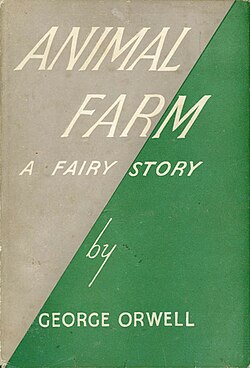
Orwell's allegorical novella about farm animals rebelling against their farmer became a sharp satire of Stalinism after several publishers rejected it for political reasons.
Image source: Animal Farm
Apr 1946
% complete
In one of his most influential essays, Orwell argued that vague and corrupt language enables political manipulation, urging clarity and precision in writing.
Jun 1946
% complete
Orwell reflected on his development as a writer, identifying four motives including sheer egoism, aesthetic enthusiasm, historical impulse, and political purpose.
Dec 4, 1948
% complete
Typing much of the manuscript while bedridden with tuberculosis, Orwell finished his dystopian masterpiece depicting totalitarian surveillance under Big Brother.
Image source: Nineteen Eighty-Four
Jun 8, 1949
% complete
The novel became an immediate bestseller, introducing concepts like Big Brother, thoughtcrime, doublethink, and Newspeak into global culture and political discourse.
Jan 1937 - Jun 1937
% complete
Orwell traveled to Spain and joined the POUM militia on the Aragon front. He was shot through the throat by a sniper and later fled Spain during the Stalinist purge of POUM.
1940 - 1943
% complete
During World War II, Orwell served in the local defence volunteers, seeing it as a potential vehicle for revolutionary change despite its official role.
Image source: Home Guard (United Kingdom)
Feb 1941
% complete
In this long essay, Orwell argued that a socialist revolution was necessary for Britain to defeat Nazi Germany, calling for nationalization and class reform.
Jan 21, 1950
% complete
Orwell died of a pulmonary hemorrhage at University College Hospital and was buried in All Saints' Churchyard, Sutton Courtenay, under his real name Eric Arthur Blair.
Dec 1954
% complete
Halas and Batchelor's animated adaptation of Animal Farm became the first British feature-length animated film, funded partly by the CIA as Cold War cultural influence.
Image source: Animal Farm (1954 film)
1968
% complete
Edited by Sonia Orwell and Ian Angus, the four-volume collection cemented Orwell's reputation as one of the twentieth century's greatest essayists.
Image source: George Orwell bibliography
1984
% complete
As the year 1984 arrived, worldwide attention focused on Orwell's warnings about surveillance and authoritarianism, making terms like 'Orwellian' ubiquitous in political commentary.
1998
% complete
Peter Davison's twenty-volume edition of Orwell's complete works, including previously unpublished letters and diaries, was published to wide acclaim.
Nov 7, 2017
% complete
A bronze statue inscribed with 'If liberty means anything at all, it means the right to tell people what they do not want to hear' was unveiled at Broadcasting House in London.
Image source: Statue of George Orwell
Or browse the full history timeline directory, with more than 2,000 topics.
This George Orwell timeline was generated with the help of AI, using information found on the internet.
We work hard to keep these timelines accurate, but mistakes do get through. If you spot one, email us at [email protected] and we'll fix it for future visitors.
Generate yours with AI or build it from scratch, for free.
Export your timeline, add your own events, edit or remove AI-generated events, and much more
No credit card required.
Cancel anytime.
Cancel anytime.
You can create an unlimited number of timelines with up to 10 events on each one, customize how they look, export them to PDF, PNG, PowerPoint, CSV, and Excel, and share them with a link. Paid plans raise the event limit and add features like spreadsheet imports and collaborators.
Yes. You can cancel your subscription from your account page at any time, and you will not be charged again. Your subscription stays active for the rest of the period you already paid for.
Yes. We will email you a reminder before the annual renewal, and we will also email you a receipt.
Yes. You can email us within 15 days of any payment, and we will issue you a full refund.
Check out our pricing docs or send us an email anytime: [email protected].