-
Use Cases
-
Resources
-
Pricing
The Golden Age of Radio was a period in American history, roughly from the late 1920s to the early 1950s, when radio broadcasting was the dominant form of home entertainment and information. Iconic programs such as 'The Shadow,' 'Amos 'n' Andy,' 'The Lone Ranger,' and Orson Welles' infamous 'War of the Worlds' broadcast captivated millions of listeners. The era ended as television rose in popularity after World War II. More Less
1890 - 1932
% complete
Transmission of live drama, comedy, music and news that would characterize the Golden Age of Radio had a precedent in a small number of telephone newspaper systems, including the Théâtrophone, commercially introduced in Paris in 1890 and available as late as 1932.
Image source: Théâtrophone
1900 - 1920
% complete
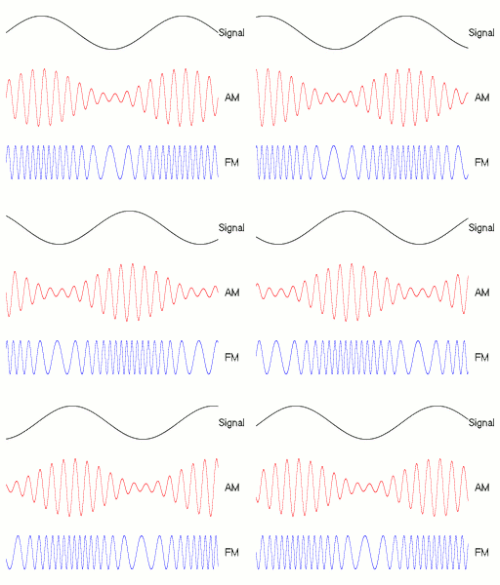
Between 1900 and 1920 the first technology for transmitting sound by radio was developed: AM (amplitude modulation). Before this era, the information-carrying ability of radio waves was limited to on-or-off telegraph-like signals. AM broadcasting sprang up around 1920.
Image source: Amplitude modulation
Dec 24, 1906
% complete
Reginald Fessenden reported making, on Christmas Eve, December 24, 1906, the first audio radio broadcast program, consisting of some violin playing and passages from the Bible. The first apparent published reference to the event was made in 1928, and its authenticity remains debated by historians.
Image source: Reginald Fessenden
1912
% complete
It was not until after the Titanic catastrophe in 1912 that radio for mass communication came into vogue, inspired first by the work of amateur ("ham") radio operators.
Image source: History of radio
1920
% complete
This was followed in 1920 with the first commercial radio station in the United States, KDKA, being established in Pittsburgh, marking the beginning of commercial broadcasting in America.
Image source: KDKA (AM)
Aug 31, 1920
% complete
The first radio news program was broadcast on August 31, 1920, on the station 8MK in Detroit; owned by The Detroit News, the station covered local election results.
Image source: WWJ (AM)
1922
% complete
The first regular entertainment programs were broadcast in 1922, and on March 10, Variety carried the front-page headline: "Radio Sweeping Country: 1,000,000 Sets in Use."
Image source: Golden Age of Radio
Jan 1, 1923
% complete
A highlight of this time was the first Rose Bowl being broadcast on January 1, 1923, on the Los Angeles station KHJ, bringing major sporting events into American living rooms.
Image source: Rose Bowl Game
1925
% complete
The Radio Corporation of America (RCA) released figures in 1925 stating that 19% of United States homes owned a radio, showing rapid adoption of the medium.
1930
% complete
In 1930, 40% of the nation's households owned a radio, a figure that was much higher in suburban and large metropolitan areas. By 1940, 83% of American homes would own a radio.
1922
% complete
In early 1922, American Telephone & Telegraph Company (AT&T) announced the beginning of radio advertisement-supported broadcasting on its owned stations, along with plans to develop the first radio network using its telephone lines to transmit content.
Image source: NBC
Jul 1926
% complete
In July 1926, AT&T abruptly decided to exit the broadcasting field, and signed an agreement to sell its entire network operations to a group headed by RCA, which used the assets to form the National Broadcasting Company.
Nov 15, 1926
% complete
Originally founded as the National Broadcasting Company in late 1926, the company was almost immediately forced to split under antitrust laws to form NBC Red and NBC Blue. The NBC Red Network launched on November 15, 1926.
Image source: NBC Radio Network
1927
% complete
Until 1926, broadcast radio power and frequency use was regulated ineffectively. Congress responded by enacting the Radio Act of 1927, which included the formation of the Federal Radio Commission (FRC) to bring order to the airwaves.
Image source: Radio Act of 1927
Jan 10, 1927
% complete
The National Broadcasting Company Blue Network (NBC Blue) launched January 10, 1927, after splitting from NBC Red. It was sold in 1942 and became the Blue Network, later transferring assets to the American Broadcasting Company on June 15, 1945.
Image source: Blue Network
Sep 18, 1927
% complete
The Columbia Broadcasting System (CBS) launched on September 18, 1927, becoming one of the dominant national radio networks of the Golden Age of Radio.
Image source: CBS
Sep 29, 1934
% complete
Four national radio networks had formed by 1934. The Mutual Broadcasting System (Mutual) launched September 29, 1934, completing the big four of American radio networks.
Image source: Mutual Broadcasting System
1948 - 1952
% complete
Liberty Broadcasting System launched in 1948. Hampered by a massive increase in rights fees and severe blackout restrictions on its cornerstone sports broadcasts, the network folded in 1952.
Image source: Liberty Broadcasting System
Nov 26, 1950 - Jan 31, 1951
% complete
Progressive Broadcasting System (PBS) launched November 26, 1950, but folded January 31, 1951, after only two months on air, due to lack of affiliate signups.
Image source: Progressive Broadcasting System
1924
% complete
National Barn Dance, begun on Chicago's WLS in 1924, helped popularize country music on the airwaves and was later picked up by NBC Radio in 1933.
Image source: National Barn Dance
1925
% complete
In 1925, WSM Barn Dance went on the air from Nashville. It was renamed the Grand Ole Opry in 1927 and remains one of the longest-running radio programs in history.
Image source: Grand Ole Opry
Oct 20, 1930
% complete
The first program generally considered to be a daytime serial drama by scholars of the genre is Painted Dreams, which premiered on WGN on October 20, 1930.
Image source: Painted Dreams
Feb 15, 1932
% complete
The first networked daytime serial is Clara, Lu, 'n Em, which started in a daytime time slot on February 15, 1932, paving the way for the soap opera genre on radio.
Image source: Clara, Lu, 'n Em
1938
% complete
One of the first quiz shows was Information Please in 1938, helping launch the popular audience-participation genre of Golden Age radio programming.
Oct 30, 1938
% complete
It was on Mercury Theatre that Welles presented his celebrated-but-infamous 1938 adaptation of H.G. Wells' The War of the Worlds, which caused panic among some listeners who believed a Martian invasion was underway.
Image source: Mercury Theatre
1943 - 1953
% complete
Bob Montana's redheaded teen of comic strips and comic books was heard on radio's Archie Andrews from 1943 to 1953, adapting popular comics for the airwaves.
Image source: Archie Andrews
1946
% complete
Winner Take All, which premiered in 1946, was the first quiz show to use lockout devices and feature returning champions, innovations that shaped future game shows.
1948 - Aug 1949
% complete
An early example was the 1939 show Pot o' Gold, but the breakout hit of the giveaway type was ABC's Stop the Music in 1948. Giveaway shows were extremely popular through 1948 and 1949, though often panned as low-brow; an unsuccessful FCC attempt to ban them as illegal lotteries came in August 1949.
Image source: Can't Stop the Music
1936
% complete
By about 1936, 16-inch aluminum-based discs coated with cellulose nitrate lacquer, commonly known as acetates and recorded at a speed of 33⅓ rpm, had been adopted by the networks and individual radio stations as the standard medium for recording broadcasts.
Image source: Electrical transcription
1941
% complete
This quest began with short-wave broadcasts of educational and information programs to troops in 1940. In 1941, the War Department began issuing "Buddy Kits" (B-Kits) to departing troops, consisting of radios, 78 rpm records and electrical transcription discs of radio shows.
Image source: American Forces Network
Mar 1, 1942
% complete
Command Performance was the first of the Armed Forces Radio Service programs, produced for the first time on March 1, 1942. On May 26, 1942, the Armed Forces Radio Service was formally established.
1945
% complete
At its peak in 1945, the Service produced around 20 hours of original programming each week for American troops serving overseas during World War II.
1947
% complete
Bing Crosby became the first major proponent of magnetic tape recording for radio, and he was the first to use it on network radio, after he did a demonstration program in 1947. By early 1949, the transition from discs to tape was complete for network programs.
Image source: Tape recorder
1950
% complete
One of the very few still-running shows from the earlier era of radio is a Christian program entitled Unshackled! The weekly half-hour show, produced in Chicago by Pacific Garden Mission, has been continuously broadcast since 1950.
1960
% complete
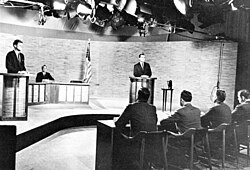
Notable events in radio's transition era included the first presidential debate broadcast on both radio and television in 1960, and the debut of the first locally produced talk radio show, 'At Your Service,' from KMOX in St. Louis.
Image source: United States presidential debates
Sep 30, 1962
% complete
The final broadcasts of Yours Truly, Johnny Dollar and Suspense on September 30, 1962 are widely considered the end of the old time radio era. This displaced full-service network radio and hastened the end of the golden-age era of radio drama by 1962.
Image source: Yours Truly, Johnny Dollar
1974 - 2016
% complete
Starting in 1974, Garrison Keillor, through his syndicated two-hour-long program A Prairie Home Companion, provided a living museum of the production, tone and listener's experience of this era of radio. Produced live in theaters throughout the country using era techniques, it ran through 2016 with Keillor as host.
Image source: A Prairie Home Companion
Or browse the full history timeline directory, with more than 2,000 topics.
This Golden Age of Radio timeline was generated with the help of AI, using information found on the internet.
We work hard to keep these timelines accurate, but mistakes do get through. If you spot one, email us at [email protected] and we'll fix it for future visitors.
Generate yours with AI or build it from scratch, for free.

Export your timeline, add your own events, edit or remove AI-generated events, and much more
No credit card required.
Cancel anytime.
Cancel anytime.
You can create an unlimited number of timelines with up to 10 events on each one, customize how they look, export them to PDF, PNG, PowerPoint, CSV, and Excel, and share them with a link. Paid plans raise the event limit and add features like spreadsheet imports and collaborators.
Yes. You can cancel your subscription from your account page at any time, and you will not be charged again. Your subscription stays active for the rest of the period you already paid for.
Yes. We will email you a reminder before the annual renewal, and we will also email you a receipt.
Yes. You can email us within 15 days of any payment, and we will issue you a full refund.
Check out our pricing docs or send us an email anytime: [email protected].