
-
Use Cases
-
Resources
-
Pricing
The Hagia Sophia, located in Istanbul, Turkey, is one of the world's most iconic architectural masterpieces. Originally built as a Christian cathedral under Byzantine Emperor Justinian I, it served as the spiritual center of Eastern Orthodoxy for nearly 1,000 years. After the Ottoman conquest of Constantinople in 1453, it was converted into a mosque. In the 20th century it became a museum, and in 2020 it was reconverted into a functioning mosque. Its massive dome and rich history make it a symbol of both Byzantine and Ottoman heritage. More Less
360
% complete
The first church on the site, known as the Megale Ekklesia, was completed in 360 under Emperor Constantius II during the reign of Constantine's dynasty. It served as the cathedral of Constantinople until it was destroyed by fire in 404 following riots.
Image source: Hagia Sophia
532
% complete
The second Hagia Sophia, rebuilt by Theodosius II after the fire of 415, was burned down during the Nika riots in January 532, a violent uprising against Emperor Justinian I that devastated much of Constantinople.
Image source: Nika riots
Feb 23, 532
% complete
Emperor Justinian I ordered the construction of a grand new basilica just weeks after the Nika riots, appointing the architects Anthemius of Tralles and Isidore of Miletus to design what would become one of the greatest buildings of antiquity.
Dec 27, 537
% complete
After only about five years of construction, the new Hagia Sophia was consecrated on December 27, 537. Its massive dome appeared to Byzantines to be suspended from heaven by a golden chain, becoming a symbol of Justinian's reign and Byzantine power.
558
% complete
An earthquake in 558 caused the original dome to partially collapse. Isidore the Younger rebuilt it with a higher profile, and the restored church was rededicated in December 562 with a new dome that survives in modified form today.
989 - 994
% complete
A major earthquake in 989 collapsed the western dome arch. Armenian architect Trdat was commissioned for repairs, which were completed around 994, restoring the building's grandeur after years of work.
1204
% complete
Crusaders of the Fourth Crusade sacked Constantinople in April 1204, desecrating Hagia Sophia and looting its treasures. During the subsequent Latin Empire period, the cathedral was used by Roman Catholic clergy under Venetian influence.
Image source: Sack of Constantinople
1261
% complete
Michael VIII Palaiologos reclaimed Constantinople in 1261, restoring Hagia Sophia to Orthodox worship. The building, though weakened by decades of neglect, remained the spiritual heart of the revived Byzantine Empire.
Image source: Empire of Nicaea
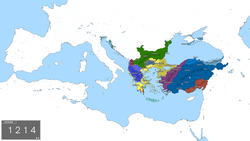
1261 - 1300
% complete
Following the Byzantine reconquest, the celebrated Deësis mosaic depicting Christ, the Virgin Mary, and John the Baptist was created in the upper gallery, widely regarded as the finest Byzantine mosaic in the building.
1346 - 1355
% complete
An earthquake in 1346 damaged portions of the dome and parts of the building collapsed. Repairs led by architects Astras and Peralta were carried out over several years, preserving the structure for another century of Orthodox worship.
1453
% complete
Under Mehmed II, Hagia Sophia became Aya Sofya Mosque. Christian icons were covered or removed, and Islamic features were gradually introduced while the building retained much of its original character.
1453 - 1455
% complete
A brick minaret was added shortly after the conquest in the southeast corner, marking the building's transformation into a mosque. Three more minarets would follow under later sultans.
Image source: Little Hagia Sophia
Apr 6, 1453 - May 29, 1453
% complete
Ottoman Sultan Mehmed II besieged Constantinople for 53 days. Hagia Sophia stood at the heart of the city as the last Byzantine emperors sought Western aid that never meaningfully arrived before the walls fell.
Image source: Fall of Constantinople
May 29, 1453
% complete
Mehmed II entered the city and proceeded to Hagia Sophia, converting it into an imperial mosque. This event marked the end of the Byzantine Empire and began the building's Ottoman chapter.
1509
% complete
Following earthquake damage in 1509, Sultan Bayezid II commissioned a new minaret and added a madrasa adjacent to the mosque, expanding its role as a center of religious learning.
1573 - 1577
% complete
Chief architect Mimar Sinan reinforced the aging structure with supports and built two large mausoleums for Selim II and later sultans, beginning the tradition of royal burials at the mosque complex.
Image source: Selim II
1739
% complete
During renovations ordered under Mahmud I, a mihrab, mimbar, sultan's lodge, and library were added or renovated, further integrating the Byzantine structure into Ottoman religious life.
1847 - 1849
% complete
Swiss architects Gaspare and Giuseppe Fossati undertook an extensive restoration under Sultan Abdülmecid I, strengthening the dome and vaults, cleaning mosaics, and adding calligraphic medallions by Kazasker Mustafa İzzet Efendi.
Image source: Fossati brothers
1847 - 1849
% complete
As part of the Fossati restoration, eight massive wooden medallions bearing the names of Allah, Muhammad, the early caliphs, and Hasan and Husayn were hung in the nave, becoming iconic features of the interior.
Image source: Kazasker Mustafa Izzet Efendi
1894
% complete
A powerful earthquake struck Istanbul in 1894, damaging the dome and destroying part of the main minaret, prompting further repairs by the Ottoman state in the final decades of empire.
Image source: 1894 Istanbul earthquake
Nov 1922 - 1924
% complete
Following the abolition of the sultanate and the founding of the Turkish Republic under Mustafa Kemal Atatürk, Hagia Sophia's role changed dramatically as the new government pursued secularizing reforms.
Image source: Abolition of the Ottoman sultanate
2013
% complete
Turkey's Council of State declined petitions seeking to reopen Hagia Sophia for Muslim worship, upholding its status as a museum amid ongoing public and political debate over its future.
Jul 2019
% complete
A US congressional resolution called on Turkey to maintain Hagia Sophia as a museum without alteration, reflecting international concern over reports that its status might change under pressure from conservative groups.
Jul 10, 2020
% complete
Turkey's highest administrative court ruled that the 1934 cabinet decision converting Hagia Sophia into a museum was unlawful, clearing the way for the building to return to use as a mosque.
Image source: Council of State (Turkey)
Jul 24, 2020
% complete
A presidential decree transferred Hagia Sophia to the Diyanet for use as a mosque, and Friday prayers were held on July 24, 2020. The decision drew international reactions, and UNESCO asked for more information about potential impacts on the World Heritage site.
1930 - 1955
% complete
Teams including Thomas Whittemore of the Byzantine Institute of America uncovered and conserved the great Byzantine mosaics, revealing masterworks such as the Deësis panel and portraits of emperors and empresses.
1935 - Feb 1, 1935
% complete
By decree of Atatürk, Hagia Sophia was secularized and opened as a museum on February 1, 1935. Mosaics long hidden under plaster were uncovered and displayed, making the building a major tourist and scholarly destination.
1985
% complete
The Historic Areas of Istanbul, encompassing Hagia Sophia and other landmarks, were inscribed on the UNESCO World Heritage List, recognizing their outstanding universal value to humanity.
Image source: Historic Areas of Istanbul
1990 - 2009
% complete
Turkish authorities carried out multi-decade restoration work addressing the dome, buttresses, mosaics, and foundations, using modern techniques to stabilize the nearly 1,500-year-old monument.
2000 - 2010
% complete
Archaeological surveys revealed previously unknown subterranean chambers, cisterns, and structures beneath and around the building, deepening understanding of the site's layered history.
Image source: Hagia Sophia
Or browse the full history timeline directory, with more than 2,000 topics.
This Hagia Sophia timeline was generated with the help of AI, using information found on the internet.
We work hard to keep these timelines accurate, but mistakes do get through. If you spot one, email us at [email protected] and we'll fix it for future visitors.
Generate yours with AI or build it from scratch, for free.
Export your timeline, add your own events, edit or remove AI-generated events, and much more
No credit card required.
Cancel anytime.
Cancel anytime.
You can create an unlimited number of timelines with up to 10 events on each one, customize how they look, export them to PDF, PNG, PowerPoint, CSV, and Excel, and share them with a link. Paid plans raise the event limit and add features like spreadsheet imports and collaborators.
Yes. You can cancel your subscription from your account page at any time, and you will not be charged again. Your subscription stays active for the rest of the period you already paid for.
Yes. We will email you a reminder before the annual renewal, and we will also email you a receipt.
Yes. You can email us within 15 days of any payment, and we will issue you a full refund.
Check out our pricing docs or send us an email anytime: [email protected].