-
Use Cases
-
Resources
-
Pricing
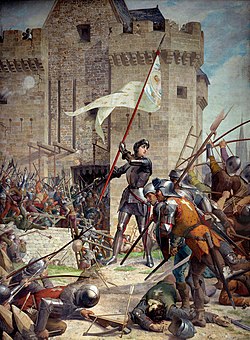
Joan of Arc was a French peasant girl who, claiming divine guidance, led French forces to key victories during the Hundred Years' War, most notably lifting the Siege of Orléans in 1429. Captured by the Burgundians and sold to the English, she was tried for heresy and burned at the stake in 1431 at age 19. She was canonized as a saint by the Catholic Church in 1920 and remains one of history's most iconic figures of courage and faith. More Less
1337
% complete
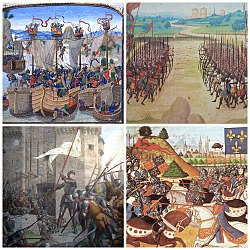
The Hundred Years' War between England and France began in 1337 over the status of English territories in France and English claims to the French throne. This long conflict shaped the world into which Joan of Arc was born and provided the backdrop for her later role in defending France.
Image source: Hundred Years' War
1407
% complete
In 1407, the Duke of Burgundy ordered the assassination of the Duke of Orléans, precipitating a civil war in France. This internal division between Armagnacs and Burgundians weakened France and allowed England to exploit the conflict during the Hundred Years' War.
Image source: Louis I, Duke of Orléans
1412
% complete
Joan of Arc was born c. 1412 in Domrémy, a small village in the Meuse valley now in the Vosges department in north-eastern France. There is no standard spelling of her name before the sixteenth century; her last name was usually written as 'Darc' without an apostrophe, with variants such as 'Tarc', 'Dart', or 'Day'.
Image source: Joan of Arc
1415
% complete
Henry V of England exploited France's internal divisions when he invaded in 1415, achieving major victories against the fractured French kingdom and strengthening English claims to the French throne during the Hundred Years' War.
Image source: Henry V of England
1418
% complete
In 1418, the Burgundians took Paris, further deepening France's civil war. The capital fell into the hands of the Burgundians, who were allied with the English, leaving the Dauphin Charles without control of his own capital city.
Image source: Burgundian (party)
1419
% complete
In 1419, the Dauphin offered a truce to negotiate peace with the Duke of Burgundy, but the duke was assassinated by the Dauphin's Armagnac partisans during the negotiations. This act pushed the Burgundians into a firmer alliance with the English.
1422
% complete
In 1422, Henry V and Charles VI died within two months of each other. The nine-month-old Henry VI of England became the nominal heir of the Anglo-French dual monarchy as agreed in the treaty, but the Dauphin Charles also claimed the French throne, prolonging the war.
Image source: Henry VI of England
1425
% complete
By 1419, the Hundred Years' War had affected Joan's home region, and in 1425, Domrémy was attacked and cattle were stolen. The war's reach into her village exposed young Joan to the realities of the conflict engulfing France.
Image source: Domrémy-la-Pucelle
1425
% complete
Joan later testified that when she was thirteen, c. 1425, a figure she identified as Saint Michael surrounded by angels appeared to her in the garden. She said she was guided by visions from the archangel Michael, Saint Margaret, and Saint Catherine to help Charles VII save France from English domination.
May 1428
% complete
In May 1428, Joan asked her uncle to take her to the nearby town of Vaucouleurs, where she petitioned the garrison commander, Robert de Baudricourt, for an armed escort to the Armagnac court at Chinon. In 1428, she requested to be taken to Charles VII, testifying that visions guided her mission.
Jan 1429
% complete
Joan returned to Vaucouleurs in January 1429 to renew her petition for an armed escort to the royal court. Her persistence eventually persuaded Robert de Baudricourt to provide her with soldiers for the journey to Chinon.
Image source: Vaucouleurs
Feb 1429 - Mar 1429
% complete
Joan and Charles VII met for the first time in late February or early March 1429 at the royal court in Chinon, when she was seventeen and he was twenty-six. After almost a century of war, the Armagnacs were demoralized, and Joan brought a message of hope and divine mission.
Image source: Charles VII of France
Jul 1428
% complete
In July 1428, the English started to surround Orléans and nearly isolated it from the rest of Charles's territory by capturing many of the smaller bridge towns on the Loire River. The siege threatened the last major stronghold blocking an English advance deeper into France.
Image source: Siege of Orléans
Feb 1429
% complete
Around February 1429, the English captured an Armagnac relief convoy at the Battle of the Herrings during the Siege of Orléans. Around this time, Baudricourt agreed to a third meeting with Joan, ultimately leading him to support her journey to Chinon.
Image source: Battle of the Herrings
Apr 1429
% complete
Joan arrived at the city of Orléans in April 1429, wielding her banner and bringing hope to the demoralized French army. Her presence galvanized the defenders and marked a turning point in the siege.
Apr 1429
% complete
In the last week of April 1429, Joan set out from Blois as part of an army carrying supplies for the relief of Orléans. The convoy fought its way into the besieged city, boosting morale and enabling counterattacks against the English lines.
May 8, 1429
% complete
The English siege of Orléans was broken on 8 May 1429, a decisive turning point in the Hundred Years' War. As early as 1429, Orléans began holding an annual celebration in honor of the raising of the siege on that date, which Joan came to centralize.
Jul 1429
% complete
Following the Loire campaign and the opening of Reims, Charles VII was crowned king of France, fulfilling Joan's insistence that he be crowned. The coronation legitimized his claim to the throne and strengthened the Armagnac cause.
Jul 16, 1429
% complete
Reims opened its gates on 16 July 1429, allowing Charles VII to be crowned in the traditional coronation city of French kings. Joan had insisted on the coronation of Charles VII as essential to saving France from English domination.
Image source: Reims
Sep 1429
% complete
After Charles's coronation, Joan participated in the unsuccessful siege of Paris in September 1429. The attack failed to retake the capital from the Burgundians and English, marking a setback for the French cause.
Image source: Siege of Paris (1429)
Nov 1429
% complete
After the failed siege of Paris, Joan participated in the failed siege of La Charité in November 1429. Another setback for the French forces, it demonstrated the limits of their momentum following the victories earlier in the year.
Image source: La Charité-sur-Loire
Mar 1430
% complete
In early 1430, Joan organized a company of volunteers to relieve Compiègne, which had been besieged by the Burgundians—French allies of the English. She set out with her company at the end of March 1430 to relieve the town.
Image source: Siege of Compiègne
1431
% complete
Despite Joan's execution, Charles remained king of France, even as a rival coronation was held for the ten-year-old Henry VI of England at Notre-Dame cathedral in Paris in 1431. The dual coronations underscored the contested nature of the French throne.
1435
% complete
In 1435, the Burgundians signed the Treaty of Arras, abandoning their alliance with England. This diplomatic shift deprived the English of their most important French ally and paved the way for French reconquests.
Image source: Congress of Arras
1453
% complete
Twenty-two years after Joan's death, the Hundred Years' War ended with a French victory at the Battle of Castillon in 1453, and the English were expelled from all of France except Calais. Joan's efforts had helped set the stage for the final French triumph.
Image source: Battle of Castillon
May 23, 1430
% complete
On 23 May 1430, Joan accompanied an Armagnac force which sortied from Compiègne to attack the Burgundian camp at Margny, northeast of the town. During the engagement she was captured by the Burgundians and subsequently handed over to the English.
Jan 9, 1431
% complete
Joan was put on trial for heresy in Rouen on 9 January 1431. The trial, conducted under English auspices, sought to discredit her and her claims of divine guidance through charges of heresy.
Image source: Trial of Joan of Arc
May 30, 1431
% complete
Joan was declared guilty and burned at the stake on 30 May 1431, aged about nineteen. Her execution made her a martyr in French eyes and did not halt the eventual French recovery in the Hundred Years' War.
Feb 15, 1450
% complete
On 15 February 1450, a few months after he regained Rouen, Charles ordered Guillaume Bouillé, a theologian and former rector of the University of Paris, to open an inquest into Joan's trial. This began the formal process of reexamining her conviction.
Image source: François Claude Amour, marquis de Bouillé
1452
% complete
In 1452, a second inquest into Joan's trial was opened by Cardinal Guillaume d'Estouteville, papal legate and relative of Charles, and Jean Bréhal, the recently appointed Inquisitor of France, who interviewed about 20 witnesses.
Image source: Guillaume d'Estouteville
1454
% complete
In 1454, Jean Bréhal forwarded a petition from Joan's mother, Isabelle, and Joan's two brothers Jean and Pierre, to Pope Nicholas V. This petition helped initiate the process that would lead to the overturning of Joan's conviction.
Image source: Jean Bréhal
Nov 7, 1455
% complete
After Nicholas V died in early 1455, the new pope Callixtus III gave permission for a rehabilitation trial, appointing three commissioners to oversee the process. The trial began on 7 November 1455 at Notre Dame Cathedral when Joan's mother publicly delivered a formal request for her daughter's rehabilitation.
Image source: Rehabilitation trial of Joan of Arc
Jul 7, 1456
% complete
In 1456, an inquisitorial court reinvestigated Joan's trial and overturned the verdict, declaring that it was tainted by deceit and procedural errors. The rehabilitation trial ended on 7 July 1456 at Rouen Cathedral, having heard from about 115 witnesses.
1435
% complete
By 1435, a play, Mistère du siège d'Orléans (Mystery of the Siege of Orléans), portrayed Joan as the vehicle of the divine will that liberated Orléans. She had become a central part of the annual celebration held by the city since 1429.
1455
% complete
The first written record of Joan being called 'Jeanne d'Ay de Domrémy' is in 1455, twenty-four years after her death. She had been called this name in Charles VII's 1429 letter granting her a coat of arms, though no standard spelling of her name existed before the sixteenth century.
1500
% complete
In the sixteenth century, Joan became known as the 'Maid of Orleans'. Louis XII commissioned a full-length biography of her around 1500, cementing her place in French historical memory.
1793
% complete
During the French Revolution, Joan's reputation came into question because of her association with the monarchy and religion, and the festival in her honor held at Orléans was suspended in 1793.
Image source: French Revolution
1800 - 1899
% complete
In the nineteenth century, hundreds of works of art about Joan—including biographies, plays, and musical scores—were created in France, and her story became popular as an artistic subject in Europe and North America. Merging qualities associated with both genders, Joan has inspired numerous artistic and cultural works for centuries.
Image source: Cultural depictions of Joan of Arc
1803
% complete
In 1803, Napoleon Bonaparte authorized the renewal of the Orléans festival and the creation of a new statue of Joan at Orléans, stating, 'The illustrious Joan...' His endorsement restored public commemoration of Joan in France.
Image source: Napoleon
1849 - 1869
% complete
In 1849, the Bishop of Orléans Félix Dupanloup delivered an oration that attracted international attention, and in 1869 he petitioned Rome to begin beatification proceedings for Joan of Arc, launching the path toward her sainthood.
Image source: Félix Dupanloup
1894
% complete
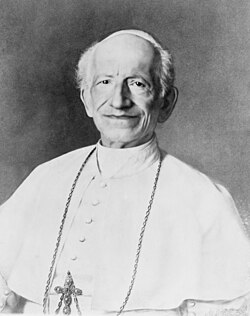
In 1894, Pope Leo XIII pronounced that Joan's mission was divinely inspired, an important step in the Church's official recognition of Joan that preceded her beatification and canonization.
Image source: Pope Leo XIII
1903
% complete
At her 1903 canonization trial, one of the Promoters of the Faith argued that Joan's visions may have been manifestations of hysteria. Despite such objections, the proceedings moved forward toward her beatification.
Image source: Canonization of Joan of Arc
1909
% complete
Joan of Arc was beatified by Pope Pius X in 1909, formally recognizing her as blessed and advancing her cause toward sainthood within the Catholic Church.
Image source: Beatification
May 16, 1920
% complete
Joan of Arc was canonized by Pope Benedict XV on 16 May 1920, becoming a saint of the Catholic Church. Nearly five centuries after her death, the peasant girl who saved France was officially recognized for her holiness.
Mar 2, 1922
% complete
In an apostolic letter dated 2 March 1922, Pope Pius XI declared Joan one of the patron saints of France, two years after her canonization. She is honored as a defender of the French nation for her role in the siege of Orléans and the coronation of Charles VII.
Or browse the full history timeline directory, with more than 2,000 topics.
This Joan of Arc timeline was generated with the help of AI, using information found on the internet.
We work hard to keep these timelines accurate, but mistakes do get through. If you spot one, email us at [email protected] and we'll fix it for future visitors.
Generate yours with AI or build it from scratch, for free.
Export your timeline, add your own events, edit or remove AI-generated events, and much more
No credit card required.
Cancel anytime.
Cancel anytime.
You can create an unlimited number of timelines with up to 10 events on each one, customize how they look, export them to PDF, PNG, PowerPoint, CSV, and Excel, and share them with a link. Paid plans raise the event limit and add features like spreadsheet imports and collaborators.
Yes. You can cancel your subscription from your account page at any time, and you will not be charged again. Your subscription stays active for the rest of the period you already paid for.
Yes. We will email you a reminder before the annual renewal, and we will also email you a receipt.
Yes. You can email us within 15 days of any payment, and we will issue you a full refund.
Check out our pricing docs or send us an email anytime: [email protected].