-
Use Cases
-
Resources
-
Pricing
Harold Godwinson (c. 1022–1066) was the last Anglo-Saxon king of England. A powerful nobleman as Earl of Wessex and son of Earl Godwin, he became the most powerful man in England before succeeding Edward the Confessor in January 1066. His reign lasted less than a year: after defeating the Norwegian invasion at the Battle of Stamford Bridge, he was killed at the Battle of Hastings by the forces of William, Duke of Normandy, ending Anglo-Saxon rule and beginning Norman England. More Less
1018
% complete
Harold's father Godwin began his political career supporting King Edmund Ironside but switched to supporting King Cnut by 1018, when Cnut named him Earl of Wessex.
Image source: Godwin, Earl of Wessex
1022
% complete
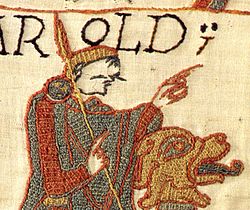
Harold Godwinson, also called Harold II, was born around 1020–1023. He was the last crowned Anglo-Saxon king of England.
Image source: Harold Godwinson
1035
% complete
On Cnut's death in 1035, Godwin originally supported Harthacnut instead of Cnut's initial successor Harold Harefoot, but managed to switch sides in 1037.
Image source: Cnut
1036
% complete
Godwin became involved in the 1036 murder of Alfred Aetheling, half-brother of Harthacnut and younger brother of the later King Edward the Confessor.
Image source: Alfred Aetheling
1040
% complete
When Harold Harefoot died in 1040, Harthacnut ascended the English throne. Godwin's power was imperiled by his earlier involvement in Alfred's murder, but an oath and large gift secured the new king's favour for Godwin.
Image source: Harold Harefoot
1043
% complete
Sweyn, Harold's elder brother, had been named an earl in 1043.
1047
% complete
Harold's elder brother Sweyn was exiled in 1047 after abducting the abbess of Leominster.
1047
% complete
Ulf and Estrid's son, Harold's cousin, would become King Sweyn II of Denmark in 1047.
Image source: Sweyn II of Denmark
1042
% complete
Harthacnut's death in 1042 probably involved Godwin in a role as kingmaker, helping to secure the English throne for Edward the Confessor.
Image source: Edward the Confessor
1045
% complete
It is possible that Harold led some of the ships from his earldom that were sent to Sandwich in 1045 against Magnus.
1045
% complete
Around the time of Edward's marriage to Edith in 1045, Harold became Earl of East Anglia. He is called 'earl' in a will that may date to 1044, but by 1045 he regularly appears as an earl in documents.
Jan 23, 1045
% complete
In 1045, Godwin reached the height of his power when King Edward married Godwin's daughter Edith on 23 January 1045.
Image source: Edith of Wessex
1049
% complete
In 1049, Harold was in command of a ship or ships sent with a fleet to aid Henry III, Holy Roman Emperor against Baldwin V, Count of Flanders, who was in revolt against Henry.
Image source: Baldwin V of Flanders
1051 - 1052
% complete
In 1051, Edward appointed an enemy of the Godwins as Archbishop of Canterbury and soon afterwards drove them into exile, but they raised an army which forced the king to restore them to their positions a year later.
1053
% complete
Earl Godwin died in 1053, and Harold succeeded him as Earl of Wessex, which made him the most powerful lay figure in England after the king.
1055
% complete
In 1055, Harold drove back the Welsh, who had burned Hereford.
1058
% complete
Harold also became Earl of Hereford in 1058, and replaced his late father as the focus of opposition to growing Norman influence in England under Edward the Confessor, who had spent more than 25 years in exile in Normandy.
Image source: Earl of Hereford
1060
% complete
There were legends of Harold's body being given a proper funeral years later in Waltham Abbey Church in Essex, which he had refounded in 1060.
Image source: Waltham Abbey Church
1062 - 1063
% complete
Harold led a series of successful campaigns (1062–1063) against Gruffydd ap Llywelyn of Gwynedd, king of Wales.
Image source: Llywelyn ap Gruffudd
1063
% complete
This conflict ended with Gruffydd's defeat and death in 1063.
1057
% complete
Some acts of Edward are inconsistent with having promised the throne to William, such as his efforts to return his nephew Edward the Exile, son of King Edmund Ironside, from Hungary in 1057.
Image source: Edward the Exile
1064
% complete
In 1064, Harold was apparently shipwrecked at Ponthieu. William seems to have believed that during this episode Harold was offered the succession, though later Norman chroniclers suggested alternative explanations, including seeking the release of family hostages or being blown across the Channel by a storm.
Jan 1066
% complete
In early January 1066, upon hearing of Harold's coronation, William began plans to invade England, building approximately 700 warships and transports at Dives-sur-Mer on the coast of Normandy.
Image source: William the Conqueror
Sep 12, 1066
% complete
Sep 20, 1066
% complete
The invading forces of Hardrada and Tostig defeated the English earls Edwin of Mercia and Morcar of Northumbria at the Battle of Fulford near York on 20 September 1066.
Image source: Battle of Fulford
Oct 14, 1066
% complete
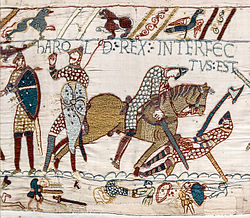
Harold died at the Battle of Hastings on 14 October 1066, the decisive battle of the Norman Conquest. Twelfth-century histories recount that Harold died by an arrow wound to his head; earlier sources suggest he was shot in the eye with an arrow, though this may be a later addition.
Image source: Battle of Hastings
1729 - 1816
% complete
Benoît's 1729 sketch shows only a dotted line where the famous arrow appears today, while Bernard de Montfaucon's 1730 engraving resembles a spear. In 1816, Charles Stothard made a copy of the Bayeux Tapestry, the first record of it after damage during the French Revolution and before repairs in the 19th century. It has been proposed that the arrow may have been added by over-enthusiastic restorers and later unstitched.
Image source: Bayeux Tapestry
1065
% complete
Due to a doubling of taxation by Tostig in 1065 that threatened to plunge England into civil war, Harold supported Northumbrian rebels against his brother Tostig, and replaced him with Morcar.
Image source: Tostig Godwinson
Dec 1065
% complete
At the end of 1065, King Edward the Confessor fell into a coma without clarifying his preference for the succession.
Jan 1066
% complete
In about January 1066, Harold married Ealdgyth, daughter of Earl Ælfgar, and widow of the Welsh prince Gruffydd ap Llywelyn. What happened to her after 1066 is not known.
Image source: Ealdgyth of Mercia
Jan 5, 1066
% complete
He died on 5 January 1066, according to the Vita Ædwardi Regis, but not before briefly regaining consciousness and commending his widow and the kingdom to Harold's 'protection'.
Jan 6, 1066
% complete
After his brother-in-law King Edward the Confessor died childless, the Witenagemot convened and chose Harold to succeed him; he was probably the first English monarch to be crowned in Westminster Abbey. He reigned from 6 January 1066 until his death.
Image source: House of Godwin
1954
% complete
Harold's strong association with Bosham, his birthplace, and the discovery in 1954 of an Anglo-Saxon coffin in the church there led some to suggest it as the place of King Harold's burial. The exhumation revealed the remains of a man in a coffin.
Or browse the full history timeline directory, with more than 2,000 topics.
This Harold Godwinson timeline was generated with the help of AI, using information found on the internet.
We work hard to keep these timelines accurate, but mistakes do get through. If you spot one, email us at [email protected] and we'll fix it for future visitors.
Generate yours with AI or build it from scratch, for free.
Export your timeline, add your own events, edit or remove AI-generated events, and much more
No credit card required.
Cancel anytime.
Cancel anytime.
You can create an unlimited number of timelines with up to 10 events on each one, customize how they look, export them to PDF, PNG, PowerPoint, CSV, and Excel, and share them with a link. Paid plans raise the event limit and add features like spreadsheet imports and collaborators.
Yes. You can cancel your subscription from your account page at any time, and you will not be charged again. Your subscription stays active for the rest of the period you already paid for.
Yes. We will email you a reminder before the annual renewal, and we will also email you a receipt.
Yes. You can email us within 15 days of any payment, and we will issue you a full refund.
Check out our pricing docs or send us an email anytime: [email protected].