-
Use Cases
-
Resources
-
Pricing
Sep 8, 1157
% complete
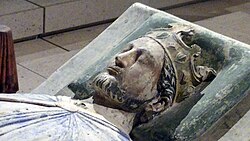
Richard was born on 8 September 1157, probably at Beaumont Palace in Oxford, England, the son of King Henry II of England and Eleanor of Aquitaine. He would later earn the byname 'the Lionheart' for his reputation as a great military leader and warrior.
Image source: Richard I of England
Mar 1159
% complete
In March 1159, it was arranged that Richard would marry one of the daughters of Ramon Berenguer IV, Count of Barcelona; however, these arrangements failed, and the marriage never took place.
Nov 2, 1160
% complete
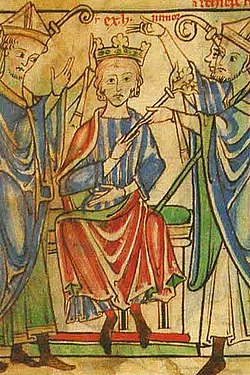
Henry the Young King, Richard's elder brother, was married to Margaret, daughter of Louis VII of France, on 2 November 1160, as part of the dynastic politics of the Plantagenet and Capetian houses.
Image source: Henry the Young King
May 1165
% complete
Richard's first recorded visit to the European continent took place in May 1165, when his mother, Eleanor of Aquitaine, took him to Normandy.
1168
% complete
In 1168, the intercession of Pope Alexander III was necessary to secure a truce between Henry II of England and Louis VII of France amid their ongoing conflicts.
Jan 1169
% complete
A peace treaty was secured in January 1169 between Henry II and Louis VII, and Richard's betrothal to Alys, Louis's daughter, was confirmed as part of the agreement.
Jun 1170
% complete
After Henry II fell seriously ill in 1170, he enacted his plan to divide his territories among his sons while retaining overall authority. His son Henry was crowned as heir apparent in June 1170.
1171
% complete
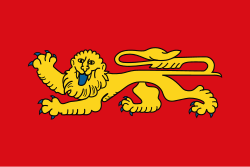
In 1171 Richard left for Aquitaine with his mother; Henry II gave him the duchy of Aquitaine at Eleanor's request. Richard and his mother then embarked on a tour of Aquitaine in an attempt to pacify the locals.
Image source: Duchy of Aquitaine
1186
% complete
Meanwhile, in 1186, Geoffrey, Duke of Brittany and brother of Richard, died in a tournament, further reshaping the family dynamics among Henry II's sons.
Image source: Geoffrey II of Brittany
Jun 1172
% complete
In June 1172, at age 14, Richard was formally recognised as Duke of Aquitaine and Count of Poitou when he was granted the lance and banner emblems of his office. The ceremony took place in Poitiers and was repeated in Limoges, where he wore the ring of St Valerie, the personification of Aquitaine.
Jul 1173 - Sep 1174
% complete
The alliance with Louis VII was initially successful, and by July 1173 the rebels were besieging Aumale, Neuf-Marché, and Verneuil, and Hugh de Kevelioc had captured Dol in Brittany. Louis was defeated and a peace treaty was signed in September 1174, the Treaty of Montlouis.
Image source: Revolt of 1173–1174
Sep 8, 1174
% complete
The terms of Henry II and Louis VII's 8 September 1174 truce specifically excluded Richard, leaving him without a settlement even after the wider revolt had been resolved.
Jan 1175
% complete
In January 1175, after failing to overthrow his father, Richard was dispatched to Aquitaine to punish the barons who had fought for him during the revolt.
1179
% complete
After failing to overthrow his father, Richard concentrated on putting down internal revolts by the nobles of Aquitaine, especially in Gascony, where the increasing cruelty of his rule led to a major revolt in 1179. The turning point came in the Charente Valley in the spring of 1179.
1180 - 1183
% complete
From 1180 to 1183 tension between father and son grew, as Henry II commanded Richard to pay homage to Henry the Young King, but Richard refused.
1181 - 1182
% complete
In 1181–82, Richard faced a revolt over the succession to the county of Angoulême, part of the ongoing resistance from nobles within his territories.
1183
% complete
Finally, in 1183, the younger Henry and Geoffrey of Brittany invaded Aquitaine in an attempt to subdue Richard. The conflict paused briefly in June 1183, when the Young King died.
1187
% complete
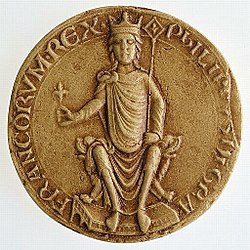
In 1187, to strengthen his position against his father, Richard allied himself with 22-year-old Philip II, the son of Eleanor's ex-husband Louis VII by Adela of Champagne.
Image source: Philip II of France
Nov 1188
% complete
In exchange for Philip's help against his father, Richard paid homage to Philip in November 1188, deepening his alignment with France against Henry II.
Jul 4, 1189
% complete
On 4 July 1189, the forces of Richard and Philip defeated Henry's army at Ballans, effectively ending Henry II's ability to resist his rebellious son.
Jul 20, 1189
% complete
Richard I was officially invested as Duke of Normandy on 20 July 1189, shortly after his father's defeat and death.
Image source: Duke of Normandy
Sep 3, 1189
% complete
Richard was crowned king in Westminster Abbey on 3 September 1189, beginning his reign as King of England, which would last until his death in 1199.
Image source: Coronation of the British monarch
1187
% complete
Richard is referred to as 'this our lion' (hic leo noster) as early as 1187 in the Topographia Hibernica of Giraldus Cambrensis, while the byname 'lionheart' (le quor de lion) is first recorded in Ambroise's L'Estoire de la Guerre Sainte in the context of the Accon campaign of 1191.
1198
% complete
The second Great Seal of Richard I (1198) shows him bearing a shield depicting three lions passant-guardant. In his earlier Great Seal of 1189, he had used either one lion rampant or two lions rampants combatants, arms which he may have adopted from his father.
Image source: Coat of arms of England
Mar 1232
% complete
Henry Sandford, Bishop of Rochester (1226–1235), announced that he had seen a vision of Richard ascending to Heaven in March 1232 (along with Stephen Langton, the former archbishop of Canterbury), the King having presumably spent 33 years in purgatory as expiation for his sins.
1250
% complete
Around the middle of the 13th century, various legends developed that, after Richard's capture, his minstrel Blondel travelled Europe from castle to castle, loudly singing a song known only to the two of them (they had composed it together). An early account of this legend is found in Claude Fauchet's Recueil de l'origine de la langue et poesie françoise (1581).
Image source: Blondel de Nesle
1300
% complete
A verse romance of Richard's life and his campaign on the Third Crusade, Richard Coer de Lyon, was composed around the start of the 14th century, romanticizing the king's exploits.
Image source: Richard Coer de Lyon
1500
% complete
At some time around the 16th century, tales of Robin Hood started to mention him as a contemporary and supporter of King Richard the Lionheart, Robin being driven to outlawry during the misrule of Richard's evil brother John, while Richard was away at the Third Crusade.
Image source: Robin Hood
1187
% complete
Richard had already taken the cross as Count of Poitou in 1187, committing himself to the crusading cause before his accession to the English throne.
Jan 21, 1188
% complete
Richard's father Henry II and Philip II of France took the cross at Gisors on 21 January 1188 after receiving news of the fall of Jerusalem to Saladin.
1190
% complete
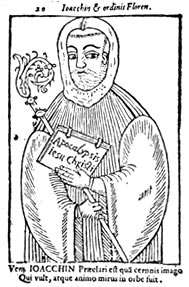
Before leaving for the Holy Land on crusade in 1190, Richard met Joachim of Fiore, who spoke to him of a prophecy contained in the Book of Revelation.
Image source: Joachim of Fiore
1190
% complete
After repositioning the part of his army remaining behind to guard his French possessions, Richard finally set out on the crusade in summer 1190.
Sep 1190
% complete
In September 1190, Richard and Philip arrived in Sicily. After the death of King William II of Sicily in 1189, his cousin Tancred had seized power, although William's aunt Constance was his legal heir.
Oct 4, 1190
% complete
Richard attacked Messina, capturing it on 4 October 1190, asserting his demands against Tancred of Sicily during the crusaders' stopover on the island.
1191
% complete
Guy's claim to the throne was challenged by Conrad of Montferrat, second husband of Sibylla's half-sister Isabella: Conrad, whose defence of Tyre had saved the kingdom in 1187, was supported by Philip of France and Leopold V, Duke of Austria. Richard also allied with Humphrey IV of Toron, Isabella's first husband, from whom she had been forcibly divorced in 1190.
Image source: Conrad of Montferrat
Mar 4, 1191
% complete
Richard remained in Messina until Tancred finally agreed to sign a treaty on 4 March 1191, resolving the dispute and allowing the crusade to proceed.
Apr 1191
% complete
In April 1191, Richard left Messina for Acre with an army of 17,000 men, but a storm dispersed his large fleet along the way.
May 1, 1191
% complete
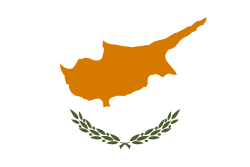
On 1 May 1191, Richard's fleet arrived in the port of Lemesos on Cyprus. He later sold the island to the master of Knights Templar, Robert de Sablé, and it was subsequently acquired, in 1192, by Guy of Lusignan and became a stable feudal kingdom. Cyprus remained a Christian stronghold until the Ottoman invasion in 1570.
Image source: Cyprus
May 12, 1191
% complete
The wedding was held in Lemesos on 12 May 1191 at the Chapel of St George and was attended by Richard's sister Joan, whom he had brought from Sicily.
Image source: Berengaria of Navarre
Jun 8, 1191
% complete
Richard landed at Acre on 8 June 1191, joining the prolonged siege of the city during the Third Crusade.
Image source: Siege of Acre (1189–1191)
Sep 7, 1191
% complete
He then moved south, defeating Saladin's forces at the Battle of Arsuf, 30 miles (50 km) north of Jaffa, on 7 September 1191, a major victory that demonstrated Richard's military prowess.
Image source: Battle of Arsuf
Nov 1191
% complete
In November 1191, following the fall of Jaffa, the Crusader army advanced inland towards Jerusalem under Richard's leadership.
1192
% complete
In the first half of 1192, Richard and his troops refortified Ascalon, having earlier taken the fortified town of Darum, consolidating the crusader position on the coast.
Image source: Ascalon
Apr 28, 1192
% complete
Only days before he could be crowned, Conrad was stabbed to death by the Assassins on 28 April 1192, removing Richard's chief rival for influence in the Kingdom of Jerusalem.
Jun 1192
% complete
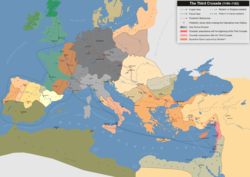
The crusader army made another advance on Jerusalem, and, in June 1192, it came within sight of the city before being forced to retreat once again, this time because of dissension amongst its leaders.
Image source: Third Crusade
Sep 2, 1192
% complete
Richard and Saladin finally came to a settlement on 2 September 1192, ending the Third Crusade and allowing Christian pilgrims access to Jerusalem while leaving the city under Muslim control.
Image source: Treaty of Jaffa (1192)
Oct 9, 1192
% complete
Richard, being ill with arnaldia, left for England on 9 October 1192, beginning his ill-fated journey home across Europe.
Dec 1192
% complete
On his way to the territory of his brother-in-law Henry the Lion, Richard was captured shortly before Christmas 1192 near Vienna by Leopold of Austria, who accused Richard of arranging the murder of his cousin Conrad of Montferrat.
Image source: Leopold V, Duke of Austria
1193
% complete
At the same time, Richard's brother John and King Philip of France offered 80,000 marks for Henry VI to hold Richard prisoner until Michaelmas 1194, hoping to keep him out of power.
Image source: John, King of England
Mar 28, 1193
% complete
On 28 March 1193, Richard was brought to Speyer and handed over to Holy Roman Emperor Henry VI, who imprisoned him in Trifels Castle.
Image source: Henry VI, Holy Roman Emperor
Feb 4, 1194
% complete
The money to release the King was transferred to Germany by the Emperor's ambassadors, but 'at the king's peril', and finally, on 4 February 1194, Richard was released from captivity.
1193
% complete
The fall of the Château de Gisors to the French in 1193 opened a gap in the Norman defences while Richard languished in captivity.
Image source: Château de Gisors
1194
% complete
At Fréteval in 1194, just after Richard's return to France from captivity and money-raising in England, Philip fled, leaving his entire archive of financial audits and documents to be captured by Richard.
Image source: Battle of Fréteval
Mar 11, 1194
% complete
At Winchester, on 11 March 1194, Richard was crowned a second time to nullify the shame of his captivity and reassert his royal authority.
Dec 1195
% complete
Under the terms of the Treaty of Louviers (December 1195) between Richard and Philip II, neither king was allowed to fortify the site; despite this, Richard intended to build the vast Château Gaillard.
1196 - 1198
% complete
The work at Château Gaillard was some of the most expensive of its time and cost an estimated £15,000 to £20,000 between 1196 and 1198. The interdict was still in force when work began, but Pope Celestine III repealed it in April 1197 after Richard made gifts of land to the archbishop and diocese of Rouen. The castle featured innovations adopted in castle architecture nearly a century later.
1198
% complete
Most importantly, Richard managed to secure the Welf inheritance in Saxony for his nephew, Henry the Lion's son, who was elected Otto IV of Germany in 1198.
Image source: Otto IV, Holy Roman Emperor
1198
% complete
At the Battle of Gisors (sometimes called Courcelles) in 1198, Richard took Dieu et mon Droit – 'God and my Right' – as his motto (still used by the British monarchy today), echoing his earlier boast to Emperor Henry that his rank acknowledged no superior but God.
Image source: Dieu et mon droit
May 1198
% complete
According to William of Newburgh, in May 1198 Richard and the labourers working on the castle were drenched in a 'rain of blood', seen as an ominous portent.
Image source: Château Gaillard
Mar 1199
% complete
In March 1199, Richard was in Limousin suppressing a revolt by Viscount Aimar V of Limoges, which would lead to his fatal wounding.
Mar 26, 1199
% complete
On 26 March 1199, Richard was hit in the shoulder by a crossbow bolt while besieging a castle in Limousin, and the wound turned gangrenous.
Apr 6, 1199
% complete
Richard died on 6 April 1199 in the arms of his mother, Eleanor of Aquitaine, and thus 'ended his earthly day'. In 2012, scientists analysed the remains of Richard's heart and found that it had been embalmed with various substances, including frankincense, a symbolically important substance because it had been present both at the birth and embalming of Christ.
Or browse the full history timeline directory, with more than 2,000 topics.
This Richard the Lionheart timeline was generated with the help of AI, using information found on the internet.
We work hard to keep these timelines accurate, but mistakes do get through. If you spot one, email us at [email protected] and we'll fix it for future visitors.
Generate yours with AI or build it from scratch, for free.
Export your timeline, add your own events, edit or remove AI-generated events, and much more
No credit card required.
Cancel anytime.
Cancel anytime.
You can create an unlimited number of timelines with up to 10 events on each one, customize how they look, export them to PDF, PNG, PowerPoint, CSV, and Excel, and share them with a link. Paid plans raise the event limit and add features like spreadsheet imports and collaborators.
Yes. You can cancel your subscription from your account page at any time, and you will not be charged again. Your subscription stays active for the rest of the period you already paid for.
Yes. We will email you a reminder before the annual renewal, and we will also email you a receipt.
Yes. You can email us within 15 days of any payment, and we will issue you a full refund.
Check out our pricing docs or send us an email anytime: [email protected].