-
Use Cases
-
Resources
-
Pricing
Herod the Great was a Roman client king of Judea who ruled from 37 BCE until his death in 4 BCE. Appointed by the Roman Senate, he was known for massive building projects such as the expansion of the Second Temple in Jerusalem, the fortress of Masada, and the port city of Caesarea Maritima. His reign was marked by political skill, ruthless elimination of rivals—including members of his own family—and a complex legacy as both a visionary builder and a brutal tyrant. More Less
72 BC
% complete
Herod was born around 72 BC in Idumea, a region south of Judea, the son of Antipater the Idumaean, a high-ranking official under the Hasmonean king Hyrcanus II. His mixed Idumaean and Nabataean heritage would later be used against him by rivals who questioned his legitimacy as a Jewish ruler.
Image source: Herod the Great
47 BC
% complete
Julius Caesar rewarded Antipater for his support during the Alexandrian War by appointing him procurator (governor) of Judea with Roman citizenship. This elevated his family's status dramatically and paved the way for Herod's future rise, as Herod was soon made governor of Galilee.
Image source: Antipater the Idumaean
47 BC
% complete
At only about twenty-five years old, Herod was appointed governor of Galilee by his father. He quickly demonstrated ruthless efficiency by suppressing banditry and executing rebel leaders such as Hezekiah and his men, winning favor with Rome but provoking anger from Hasmonean aristocrats in Jerusalem.
40 BC
% complete
Parthian forces invaded the Levant in 40 BC and installed Antigonus II Mattathias, the last Hasmonean claimant, as king of Judea. Herod's brother Phasael committed suicide rather than be captured, while Herod fled Jerusalem, beginning his dramatic bid to reclaim power with Roman backing.
Image source: Hasmonean dynasty
40 BC
% complete
After escaping Judea, Herod sailed to Rome, where Mark Antony and Octavian convinced the Senate to declare him King of Judea in 40 BC. Though he held no actual territory at the time, this designation gave him the political mandate he needed to fight his way back to power.
37 BC
% complete
With Roman legions supplied by Mark Antony, Herod besieged and captured Jerusalem in 37 BC after months of assault. Antigonus was captured and executed by order of Antony, ending Hasmonean rule. Herod now reigned as sole ruler of Judea, beginning an era that historians call the Herodian Kingdom.
Image source: Herod's siege of Jerusalem
Sep 2, 31 BC
% complete
The naval Battle of Actium saw Octavian decisively defeat the combined fleets of Mark Antony and Cleopatra VII. Since Herod owed his throne to Antony, this victory placed him in a precarious position, forcing him to make a calculated gamble by switching allegiance to Octavian.
Image source: Battle of Actium
30 BC
% complete
Meeting Octavian at Rhodes in 30 BC, Herod candidly pledged the same loyalty he had shown Antony. Impressed by his honesty and usefulness, Octavian confirmed Herod as king and later expanded his territories, cementing a partnership that defined the next three decades of Herod's reign.
Image source: Augustus
37 BC
% complete
To legitimize his rule among Jews, Herod married Mariamne I, granddaughter of Hyrcanus II and niece of Aristobulus II. The marriage tied him to the Hasmonean priestly line, but the relationship was marked by jealousy, suspicion, and tragedy, ultimately ending in Mariamne's execution.
Image source: Mariamne I
35 BC
% complete
Aristobulus III, the teenage Hasmonean high priest whom Herod had appointed, became immensely popular in Jerusalem, alarming Herod. During a party at Jericho, Aristobulus drowned in a swimming pool, widely believed to be arranged by Herod or his agents. This deepened the hostility between Herod and Mariamne's family.
Image source: Aristobulus III of Judea
29 BC
% complete
Convinced by family rumors of infidelity and driven by mounting paranoia, Herod ordered the execution of his beloved wife Mariamne I in 29 BC. He reportedly grieved deeply afterward, and her death haunted him, fueling further purges of her relatives and contributing to his reputation for cruelty.
28 BC
% complete
Alexandra, Mariamne's ambitious mother, continued scheming to restore Hasmonean influence even after her daughter's death. Herod eliminated her in 28 BC, removing one of the last powerful members of the old royal line and consolidating his personal grip on power.
Image source: Alexandra the Maccabee
7 BC
% complete
Paranoid about succession, Herod put his sons by Mariamne, Alexander and Aristobulus IV, on trial for alleged treason in 7 BC. Both were strangled on his orders at Sebaste. Augustus reportedly quipped it was safer to be Herod's pig than his son, mocking both his cruelty and Jewish dietary law.
6 BC - 4 BC
% complete
According to the Gospel of Matthew, when Magi announced the birth of a 'king of the Jews,' Herod ordered all male infants under two years old in Bethlehem and its vicinity killed. While historians debate the event's historicity since Josephus does not mention it, it reflects Herod's notorious ruthlessness toward perceived threats.
Image source: Massacre of the Innocents
4 BC
% complete
Days before Herod's death, his eldest surviving son Antipater II, long heir apparent, was executed for plotting against his father. Antipater had manipulated Herod against other princes but was ultimately exposed. His death left the succession to the three remaining sons named in Herod's will.
Image source: Herod Archelaus
37 BC - 4 BC
% complete
Throughout his reign, Herod beautified Jerusalem, rebuilding the city walls, constructing the Antonia Fortress adjacent to the Temple to monitor unrest, and erecting palaces and monuments. He also funded projects abroad, becoming a major benefactor of cities across the eastern Mediterranean.
Image source: Antonia Fortress
30 BC - 20 BC
% complete
Herod transformed the remote desert plateau of Masada into an impregnable refuge, building two luxurious palaces, extensive storehouses, cisterns, bathhouses, and formidable casemate walls. Designed partly as a haven against Cleopatra's ambitions and internal revolt, it showcased his engineering ambition.
Image source: Masada
27 BC
% complete
Herod refounded the ruined city of Samaria as Sebaste ('Augustus') in honor of Emperor Augustus, building temples, colonnaded streets, and fortifications. This Greco-Roman style city reflected his strategy of pleasing imperial patrons while diversifying the cultural landscape of his realm.
25 BC - 13 BC
% complete
Herod built the magnificent port city of Caesarea Maritima on the Mediterranean coast between 25 and 13 BC, complete with artificial harbors constructed from innovative hydraulic concrete, aqueducts, theaters, and temples dedicated to Rome and Augustus. It became the administrative capital of his kingdom.
Image source: Caesarea Maritima
25 BC
% complete
During a severe famine that struck Judea, Herod demonstrated statesmanship by melting down palace treasures to buy grain from Egypt. He organized relief efforts so effectively that Josephus praised him, noting that no one died of hunger thanks to the king's swift action.
23 BC - 15 BC
% complete
Herod built Herodium, a massive artificial mountain fortress southeast of Jerusalem, complete with a palace, bathhouse, and elaborate water systems. Named after himself, it served both as a monument to his victory over rebels fleeing after the Parthian invasion and as his chosen burial place.
Image source: Herodium
22 BC
% complete
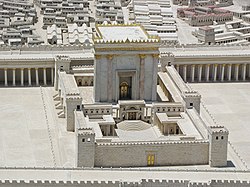
In 22 BC, Herod began his most famous project: a massive reconstruction and expansion of the Second Temple in Jerusalem. Using thousands of priests trained as masons to work on sacred areas, he created a temple complex far grander than Solomon's, earning grudging admiration despite his unpopularity.
Image source: Second Temple
12 BC
% complete
Although construction continued for decades, the main structure of Herod's Temple was completed around 12 BC and dedicated with lavish ceremonies. The gleaming white stone and gold-adorned sanctuary became one of the wonders of the ancient world before its destruction by Rome in AD 70.
5 BC
% complete
In his final years, Herod suffered from a horrific illness described by Josephus involving intense itching, intestinal ulcers, gangrene, and breathing difficulties. Modern scholars have speculated about causes ranging from kidney disease complicated by Fournier's gangrene to chronic hypertension.
4 BC
% complete
When Pharisaic students tore down the golden eagle Herod had erected over the Temple gate, viewing it as idolatrous, Herod had the perpetrators burned alive and the high priest Matthias removed. This harsh response inflamed religious opposition during his dying days.
Image source: Golden eagle
4 BC
% complete
Knowing his death would not be mourned, Herod reportedly ordered prominent Jewish leaders gathered in Jericho to be killed upon his passing so there would be universal grief. His sister Salome countermanded the order after his death, releasing them instead, according to Josephus.
Jan 1, 4 BC
% complete
Herod died in early 4 BC at his winter palace in Jericho, most likely between March and April based on eclipse chronology. Scholars debate the exact year due to conflicting sources, but his death ended a 37-year reign marked by monumental achievements and notorious brutality.
4 BC
% complete
Herod's body was borne in a lavish procession with soldiers, treasures, and spices from Jericho to Herodium, where he was interred in an elaborate mausoleum. The tomb eluded discovery until archaeologist Ehud Netzer announced its identification at Herodium in 2007.
4 BC
% complete
Per Herod's will, ratified by Augustus, his kingdom was split: Archelaus received Judea, Samaria, and Idumea as ethnarch; Herod Antipas got Galilee and Perea; Philip received northern territories as tetrarch. This division shaped the political landscape of Jesus's lifetime.
Image source: Herodian tetrarchy
Or browse the full history timeline directory, with more than 2,000 topics.
This Herod the Great timeline was generated with the help of AI, using information found on the internet.
We work hard to keep these timelines accurate, but mistakes do get through. If you spot one, email us at [email protected] and we'll fix it for future visitors.
Generate yours with AI or build it from scratch, for free.
Export your timeline, add your own events, edit or remove AI-generated events, and much more
No credit card required.
Cancel anytime.
Cancel anytime.
You can create an unlimited number of timelines with up to 10 events on each one, customize how they look, export them to PDF, PNG, PowerPoint, CSV, and Excel, and share them with a link. Paid plans raise the event limit and add features like spreadsheet imports and collaborators.
Yes. You can cancel your subscription from your account page at any time, and you will not be charged again. Your subscription stays active for the rest of the period you already paid for.
Yes. We will email you a reminder before the annual renewal, and we will also email you a receipt.
Yes. You can email us within 15 days of any payment, and we will issue you a full refund.
Check out our pricing docs or send us an email anytime: [email protected].